Showing posts with label omega-3. Show all posts

Thursday, December 23, 2010

38 g of sardines or 2 fish oil softgels? Let us look at the numbers

The bar chart below shows the fat content of 1 sardine (38 g) canned in tomato sauce, and 2 fish oil softgels of the Nature Made brand. (The sardine is about 1/3 of the content of a typical can, and the data is from Nutritiondata.com. The two softgels are listed as the “serving size” on the Nature Made bottle.) Both the sardine and softgels have some vegetable oil added; presumably to increase their vitamin E content and form a more stable oil mix. This chart is a good reminder that looking at actual numbers can be quite instructive sometimes. Even though the chart focuses on fat content, it is worth noting that the 38 g sardine also contains 8 g of high quality protein.


If your goal with the fish oil is to “neutralize” the omega-6 fat content of your diet, which is most people’s main goal, you should consider this. A rough measure of the omega-6 neutralization “power” of a food portion is, by definition, its omega-3 minus omega-6 content. For the 1 canned sardine, this difference is 596 mg; for the 2 fish oil softgels, 440 mg. The reason is that the two softgels have more omega-6 than the sardine.

In case you are wondering, the canning process does not seem to have much of an effect on the nutrient composition of the sardine. There is some research suggesting that adding vegetable oil (e.g., soy) helps preserve the omega-3 content during the canning process. There is also research suggesting that not much is lost even without any vegetable oil being added.

Fish oil softgels, when taken in moderation (e.g., two of the type discussed in this post, per day), are probably okay as “neutralizers” of omega-6 fats in the diet, and sources of a minimum amount of omega-3 fats for those who do not like seafood. For those who can consume 1 canned sardine per day, which is only 1/3 of a typical can of sardines, the sardine is not only a more effective source of omega-3, but also a good source of protein and many other nutrients.

As far as balancing dietary omega-6 fats is concerned, you are much better off reducing your consumption of foods rich in omega-6 fats in the first place. Apparently nothing beats avoiding industrial seed oils in that respect. It is also advisable to eat certain types of nuts with high omega-6 content, like walnuts, in moderation.

Both omega-6 and omega-3 fats are essential; they must be part of one’s diet. The actual minimum required amounts are fairly small, probably much lower than the officially recommended amounts. Chances are they would be met by anyone on a balanced diet of whole foods. Too much of either type of fat in synthetic or industrialized form can cause problems. A couple of instructive posts on this topic are this post by Chris Masterjohn, and this one by Chris Kresser.

Even if you don’t like canned sardines, it is not much harder to gulp down 38 g of sardines than it is to gulp down 2 fish oil softgels. You can get the fish oil for $12 per bottle with 300 softgels; or 8 cents per serving. You can get a can of sardines for 50 cents; which gives 16.6 cents per serving. The sardine is twice as expensive, but carries a lot more nutritional value.

You can also buy wild caught sardines, like I do. I also eat canned sardines. Wild caught sardines cost about $2 per lb, and are among the least expensive fish variety. They are not difficult to prepare; see this post for a recipe.

I don’t know how many sardines go into the industrial process of making 2 fish oil softgels, but I suspect that it is more than one. So it is also probably more ecologically sound to eat the sardine.

Monday, December 20, 2010

Nuts by numbers: Should you eat them, and how much?

Nuts are generally seen as good sources of protein and magnesium. The latter plays a number of roles in the human body, and is considered critical for bone health. Nuts are also believed to be good sources of vitamin E. While there is a lot of debate about vitamin E’s role in health, it is considered by many to be a powerful antioxidant. Other than in nuts, vitamin E is not easily found in foods other than seeds and seed oils.

Some of the foods that we call nuts are actually seeds; others are legumes. For simplification, in this post I am calling nuts those foods that are generally protected by shells (some harder than others). This protective layer is what makes most people call them nuts.

Let us see how different nuts stack up against each other in terms of key nutrients. The quantities listed below are per 1 oz (28 g), and are based on data from Nutritiondata.com. All are raw. Roasting tends to reduce the vitamin content of nuts, often by half, and has little effect on the mineral content. Protein and fat content are also reduced, but not as much as the vitamin content.

These two figures show the protein, fat, and carbohydrate content of nuts (on the left); and the omega-6 and omega-3 fat content (on the right).


When we talk about nuts, walnuts are frequently presented in a very positive light. The reason normally given is that walnuts have a high omega-3 content; the plant form of omega-3, alpha-linolenic acid (ALA). That is true. But look at the large amount of omega-6 in walnuts. The difference between the omega-6 and omega-3 content in walnuts is about 8 g! And this is in only 1 oz of walnuts. That is 8 g of pro-inflammatory omega-6 fats to be “neutralized”. It would take many fish oil softgels to achieve that.

Walnuts should be eaten in moderation. Most studies looking at the health effects of nuts, including walnuts, show positive results in short-term interventions. But they usually involve moderate consumption, often of 1 oz per day. Eat several ounces of walnuts every day, and you are entering industrial see oil territory in terms of omega-6 fats consumption. Maybe other nutrients in walnuts have protective effects, but still, this looks like dangerous territory; “diseases of civilization” territory.

A side note. Focusing too much on the omega-6 to omega-3 ratio of individual foods can be quite misleading. The reason is that a food with a very small amount of omega-6 (e.g., 50 mg) but close to zero omega-3 will have a very high ratio. (Any number divided by zero yields infinity.) Yet, that food will contribute little omega-6 to a person’s diet. It is the ratio at the end of the day that matters, when all foods that have been eaten are considered.

The figures below show the magnesium content of nuts (on the left); and the vitamin E content (on the right).


Let us say that you are looking for the best combination of protein, magnesium, and vitamin E. And you also want to limit your intake of omega-6 fats, which is a very wise thing to do. Then what is the best choice? It looks like it is almonds. And even they should be eaten in small amounts, as 1 oz has more than 3 g of omega-6 fats.

Macadamia nuts don’t have much omega-6; their fats are mostly monounsaturated, which are very good. Their protein to fat ratio is very low, and they don’t have much magnesium or vitamin E. Coconuts (i.e., their meat) have mostly medium-chain saturated fats, which are also very good. Coconuts have little protein, magnesium, and vitamin E. If you want to increase your intake of healthy fats, both macadamia nuts and coconuts are good choices, with macadamia nuts providing about 3 times more fat.

There are many other dietary sources of magnesium around. In fact, magnesium is found in many foods. Examples are, in approximate descending order of content: salmon, spinach, sardine, cod, halibut, banana, white potato, sweet potato, beef, chicken, pork, liver, and cabbage. This is by no means a comprehensive list.

As for vitamin E, it likes to hide in seeds. While it may be a powerful antioxidant, I wonder whether Mother Nature really had it “in mind” as she tinkered with our DNA for the last few million years.

Monday, September 6, 2010

Low omega-6 to omega-3 ratio: Grain-fed meats or industrial vegetable oils?

Just a little note on the use of language. Clearly there is no such a thing as grain-fed or grass-fed beef, because one does not feed beef anything. One feeds cattle grain or grass, and then the resulting beef is said to be “grain-fed” or “grass-fed”. It is a manner of speaking that facilitates discourse, which is why it is used here.

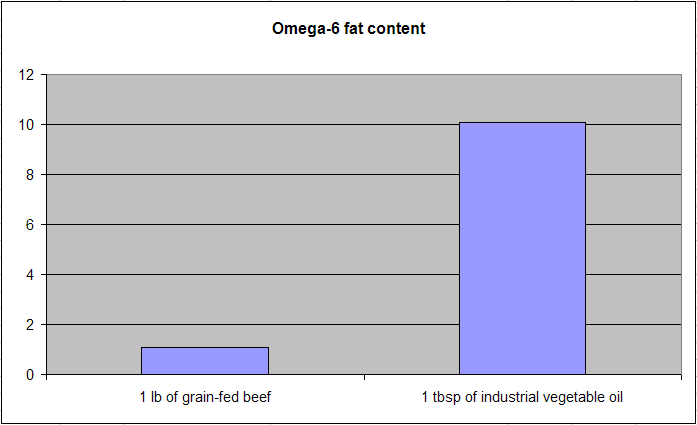
To compensate for this digression, let me show you a graph, which pretty much summarizes the "punch line" of this post. The graph below shows the omega-6 fat contents of 1 lb (454 g) of grain-fed beef and 1 tablespoon (roughly 14 g) of a typical industrial vegetable oil (safflower oil). As you can see, there is a lot more omega-6 in the much smaller amount of industrial vegetable oil. A gram-for-gram comparison would practically make the beef content bar disappear.


It has been estimated that our Paleolithic ancestors consumed a diet with an omega-6 to omega-3 ratio of about 1. While other estimates exist, the general consensus seems to be that that ratio was not much greater than 5. Western diets, in contrast, typically have omega-6 to omega-3 ratios of between 15 and 40. In some cases, the ratio is even higher.

Omega-6 fats are essential fats, meaning that they must be part of one’s diet. Fats make up about 60 percent of our brain. About 20 percent is made up of omega-6 and omega-3 fats. The primary omega-6 fat found in our brain is arachidonic acid, which is either synthesized by our body based on linoleic acid from plant foods or obtained directly from animal foods such as meat and eggs. The predominant omega 3 fat found in our brain is docosahexaenoic acid (DHA), of which certain types of fish and algae are rich sources.

Inflammation is an important process in the human body, without which wounds would never heal. Incidentally, muscle gain would not occur without inflammation either. Strength training causes muscle damage and inflammation, after which recovery leads to muscle gain. Omega-6 fats play an important role in inflammation. Generally, they are pro-inflammatory.

Too much inflammation, particularly in a chronic fashion, is believed to be very detrimental to our health. A very high omega-6 to omega-3 ratio seems to cause excessive and chronic inflammation. The reason is that omega-3 fats are generally anti-inflammatory, counteracting the pro-inflammatory action of omega-6 fats. Over time, a very high omega-6 to omega-3 ratio is believed to cause a number of Western diseases. Among them are cardiovascular complications, cancer, and various autoimmune diseases.

So, should you worry about too much omega-6 from grain-fed meats?

If you think that the answer is “yes”, consider this. Apparently the (arguably) longest-living group in the world, the non-Westernized Okinawans, consume plenty of pork. Pork is a staple of their traditional diet. It is true that the average cut will have an omega-6 to omega-3 ratio of more than 7, which is not very favorable. Pork in general, whether grain-fed or not, is relatively high in omega-6 fats. As a side note, pork is not a good source of linoleic acid (found in plants), even though it is a rich source of arachidonic acid, the omega-6 fat synthesized from linoleic acid by various animals.

It is difficult to estimate the exact amounts of omega-6 and omega-3 fats from grain-fed cuts of meat; different sources provide different estimates. Here are some reasonable estimates based on various sources, including Nutritiondata.com. A typical 100 g portion of grain-fed pork should contain about 690 mg of omega-6 fats, and 120 mg of omega-3 fats. A typical 100 g portion of grain-fed beef should have about 234 mg of omega-6 fats, and 12 mg of omega-3 fats. It does not take that much omega-3 to counterbalance the omega-6 obtained from grain-fed pork or beef, even if one eats a lot of them. Two softgels of fish oil will normally contain about 720 mg of omega-3 fats (they will also come with 280 mg of omega-6 fats). Three sardines will have over 2 g of omega-3 fats, and less than 200 mg of omega-6 fats.

Industrial vegetable oils (made from, e.g., safflower seeds, soybean, and sunflower seeds) are very, very rich sources of omega-6 fats, in the form of linoleic acid. There is a lot more omega-6 in them than in grain-fed meats. One tablespoon of safflower oil contains over 10 g of omega-6 fats, in the form of linoleic acid, and virtually zero omega-3 fats. About 2 kg (4.4 lbs) of grain-fed pork, and 5 kg (11 lbs) of grain-fed beef will give you that much omega-6; but they will also come with omega-3.

How much fish oil does one need to neutralize 10 g of pure omega-6 fats? A lot! And there is a problem. Excessive fish oil consumption may be toxic to the liver.

If you cook with industrial vegetable oils rich in linoleic acid (this excludes olive and coconut oils), or eat out a lot in restaurants that use them (the vast majority), you will probably be consuming significantly more than 10 g of omega-6 fats per day. The likely negative health effects of eating grain-fed meats pales in comparison with the likely negative health effects of this much omega-6 fats from industrial vegetable oils.

You should reduce as much as possible your consumption of industrial vegetable oils rich in linoleic acid, as well as other products that use them (e.g., margarine). Keep in mind that industrial vegetable oils are in many, many industrialized foods; even canned sardines, if they are canned with soybean oil.

It is also advisable to couple this with moderate consumption of fish rich in omega-3, such as sardines and salmon. (See this post for a sardine recipe.) Taking large doses of fish oil every day may not be such a good idea.

Should you also consume only grass-fed meat? Do it if you can. But, if you cannot, maybe you shouldn’t worry too much about it. This also applies to eggs, dairy, and other animal products.

References:

Elliott, W.H., & Elliott, D.C. (2009). Biochemistry and molecular biology. New York: NY: Oxford University Press.

Ramsden, C.E., Faurot, K.R., Carrera-Bastos, P., Cordain, L., De Lorgeril, M., & Sperling (2009). Dietary fat quality and coronary heart disease prevention: A unified theory based on evolutionary, historical, global, and modern perspectives. Current Treatment Options in Cardiovascular Medicine, 11(4), 289-301.

Schmidt, M.A. (1997). Smart fats: How dietary fats and oils affect mental, physical and emotional intelligence. Berkeley, CA: North Atlantic Books.

Wednesday, March 24, 2010

More on the Harvard study on saturated versus polyunsaturated fats

This is a follow up on this post, which addressed the main argument put forth in a recent BBC article. The BBC article argued that people should replace saturated with polyunsaturated fats to reduce their risk of heart disease.

Let us take a look at the actual Harvard study itself (i.e., the study discussed in the BBC article). The Harvard study is linked here.

This post, by Stephan Guyenet, already pointed out several problems with the study. Stephan actually reviewed the studies used in the meta-analysis, and also some that were excluded in the meta-analysis and that he believes should have been included.

Here are a few other problems, in addition to the ones already pointed out by Stephan:

One thing that looks suspicious about this Harvard meta-analysis study is that they say that: “Statistical evidence for substantial between-study heterogeneity was not present (Q-statistic p = 0.13; I2 = 37%).”

A meta-analysis is a study that essentially summarizes, in a statistically sophisticated way, a bunch of other studies (the “sourced” studies). Too much between-study heterogeneity (i.e., widely disparate results among sourced studies) is undesirable, because it can bias the results.

The problem is similar to that of trying to summarize net worth figures (e.g., by calculating their average) in a middle class neighborhood that happens to have a few billionaires living in it. The heterogeneity in wealth may lead to a wildly overestimated average.

Now, we know that p values go down with sample size, and are usually high with small samples unless the effect measured by the statistic is very strong, regardless of the statistic used.

Well, with a sample of only 8 studies, their p value (associated with the Q statistic) is close to being significant at the 0.05 level!

If this sample of sourced studies were a little higher (say, 20), there would be significant between-study heterogeneity, which would call the meta-analysis into question. This is a big problem, since a good meta-analysis is expected to include a large number of studies (e.g., greater than 100), and this one included only 8 studies.

Moreover, to the best of my knowledge, the Q statistic is not very reliable when used with small samples, due to its low power as a test of heterogeneity. This makes the p value reported even more problematic.

Finally, the sourced study with the largest sample (n = 9,057; thus possibly the most credible), indicated as “Minnesota CS” on Figure 2 of the Harvard study, found increased risk of heart disease associated with increased consumption of polyunsaturated fats and reduced consumption of saturated fats.

Reference:

Mozaffarian, D., Micha, R., & Wallace, S. (2010). Effects on Coronary Heart Disease of Increasing Polyunsaturated Fat in Place of Saturated Fat: A Systematic Review and Meta-Analysis of Randomized Controlled Trials. PLoS Med., 7(3): e1000252. doi: 10.1371/journal.pmed.1000252.

Tuesday, March 23, 2010

BBC article's advice: Replace saturated with polyunsaturated fats

The BBC article is here. It is based on meta-analysis of eight previous studies conducted by Harvard researchers, which the article states cover more than 13,000 people. The article also says that: “… [saturated] fats raise the levels of bad cholesterol that block the arteries to the heart.” They are of course referring to LDL cholesterol as the "bad cholesterol".

Sourcing bias is a notorious problem with meta-analyses (i.e., the choice of studies to use in a meta-analysis). Another problem is that you cannot tell what the studies sourced controlled for. Consider a study that compares health markers for smokers and non-smokers, where the smokers eat more saturated fat than the non-smokers. This study may confuse the effect of smoking with that of saturated fat consumption. To be reliable, the study must analyze the effect of saturated fat consumption, controlling for smoking habits.

There are other statistical issues to be considered in meta-analyses. For example, some of the sourced studies may take nonlinear relationships into consideration and others not. In multivariate analysis studies, nonlinearity may lead to significantly different results from those obtained through more conventional linear analyses.

Finally, reaching misleading results with sound statistical analyses is not that hard. As my age went from 1 to 20 years, my weight was strongly correlated with the price of gasoline. Yet, neither my weight caused the price of gasoline, nor the other way around. When you look at an individual study, not a meta-analysis, you can at least try to identify the possible sources of bias and mistakes.

Having said that, a solid refutation of the main argument in the article can be made from many angles. Here is a simple refutation based on what I would call the “HDL cholesterol angle”, with links to posts and various refereed publications:

- Increasing HDL cholesterol levels, especially beyond 60 mg/dl, dramatically decreases the risk of heart disease; and this is an almost universal effect in humans. This reduction in risk occurs even for people who suffer from diabetes and familial hypercholesterolemia. The latter is a genetic condition that is associated with very elevated LDL cholesterol and that is rare, typically afflicting 1 in 500 people in its heterozygous (and most common) form.

- Increasing consumption of saturated fats (present in: lard, fatty meat, coconut oil) and dietary cholesterol (from: fish, organ meats, eggs), while decreasing consumption of refined carbohydrates (e.g., pasta, white bread) and sugars (e.g., table sugar, high fructose corn syrup), significantly increases HDL cholesterol for the vast majority of people. Neither omega-6 nor omega-3 polyunsaturated fats lead to the same results. Omega-3 fats do reduce triglycerides, and increase HDL somewhat, but their effect on HDL pales in comparison with that of saturated fats. Excessive consumption of omega-6 fats is associated with chronic inflammation and related health problems.

- With the exception of cases involving familial hypercholesterolemia, there is no conclusive evidence that LDL cholesterol levels are associated with heart disease. Two widely used online calculators of risk of heart disease, based on the Framingham Heart Study and the Reynold Risk Score, do not even ask for LDL cholesterol levels to estimate risk. And that is not because they calculate LDL cholesterol based on other figures; they do not ask for VLDL cholesterol or triglycerides either.

After reading the BBC article again, it is clear that they are re-stating, in general terms, Rudolph Virchow’s mid-1800s lipid hypothesis. And they do so as if it was big news!

Monday, March 8, 2010

Steamed gulf shrimp with vegetables

Few would argue against eating seafood several times a week, except in the case of seafood allergy. Shrimp is a very good option, especially if it is not farm raised.

100 g of shrimp will typically have 20 g of protein, and about 152 mg of cholesterol (this is good for your health). It will also have about 0.6 g of omega-3 fats, and 0.03 g of omega-6; an omega-3 to omega-6 ratio of about 20.


My wife prepared this steamed gulf shrimp with vegetables dish. And it was very, very delicious. Here is her recipe:

- Add a small amount of olive oil and water to a frying pan.
- Add 1 lb of wild-caught peeled gulf shrimp, cabbage, onion, and asparagus (or green beans, as in the photo).
- Cook in low heat for 15 minutes.
- Add spinach and cook in low heat for another 10 minutes.
- Turn off heat, season to taste while mixing; I suggest using garlic powder, cumin powder, and parsley flakes.

Peeled shrimp is usually farm raised, which does not have the same amount of omega-3, or the same ratio of omega-3 to omega-6, as wild-caught shrimp. This small “salad” gulf shrimp was an exception.

Check the package. If it doesn’t explicitly say “wild”, you are better off buying wild-caught shrimp and peeling it yourself. Shrimp peelers are sold in most supermarkets; the one I use looks like a Velociraptor claw.

Saturday, January 23, 2010

Eating fish whole: Sardines

Different parts of a fish have different types of nutrients that are important for our health; this includes bones and organs. Therefore it makes sense to consume the fish whole, not just filets made from it. This is easier to do with small than big fish.

Small fish have the added advantage that they have very low concentrations of metals, compared to large fish. The reason for this is that small fish are usually low in the food chain, typically feeding mostly on plankton, especially algae. Large carnivorous fish tend to accumulate metals in their body, and their consumption over time may lead to the accumulation of toxic levels of metals in our bodies.

One of my favorite types of small fish is the sardine. The photo below is of a dish of sardines and vegetables that I prepared recently. Another small fish favorite is the smelt (see this post). I buy wild-caught sardines regularly at the supermarket.


Sardines are very affordable, and typically available throughout the year. In fact, sardines usually sell for the lowest price among all fish in my supermarket; lower even than tilapia and catfish. I generally avoid tilapia and catfish because they are often farmed (tilapia, almost always), and have a poor omega-6 to omega-3 ratio. Sardines are rich in omega-3, which they obtain from algae. They have approximately 14 times more omega-3 than omega-6 fatty acids. This is an excellent ratio, enough to make up for the poorer ratio of some other foods consumed on a day.

This link gives a nutritional breakdown of canned sardines; possibly wild, since they are listed as Pacific sardines. (Fish listed as Atlantic are often farm-raised.) The wild sardines that I buy and eat probably have a higher vitamin and mineral content that the ones the link refers to, including higher calcium content, because they are not canned or processed in any way. Two sardines should amount to a little more than 100 g; of which about 1.6 g will be the omega-3 content. This is a pretty good amount of omega-3, second only to a few other fish, like wild-caught salmon.

Below is a simple recipe. I used it to prepare the sardines shown on the photo above.

- Steam cook the sardines for 1 hour.
- Spread the steam cooked sardines on a sheet pan covered with aluminum foil; use light olive oil to prevent the sardines from sticking to the foil.
- Preheat the oven to 350 degrees Fahrenheit.
- Season the steam cooked sardines to taste; I suggest using a small amount of salt, and some chili powder, garlic powder, cayenne pepper, and herbs.
- Bake the sardines for 30 minutes, turn the oven off, and leave them there for 1 hour.

The veggies on the plate are a mix of the following: sweet potato, carrot, celery, zucchini, asparagus, cabbage, and onion. I usually add spinach but I had none around today. They were cooked in a covered frying pan, with olive oil and a little bit of water, in low heat. The cabbage and onion pieces were added to the mix last, so that in the end they had the same consistency as the other veggies.

I do not clean, or gut, my sardines. Normally I just wash them in water, as they come from the supermarket, and immediately start cooking them. Also, I eat them whole, including the head and tail. Since they feed primarily on plant matter, and have a very small digestive tract, there is not much to be “cleaned” off of them anyway. In this sense, they are like smelts and other small fish.

For about a year now I have been eating them like that; and so have my family (wife and 4 kids), of their own volition. Other than some initial ew’s, nobody has ever had even a hint of a digestive problem as a result of eating the sardines like I do. Maybe the Kock family members share a common crocodile-like digestive system, but I think most people will do fine following the same approach. This is very likely the way most of our hominid ancestors ate small fish.

If you prepare the sardines as above, they will be ready to store, or eat somewhat cold. There are several variations of this recipe. For example, you can bake the sardines for 40 minutes, and then serve them hot.

You can also add the stored sardines later to a soup, lightly steam them in a frying pan (with a small amount of water), or sauté them for a meal. For the latter I would recommend using coconut oil and low heat. Butter can also be used, which will give the sardines a slightly different taste.

Wednesday, January 20, 2010

Go see your doctor, often

As I blog about health issues, and talk with people about them, I often notice that there is a growing contempt for the medical profession.

This comes in part from the fact that many MDs are still providing advice based on the mainstream assumption that saturated fat is the enemy. Much recent (and even some old) research suggests that among the main real enemies of good health are: chronic stress, refined carbs, refined sugars, industrial trans-fats, and an omega-6/omega-3 imbalance caused by consumption of industrial vegetable oils rich in omega-6 fats.

Because of this disconnect, some people stop seeing their doctors regularly; others avoid doctors completely. Many rely exclusively on Internet advice, from health-related blogs (like this) and other sources. In my opinion, this is a BIG mistake.

A good MD has something that no blogger who is not an MD (like me) can have. He or she has direct access to a much larger group of people, and to confidential information that can clarify things that would look mysterious to non-MDs. They cannot share that information with others, but they know.

For example, often I hear from people that they did this and that, in terms of diet a lifestyle, and that their lab tests were such and such. Later I find out that what they told me was partially, or completely, wrong. That is, they distorted the truth, maybe subconsciously.

I have never met an MD who completely ignored hard facts, such as results of lab tests and common health-related measurements. I have never met an MD who tried to force me to do anything either; although I have to admit that some tend to be a bit pushy.

I see a doctor who does not agree with me; e.g., he wanted me to take statins. No problem; that is the way I like it. If my doctor will agree 100% with all I say, do I need to see that doctor?

My doctor does not question lab results though, and maybe I am changing a bit the way he thinks. He wanted me to take statins, but once I told him that I wanted to try a few other things first, he said: no problem. When the results came, he had that look on this face - maybe u wuz royt eh!?

Many, many patients are under the mistaken assumption that they need to please their doctors. A subconscious assumption for most, no doubt. I guess this is part of human nature, but I don’t think it is helpful to doctors or patients.

Patients actually need to work together with their doctors, see them often, do their own research, ask questions, and do those things that lead to health improvements – ideally measurable ones.

Friday, January 1, 2010

Saturated fat intake not associated with heart disease – Dr. Cordain’s article

I would like to comment on a recent article co-authored by Dr. Loren Cordain, and published in the journal Current Treatment Options in Cardiovascular Medicine, in 2009. Dr. Cordain is probably the leading expert today on the diet of our Stone Age ancestors.

The importance of this article comes from the fact that in the past Dr. Cordain has argued that our Stone Age ancestors have not consumed large amounts of saturated fat, because of the relatively low percentage of fat in the flesh of wild animals. This led, according to Dr. Cordain, to an evolved body design that is not well adapted to the consumption of significant amounts of saturated fat.

Yet, many other researchers have argued that saturated fats are beneficial to our health, with ample empirical evidence to back up their statements. The researchers at the Weston A. Price Foundation have been particularly prominent voices in favor of saturate fats.

Now, this acknowledgement that saturated fats (or saturated fatty acids) are not detrimental to health, particularly heart health, was made with qualifications. And, Dr. Cordain is not the first author of the article. Page 293 of the article states that:
Replacement of SFAs, especially palmitate, with MUFAs may provide moderate cardiometabolic benefits, and is unlikely to do harm. However, SFA reduction does not appear to be the most important dietary modification for CHD risk reduction.
(Notes: SFA=saturated fatty acids=saturated fat, think greasy steak and egg yolk; MUFAs=monounsaturated fatty acids, think olive oil and lard; CHD=coronary heart disease.)

Palmitate refers to palmitic acid, of which meat, butter, eggs, and dark chocolate are all good sources. Even salmon is a good source of palmitic acid, although it is also an excellent source of DHA and EPA omega-3 fat acids. EPA is eicosapentaenoic acid, and DHA is docosahexaenoic acid; both of which are found in fish.

So, the caution in the statement above does not make much sense given the mounting evidence that palmitic acid (especially when consumed with a low carb. diet, in my view), may have cardio-protective effects.

Nevertheless, this is a major shift from Dr. Cordain’s previous position that saturated fats cannot be part of a healthy diet because they do not fit well with what we currently know about the diet of our Stone Age ancestors.

Maybe those ancestors ate a lot of saturated fat after all, and that consumption led to adaptations that make saturated fat consumption healthy; again, in my view, as long as it is not accompanied by high consumption of refined carbs. and sugars.

Saturated fat was probably the most readily available type of fat to those ancestors, a rich source of calories, and virtually impossible to avoid given the main component of those ancestors’ diet – meat.