In a previous post (), I discussed the frequently reported lowest-mortality body mass index (BMI), which is about 26. The empirical results reviewed in that post suggest that fat-free mass plays an important role in that context. Keep in mind that this "BMI=26 phenomenon" is often reported in studies of populations from developed countries, which are likely to be relatively sedentary. This is important for the point made in this post.
A lowest-mortality BMI of 26 is somehow at odds with the fact that many healthy and/or long-living populations have much lower BMIs. You can clearly see this in the distribution of BMIs among males in Kitava and Sweden shown in the graph below, from a study by Lindeberg and colleagues (). This distribution is shifted in such a way that would suggest a much lower BMI of lowest-mortality among the Kitavans, assuming a U-curve shape similar to that observed in studies of populations from developed countries ().
Another relevant example comes from the China Study II (see, e.g., ), which is based on data from 8000 adults. The average BMI in the China Study II dataset, with data from the 1980s, is approximately 21; for an average weight that is about 116 lbs. That BMI is relatively uniform across Chinese counties, including those with the lowest mortality rates. No county has an average BMI that is 26; not even close. This also supports the idea that Chinese people were, at least during that period, relatively thin.
Now take a look at the graph below, also based on the China Study II dataset, from a previous post (), relating total daily calorie intake with longevity. I should note that the relationship between total daily calorie intake and longevity depicted in this graph is not really statistically significant. Still, the highest longevity seems to be in the second tercile of total daily calorie intake.
Again, the average weight in the dataset is about 116 lbs. A conservative estimate of the number of calories needed to maintain this weight without any physical activity would be about 1740. Add about 700 calories to that, for a reasonable and healthy level of physical activity, and you get 2440 calories needed daily for weight maintenance. That is right in the middle of the second tercile, the one with the highest longevity.
What does this have to do with the lowest-mortality BMI of 26 from studies of samples from developed countries? Populations in these countries are likely to be relatively sedentary, at least on average, in which case a low BMI will be associated with a low total calorie intake. And a low total calorie intake will lead to a low intake of nutrients needed by the body to fight disease.
And don’t think you can fix this problem by consuming lots of vitamin and mineral pills. When I refer here to a higher or lower nutrient intake, I am not talking only about micronutrients, but also about macronutrients (fatty and amino acids) in amounts that are needed by your body. Moreover, important micronutrients, such as fat-soluble vitamins, cannot be properly absorbed without certain macronutrients, such as fat.
Industrial nutrient isolation for supplementation use has not been a very successful long-term strategy for health optimization (). On the other hand, this type of supplementation has indeed been found to have had modest-to-significant success in short-term interventions aimed at correcting acute health problems caused by severe nutritional deficiencies ().
So the "BMI=26 phenomenon" may be a reflection not of a direct effect of high muscularity on health, but of an indirect effect mediated by a high intake of needed nutrients among sedentary folks. This may be so even though the lowest mortality is for the combination of that BMI with a relatively small waist (), which suggests some level of muscularity, but not necessarily serious bodybuilder-level muscularity. High muscularity, of the serious bodybuilder type, is not very common; at least not enough to significantly sway results based on the analysis of large samples.
The combination of a BMI=26 with a relatively small waist is indicative of more muscle and less body fat. Having more muscle and less body fat has an advantage that is rarely discussed. It allows for a higher total calorie intake, and thus a higher nutrient intake, without an unhealthy increase in body fat. Muscle mass increases one's caloric requirement for weight maintenance, more so than body fat. Body fat also increases that caloric requirement, but it also acts like an organ, secreting a number of hormones into the bloodstream, and becoming pro-inflammatory in an unhealthy way above a certain level.
Clearly having a low body fat percentage is associated with lower incidence of degenerative diseases, but it will likely lead to a lower intake of nutrients relative to one’s needs unless other factors are present, e.g., being fairly muscular or physically active. Chronic low nutrient intake tends to get people closer to the afterlife like nothing else ().
In this sense, having a BMI=26 and being relatively sedentary (without being skinny-fat) has an effect that is similar to that of having a BMI=21 and being fairly physically active. Both would lead to consumption of more calories for weight maintenance, and thus more nutrients, as long as nutritious foods are eaten.
Healthy living soul there is a strong, here are a few lots of information about health. Some information on body care, skin care, eye health, and others.
Showing posts with label body fat. Show all posts
Monday, July 2, 2012
Monday, June 18, 2012
The lowest-mortality BMI: What is its relationship with fat-free mass?
Do overweight folks live longer? It is not uncommon to see graphs like the one below, from the Med Journal Watch blog (), suggesting that, at least as far as body mass index (BMI) is concerned (), overweight folks (25 < BMI < 30) seem to live longer. The graph shows BMI measured at a certain age, and risk of death within a certain time period (e.g., 20 years) following the measurement. The lowest-mortality BMI is about 26, which is in the overweight area of the BMI chart.
Note that mortality risk, relative to the mortality risk of people in the same age group, increases less steeply in response to weight variations as one becomes older. An older person increases the risk of dying to a lesser extent by weighing more or less than does a younger person. This seems to be particularly true for gains in weight.
The table below is from a widely cited 2002 article by Allison and colleagues (), where they describe a study of 10,169 males aged 25-75. Almost all of the participants, ninety-eight percent, were followed up for many years after measurement; a total of 3,722 deaths were recorded.
Take a look at the two numbers circled in red. The one on the left is the lowest-mortality BMI not adjusting for fat mass or fat-free mass: a reasonably high 27.4. The one on the right is the lowest-mortality BMI adjusting for fat mass and fat-free mass: a much lower 21.6.
I know this may sound confusing, but due to possible statistical distortions this does not mean that you should try to bring your BMI to 21.6 if you want to reduce your risk of dying. What this means is that fat mass and fat-free mass matter. Moreover, all of the participants in this study were men. The authors concluded that: “…marked leanness (as opposed to thinness) has beneficial effects.”
Then we have an interesting 2003 article by Bigaard and colleagues () reporting on a study of 27,178 men and 29,875 women born in Denmark, 50 to 64 years of age. The table below summarizes deaths in this study, grouping them by BMI and waist circumference.
These are raw numbers; no complex statistics here. Circled in green is the area with samples that appear to be large enough to avoid “funny” results. Circled in red are the lowest-mortality percentages; I left out the 0.8 percentage because it is based on a very small sample.
As you can see, they refer to men and women with BMIs in the 25-29.9 range (overweight), but with waist circumferences in the lower-middle range: 90-96 cm for men and 74-82 cm for women; or approximately 35-38 inches for men and 29-32 inches for women.
Women with BMIs in the 18.5-24.9 range (normal) and the same or lower waists also died in small numbers. Underweight men and women had the highest mortality percentages.
A relatively small waist (not a wasp waist), together with a normal or high BMI, is an indication of more fat-free mass, which is retained together with some body fat. It is also an indication of less visceral body fat accumulation.
Note that mortality risk, relative to the mortality risk of people in the same age group, increases less steeply in response to weight variations as one becomes older. An older person increases the risk of dying to a lesser extent by weighing more or less than does a younger person. This seems to be particularly true for gains in weight.
The table below is from a widely cited 2002 article by Allison and colleagues (), where they describe a study of 10,169 males aged 25-75. Almost all of the participants, ninety-eight percent, were followed up for many years after measurement; a total of 3,722 deaths were recorded.
Take a look at the two numbers circled in red. The one on the left is the lowest-mortality BMI not adjusting for fat mass or fat-free mass: a reasonably high 27.4. The one on the right is the lowest-mortality BMI adjusting for fat mass and fat-free mass: a much lower 21.6.
I know this may sound confusing, but due to possible statistical distortions this does not mean that you should try to bring your BMI to 21.6 if you want to reduce your risk of dying. What this means is that fat mass and fat-free mass matter. Moreover, all of the participants in this study were men. The authors concluded that: “…marked leanness (as opposed to thinness) has beneficial effects.”
Then we have an interesting 2003 article by Bigaard and colleagues () reporting on a study of 27,178 men and 29,875 women born in Denmark, 50 to 64 years of age. The table below summarizes deaths in this study, grouping them by BMI and waist circumference.
These are raw numbers; no complex statistics here. Circled in green is the area with samples that appear to be large enough to avoid “funny” results. Circled in red are the lowest-mortality percentages; I left out the 0.8 percentage because it is based on a very small sample.
As you can see, they refer to men and women with BMIs in the 25-29.9 range (overweight), but with waist circumferences in the lower-middle range: 90-96 cm for men and 74-82 cm for women; or approximately 35-38 inches for men and 29-32 inches for women.
Women with BMIs in the 18.5-24.9 range (normal) and the same or lower waists also died in small numbers. Underweight men and women had the highest mortality percentages.
A relatively small waist (not a wasp waist), together with a normal or high BMI, is an indication of more fat-free mass, which is retained together with some body fat. It is also an indication of less visceral body fat accumulation.
Monday, May 7, 2012
The 2012 Arch Intern Med red meat-mortality study: The “protective” effect of smoking
In a previous post () I used WarpPLS () to analyze the model below, using data reported in a recent study looking at the relationship between red meat consumption and mortality. The model below shows the different paths through which smoking influences mortality, highlighted in red. The study was not about smoking, but data was collected on that variable; hence this post.
When one builds a model like the one above, and tests it with empirical data, the person does something similar to what a physicist would do. The model is a graphical representation of a complex equation, which embodies the beliefs of the modeler. WarpPLS builds the complex equation automatically for the user, who would otherwise have to write it down using mathematical symbols.
The results yielded by the complex equation, partly in the form of coefficients of association for direct relationships (the betas next to the arrows), have a meaning. Some may look odd, and require novel interpretations, much in the same way that odd results from an equation describing planetary motions may have led to the development of the theory of black holes.
Nothing is actually "proven" by the results. They are part of the long and painstaking process we call "research". To advance new knowledge, one needs a lot more than a single study. Darwin's theory of evolution is still being tested. Based on various tests and partial refutations, it has itself evolved a great deal since its original formulation.
One set of results that are generated based on the model above by WarpPLS, in addition to coefficients for direct relationships, are coefficients of association called "total effects". They aggregate all of the effects, via multiple paths, between each pair of variables. Below is a table of total effects, with the total effects of smoking on diabetes incidence and overall mortality highlighted in red.
As you can see, the total effects of smoking on diabetes incidence and overall mortality are negative, but small enough to be considered insignificant. This is interesting, because smoking is definitely not health-promoting. Among hunter-gatherers, who often smoke tobacco, it increases the incidence of various types of cancer (). And it may be at the source of many of the health problems suggested by analyses on the China Study II data ().
So what are these results telling us? They tell us that smoking has an intermediate protective effect, very likely associated with its anorexic effect. Smoking is an appetite suppressor. Its total effect on food intake is negative, and strong. As we can see from the table of total effects, just below the two numbers highlighted in red, the total effect of smoking on food intake is -0.356.
Still, it looks like smoking is nearly as bad as overeating to the point of becoming obese (), in terms of its overall effect on health. Otherwise we would see a positive total effect on overall mortality of comparable strength to the negative total effect on food intake.
Smoking may make one eat less, but it ends up hastening one’s demise through different paths.
When one builds a model like the one above, and tests it with empirical data, the person does something similar to what a physicist would do. The model is a graphical representation of a complex equation, which embodies the beliefs of the modeler. WarpPLS builds the complex equation automatically for the user, who would otherwise have to write it down using mathematical symbols.
The results yielded by the complex equation, partly in the form of coefficients of association for direct relationships (the betas next to the arrows), have a meaning. Some may look odd, and require novel interpretations, much in the same way that odd results from an equation describing planetary motions may have led to the development of the theory of black holes.
Nothing is actually "proven" by the results. They are part of the long and painstaking process we call "research". To advance new knowledge, one needs a lot more than a single study. Darwin's theory of evolution is still being tested. Based on various tests and partial refutations, it has itself evolved a great deal since its original formulation.
One set of results that are generated based on the model above by WarpPLS, in addition to coefficients for direct relationships, are coefficients of association called "total effects". They aggregate all of the effects, via multiple paths, between each pair of variables. Below is a table of total effects, with the total effects of smoking on diabetes incidence and overall mortality highlighted in red.
As you can see, the total effects of smoking on diabetes incidence and overall mortality are negative, but small enough to be considered insignificant. This is interesting, because smoking is definitely not health-promoting. Among hunter-gatherers, who often smoke tobacco, it increases the incidence of various types of cancer (). And it may be at the source of many of the health problems suggested by analyses on the China Study II data ().
So what are these results telling us? They tell us that smoking has an intermediate protective effect, very likely associated with its anorexic effect. Smoking is an appetite suppressor. Its total effect on food intake is negative, and strong. As we can see from the table of total effects, just below the two numbers highlighted in red, the total effect of smoking on food intake is -0.356.
Still, it looks like smoking is nearly as bad as overeating to the point of becoming obese (), in terms of its overall effect on health. Otherwise we would see a positive total effect on overall mortality of comparable strength to the negative total effect on food intake.
Smoking may make one eat less, but it ends up hastening one’s demise through different paths.
Monday, April 23, 2012
Hunger is your best friend: It makes natural foods taste delicious and promotes optimal nutrient partitioning
One of the biggest problems with modern diets rich in industrial foods is that they promote unnatural hunger patterns. For example, hunger can be caused by hypoglycemic dips, coupled with force-storage of fat in adipocytes, after meals rich in refined carbohydrates. This is a double-edged post-meal pattern that is induced by, among other things, abnormally elevated insulin levels. The resulting hunger is a rather unnatural type of hunger.
By the way, I often read here and there, mostly in blogs, that “insulin suppresses hunger”. I frankly don’t know where this idea comes from. What actually happens is that insulin is co-secreted with a number of other hormones. One of those, like insulin also secreted by the beta-cells in the pancreas, is amylin – a powerful appetite suppressor. Amylin deficiency leads to hunger even after a large carbohydrate-rich meal, when insulin levels are elevated.
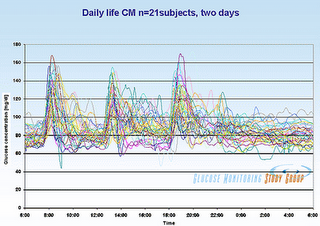
Abnormally high insulin levels – like those after a “healthy” breakfast of carbohydrate-rich cereals, pancakes etc. – lead to abnormal blood glucose dips soon after the meal. What I am talking about here is a fall in glucose levels that is considerable, and that also happens very fast – illustrated by the ratio between the lengths of the vertical and horizontal black lines on the figure below, from a previous post ().
Those hypoglycemic dips induce hunger, because the hormonal changes necessary to apply a break to the fall in glucose levels (which left unchecked would lead to death) leave us with a hormonal mix that ends up stimulating hunger, in an unnatural way. At the bottom of those dips, insulin levels are much lower than before. I am not talking about diabetics here. I am talking about normoglycemic folks, like the ones whose glucose levels are show on the figure above.
On a diet primarily of natural foods, or foods that are not heavily modified from their natural state, hunger patterns tend to be better synchronized with nutrient deficiencies. This is one of the main advantages of a natural foods diet. By nutrients, I do not mean only micronutrients such as vitamins and minerals, but also macronutrients such as amino and fatty acids.
On a natural diet, nutrient deficiencies should happen regularly. Our bodies are designed for sporadic nutrient intake, remaining most of the time in the fasted state. Human beings are unique in that they have very large brains in proportion to their overall body size, brains that run primarily on glucose – the average person’s brain consumes about 5 g/h of glucose. This latter characteristic makes it very difficult to extrapolate diet-based results based on other species to humans.
As hunger becomes better synchronized with nutrient deficiencies, it should promote optimal nutrient partitioning. This means that, among other things: (a) you should periodically feel hungry for different types of food, depending on your nutrient needs at that point in time; (b) if you do weight training, and fell hungry, some muscle gain should follow; and (c) if you let hunger drive food consumption, on a diet of predominantly natural foods, body fat levels should remain relatively low.
In this sense, hunger becomes your friend – and the best spice!
By the way, I often read here and there, mostly in blogs, that “insulin suppresses hunger”. I frankly don’t know where this idea comes from. What actually happens is that insulin is co-secreted with a number of other hormones. One of those, like insulin also secreted by the beta-cells in the pancreas, is amylin – a powerful appetite suppressor. Amylin deficiency leads to hunger even after a large carbohydrate-rich meal, when insulin levels are elevated.
Abnormally high insulin levels – like those after a “healthy” breakfast of carbohydrate-rich cereals, pancakes etc. – lead to abnormal blood glucose dips soon after the meal. What I am talking about here is a fall in glucose levels that is considerable, and that also happens very fast – illustrated by the ratio between the lengths of the vertical and horizontal black lines on the figure below, from a previous post ().
Those hypoglycemic dips induce hunger, because the hormonal changes necessary to apply a break to the fall in glucose levels (which left unchecked would lead to death) leave us with a hormonal mix that ends up stimulating hunger, in an unnatural way. At the bottom of those dips, insulin levels are much lower than before. I am not talking about diabetics here. I am talking about normoglycemic folks, like the ones whose glucose levels are show on the figure above.
On a diet primarily of natural foods, or foods that are not heavily modified from their natural state, hunger patterns tend to be better synchronized with nutrient deficiencies. This is one of the main advantages of a natural foods diet. By nutrients, I do not mean only micronutrients such as vitamins and minerals, but also macronutrients such as amino and fatty acids.
On a natural diet, nutrient deficiencies should happen regularly. Our bodies are designed for sporadic nutrient intake, remaining most of the time in the fasted state. Human beings are unique in that they have very large brains in proportion to their overall body size, brains that run primarily on glucose – the average person’s brain consumes about 5 g/h of glucose. This latter characteristic makes it very difficult to extrapolate diet-based results based on other species to humans.
As hunger becomes better synchronized with nutrient deficiencies, it should promote optimal nutrient partitioning. This means that, among other things: (a) you should periodically feel hungry for different types of food, depending on your nutrient needs at that point in time; (b) if you do weight training, and fell hungry, some muscle gain should follow; and (c) if you let hunger drive food consumption, on a diet of predominantly natural foods, body fat levels should remain relatively low.
In this sense, hunger becomes your friend – and the best spice!
Monday, March 12, 2012
Gaining muscle and losing fat at the same time: A more customized approach based on strength training and calorie intake variation
In the two last posts I discussed the idea of gaining muscle and losing fat at the same time () (). This post outlines one approach to make that happen, based on my own experience and that of several HCE () users. This approach may well be the most natural from an evolutionary perspective.
But first let us address one important question: Why would anyone want to reach a certain body weight and keep it constant, resorting to the more difficult and slow strategy of “turning fat into muscle”, so to speak? One could simply keep on losing fat, without losing or gaining muscle, until he or she reaches a very low body fat percentage (e.g., a single-digit body fat percentage, for men). Then he or she could go up from there, slowly putting on muscle.
The reason why it is advisable to reach a certain body weight and keep it constant is that, below a certain weight, one is likely to run into nutrient deficiencies. Non-exercise energy expenditure is proportional to body weight. As you keep on losing body weight, calorie intake may become too low to allow you to have a nutrient intake that is the minimum for your body structure. Unfortunately eating highly nutritious vegetables or consuming copious amounts of vitamin and mineral supplements will not work very well, because the nutritional needs of your body include both micro- and macro-nutrients that need co-factors to be properly absorbed and/or metabolized. One example is dietary fat, which is necessary for the absorption of fat-soluble vitamins.
If you place yourself into a state of nutrient deficiency, your body will compensate by mounting a multipronged defense, resorting to psychological and physiological mechanisms. Your body will do that because it is hardwired for self-preservation; as noted below, being in a state of nutrient deficiency for too long is very dangerous for one's health. Most people cannot oppose this body reaction by willpower alone. That is where binge-eating often starts. This is one of the key reasons why looking for a common denominator of most diets leads to the conclusion that all succeed at first, and eventually fail ().
If you are one of the few who can oppose the body’s reaction, and maintain a very low calorie intake even in the face of nutrient deficiencies, chances are you will become much more vulnerable to diseases caused by pathogens. Individually you will be placing yourself in a state that is similar to that of populations that have faced famine in the past. Historically speaking, famines are associated with decreases in degenerative diseases, and increases in diseases caused by pathogens. Pandemics, like the Black Death (), have historically been preceded by periods of food scarcity.
The approach to gaining muscle and losing fat at the same time, outlined here, relies mainly on the following elements: (a) regularly conducting strength training; (b) varying calorie intake based on exercise; and (c) eating protein regularly. To that, I would add becoming more active, which does not necessarily mean exercising but does mean doing things that involve physical motion of some kind (e.g., walking, climbing stairs, moving things around), to the tune of 1 hour or more every day. These increase calorie expenditure, enabling a slightly higher calorie intake while maintaining the same weight, and thus more nutrients on a diet of unprocessed foods. In fact, even things like fidgeting count (). These activities should not cause muscle damage to the point of preventing recovery from strength training.
As far as strength training goes, the main idea, as discussed in the previous post, is to regularly hit the supercompensation window, with progressive overload, and maintain your current body weight. In fact, over time, as muscle gain progresses, you will probably want to increase your calorie intake to increase your body weight, but very slowly to keep any fat gain from happening. This way your body fat percentage will go down, even as your weight goes up slowly. The first element, regularly hitting the supercompensation window, was discussed in a previous post ().
Varying calorie intake based on exercise. Here one approach that seems to work well is to eat more in the hours after a strength training session, and less in the hours preceding the next strength training session, keeping the calorie intake at maintenance over a week. Individual customization here is very important. Many people will respond quite well to a calorie surplus window of 8 – 24 h after exercise, and a calorie deficit in the following 40 – 24 h. This assumes that strength training sessions take place every other day. The weekend break in routine is a good one, as well as other random variations (e.g., random fasts), as the body tends to adapt to anything over time ().
One example would be someone following a two-day cycle where on the first day he or she would do strength training, and eat the following to satisfaction: muscle meats, fatty seafood (e.g., salmon), cheese, eggs, fruits, and starchy tubers (e.g., sweet potato). On the second day, a rest day, the person would eat the following, to near satisfaction, limiting portions a bit to offset the calorie surplus of the previous day: organ meats (e.g., heart and liver), lean seafood (e.g., shrimp and mussels), and non-starchy nutritious vegetables (e.g., spinach and cabbage). This would lead to periodic glycogen depletion, and also to unsettling water-weight variations; these can softened a bit, if they are bothering, by adding a small amount of fruit and/or starchy foods on rest days.
Organ meats, lean seafood, and non-starchy nutritious vegetables are all low-calorie foods. So restricting calories with them is relatively easy, without the need to reduce the volume of food eaten that much. If maintenance is achieved at around 2,000 calories per day, a possible calorie intake pattern would be 3,000 calories on one day, mostly after strength training, and 1,000 calories the next. This of course would depend on a number of factors including body size and nonexercise thermogenesis. A few calories could be added or removed here and there to make up for a different calorie intake during the weekend.
Some people believe that, if you vary your calorie intake in this way, the calorie deficit period will lead to muscle loss. This is the rationale behind the multiple balanced meals a day approach; which also works, and is successfully used by many bodybuilders, such as Doug Miller () and Scooby (). However, it seems that the positive nitrogen balance stimulus caused by strength training leads to a variation in nitrogen balance that is nonlinear and also different from the stimulus to muscle gain. Being in positive or neutral nitrogen balance is not the same as gaining muscle mass, although the two should be very highly correlated. While the muscle gain window may close relatively quickly after the strength training session, the window in which nitrogen balance is positive or neutral may remain open for much longer, even in the face of a calorie deficit during part of it. This difference in nonlinear response is illustrated through the schematic graph below.
Eating protein regularly. Here what seems to be the most advisable approach is to eat protein throughout, in amounts that make you feel good. (Yes, you should rely on sense of well being as a measure as well.) There is no need for overconsumption of protein, as one does not need much to be in nitrogen balance when doing strength training. For someone weighing 200 lbs (91 kg) about 109 g/d of high-quality protein would be an overestimation () because strength training itself pushes one’s nitrogen balance into positive territory (). The amount of carbohydrate needed depends on the amount of glycogen depleted through exercise and the amount of protein consumed. The two chief sources for glycogen replenishment, in muscle and liver, are protein and carbohydrate – with the latter being much more efficient if you are not insulin resistant.
How much dietary protein can you store in muscle? About 15 g/d if you are a gifted bodybuilder (). Still, consumption of protein stimulates muscle growth through complex processes. And protein does not usually become fat if one is in calorie deficit, particularly if consumption of carbohydrates is limited ().
The above is probably much easier to understand than to implement in practice, because it requires a lot of customization. It seems natural because our Paleolithic ancestors probably consumed more calories after hunting-gathering activities (i.e., exercise), and fewer calories before those activities. Our body seems to respond quite well to alternate day calorie restriction (). Moreover, the break in routine every other day, and the delayed but certain satisfaction provided by the higher calorie intake on exercise days, can serve as powerful motivators.
The temptation to set rigid rules, or a generic formula, always exists. But each person is unique (). For some people, adopting various windows of fasting (usually in the 8 – 24 h range) seems to be a very good strategy to achieve calorie deficits while maintaining a positive or neutral nitrogen balance.
For others, fasting has the opposite effect, perhaps due to an abnormal increase in cortisol levels. This is particularly true for fasting windows of 12 – 24 h or more. If regularly fasting within this range stresses you out, as opposed to “liberating” you (), you may be in the category that does better with more frequently meals.
But first let us address one important question: Why would anyone want to reach a certain body weight and keep it constant, resorting to the more difficult and slow strategy of “turning fat into muscle”, so to speak? One could simply keep on losing fat, without losing or gaining muscle, until he or she reaches a very low body fat percentage (e.g., a single-digit body fat percentage, for men). Then he or she could go up from there, slowly putting on muscle.
The reason why it is advisable to reach a certain body weight and keep it constant is that, below a certain weight, one is likely to run into nutrient deficiencies. Non-exercise energy expenditure is proportional to body weight. As you keep on losing body weight, calorie intake may become too low to allow you to have a nutrient intake that is the minimum for your body structure. Unfortunately eating highly nutritious vegetables or consuming copious amounts of vitamin and mineral supplements will not work very well, because the nutritional needs of your body include both micro- and macro-nutrients that need co-factors to be properly absorbed and/or metabolized. One example is dietary fat, which is necessary for the absorption of fat-soluble vitamins.
If you place yourself into a state of nutrient deficiency, your body will compensate by mounting a multipronged defense, resorting to psychological and physiological mechanisms. Your body will do that because it is hardwired for self-preservation; as noted below, being in a state of nutrient deficiency for too long is very dangerous for one's health. Most people cannot oppose this body reaction by willpower alone. That is where binge-eating often starts. This is one of the key reasons why looking for a common denominator of most diets leads to the conclusion that all succeed at first, and eventually fail ().
If you are one of the few who can oppose the body’s reaction, and maintain a very low calorie intake even in the face of nutrient deficiencies, chances are you will become much more vulnerable to diseases caused by pathogens. Individually you will be placing yourself in a state that is similar to that of populations that have faced famine in the past. Historically speaking, famines are associated with decreases in degenerative diseases, and increases in diseases caused by pathogens. Pandemics, like the Black Death (), have historically been preceded by periods of food scarcity.
The approach to gaining muscle and losing fat at the same time, outlined here, relies mainly on the following elements: (a) regularly conducting strength training; (b) varying calorie intake based on exercise; and (c) eating protein regularly. To that, I would add becoming more active, which does not necessarily mean exercising but does mean doing things that involve physical motion of some kind (e.g., walking, climbing stairs, moving things around), to the tune of 1 hour or more every day. These increase calorie expenditure, enabling a slightly higher calorie intake while maintaining the same weight, and thus more nutrients on a diet of unprocessed foods. In fact, even things like fidgeting count (). These activities should not cause muscle damage to the point of preventing recovery from strength training.
As far as strength training goes, the main idea, as discussed in the previous post, is to regularly hit the supercompensation window, with progressive overload, and maintain your current body weight. In fact, over time, as muscle gain progresses, you will probably want to increase your calorie intake to increase your body weight, but very slowly to keep any fat gain from happening. This way your body fat percentage will go down, even as your weight goes up slowly. The first element, regularly hitting the supercompensation window, was discussed in a previous post ().
Varying calorie intake based on exercise. Here one approach that seems to work well is to eat more in the hours after a strength training session, and less in the hours preceding the next strength training session, keeping the calorie intake at maintenance over a week. Individual customization here is very important. Many people will respond quite well to a calorie surplus window of 8 – 24 h after exercise, and a calorie deficit in the following 40 – 24 h. This assumes that strength training sessions take place every other day. The weekend break in routine is a good one, as well as other random variations (e.g., random fasts), as the body tends to adapt to anything over time ().
One example would be someone following a two-day cycle where on the first day he or she would do strength training, and eat the following to satisfaction: muscle meats, fatty seafood (e.g., salmon), cheese, eggs, fruits, and starchy tubers (e.g., sweet potato). On the second day, a rest day, the person would eat the following, to near satisfaction, limiting portions a bit to offset the calorie surplus of the previous day: organ meats (e.g., heart and liver), lean seafood (e.g., shrimp and mussels), and non-starchy nutritious vegetables (e.g., spinach and cabbage). This would lead to periodic glycogen depletion, and also to unsettling water-weight variations; these can softened a bit, if they are bothering, by adding a small amount of fruit and/or starchy foods on rest days.
Organ meats, lean seafood, and non-starchy nutritious vegetables are all low-calorie foods. So restricting calories with them is relatively easy, without the need to reduce the volume of food eaten that much. If maintenance is achieved at around 2,000 calories per day, a possible calorie intake pattern would be 3,000 calories on one day, mostly after strength training, and 1,000 calories the next. This of course would depend on a number of factors including body size and nonexercise thermogenesis. A few calories could be added or removed here and there to make up for a different calorie intake during the weekend.
Some people believe that, if you vary your calorie intake in this way, the calorie deficit period will lead to muscle loss. This is the rationale behind the multiple balanced meals a day approach; which also works, and is successfully used by many bodybuilders, such as Doug Miller () and Scooby (). However, it seems that the positive nitrogen balance stimulus caused by strength training leads to a variation in nitrogen balance that is nonlinear and also different from the stimulus to muscle gain. Being in positive or neutral nitrogen balance is not the same as gaining muscle mass, although the two should be very highly correlated. While the muscle gain window may close relatively quickly after the strength training session, the window in which nitrogen balance is positive or neutral may remain open for much longer, even in the face of a calorie deficit during part of it. This difference in nonlinear response is illustrated through the schematic graph below.
Eating protein regularly. Here what seems to be the most advisable approach is to eat protein throughout, in amounts that make you feel good. (Yes, you should rely on sense of well being as a measure as well.) There is no need for overconsumption of protein, as one does not need much to be in nitrogen balance when doing strength training. For someone weighing 200 lbs (91 kg) about 109 g/d of high-quality protein would be an overestimation () because strength training itself pushes one’s nitrogen balance into positive territory (). The amount of carbohydrate needed depends on the amount of glycogen depleted through exercise and the amount of protein consumed. The two chief sources for glycogen replenishment, in muscle and liver, are protein and carbohydrate – with the latter being much more efficient if you are not insulin resistant.
How much dietary protein can you store in muscle? About 15 g/d if you are a gifted bodybuilder (). Still, consumption of protein stimulates muscle growth through complex processes. And protein does not usually become fat if one is in calorie deficit, particularly if consumption of carbohydrates is limited ().
The above is probably much easier to understand than to implement in practice, because it requires a lot of customization. It seems natural because our Paleolithic ancestors probably consumed more calories after hunting-gathering activities (i.e., exercise), and fewer calories before those activities. Our body seems to respond quite well to alternate day calorie restriction (). Moreover, the break in routine every other day, and the delayed but certain satisfaction provided by the higher calorie intake on exercise days, can serve as powerful motivators.
The temptation to set rigid rules, or a generic formula, always exists. But each person is unique (). For some people, adopting various windows of fasting (usually in the 8 – 24 h range) seems to be a very good strategy to achieve calorie deficits while maintaining a positive or neutral nitrogen balance.
For others, fasting has the opposite effect, perhaps due to an abnormal increase in cortisol levels. This is particularly true for fasting windows of 12 – 24 h or more. If regularly fasting within this range stresses you out, as opposed to “liberating” you (), you may be in the category that does better with more frequently meals.
Monday, March 5, 2012
Gaining muscle and losing fat at the same time: Various issues and two key requirements
In my previous post (), I mentioned that the idea of gaining muscle and losing fat at the same time seems impossible to most people because of three widely held misconceptions: (a) to gain muscle you need a calorie surplus; (b) to lose fat you need a calorie deficit; and (c) you cannot achieve a calorie surplus and deficit at the same time.
The scenario used to illustrate what I see as a non-traumatic move from obese or seriously overweight to lean is one in which weight loss and fat loss go hand in hand until a relatively lean level is reached, beyond which weight is maintained constant (as illustrated in the schematic graph below). If you are departing from an obese or seriously overweight level, it may be advisable to lose weight until you reach a body fat level of around 21-24 percent for women or 14-17 percent for men. Once you reach that level, it may be best to stop losing weight, and instead slowly gain muscle and lose fat, in equal amounts. I will discuss the rationale for this in more detail in my next post; this post will focus on addressing the misconceptions above.
Before I address the misconceptions, let me first clarify that, when I say “gaining muscle” I do not mean only increasing the amount of protein stored in muscle tissue. Muscle tissue is mostly water, by far. An important component of muscle tissue is muscle glycogen, which increases dramatically with strength training, and also tends to increase the amount of water stored in muscle. So, when you gain muscle, you gain a significant amount of water.
Now let us take a look at the misconceptions. The first misconception, that to gain muscle you need a calorie surplus, was dispelled in a previous post featuring a study by Ballor and colleagues (). In that study, obese subjects combined strength training with a mild calorie deficit, and gained muscle. They also lost fat, but ended up a bit heavier than at the beginning of the intervention. Another study along the same lines was linked by Clint (thanks) in the comments section under the last post ().
The second misconception, that to lose fat you need a calorie deficit; is related to the third, that you cannot achieve a calorie surplus and deficit at the same time. In part these misconceptions are about semantics, as most people understand “calorie deficit” to mean “constant calorie deficit”. One can easily vary calorie intake every other day, generating various calorie deficits and surpluses over a week, but with no overall calorie deficit or surplus for the entire week. This is why I say that one can achieve a calorie surplus and deficit “at the same time”. But let us make a point very clear, most of the evidence that I have seen so far suggests that you do not need a calorie deficit to lose fat, but you do need a calorie deficit to lose structural weight (i.e., non-water weight). With a few exceptions, not many people will want to lose structural weight by shedding anything other than body fat. One exception would be professional athletes who are already very lean and yet are very big for the weight class in which they compete, being unable to "make weight" through dehydration.
Perhaps the most surprising to some people is that, based on my own experience and that of several HCE () users, you don’t even need to vary your calorie intake that much to gain muscle and lose fat at the same time. You can achieve that by eating enough to maintain your body weight. In fact, you can even slowly increase your calorie intake over time, as muscle growth progresses beyond the body fat lost. And here I mean increasing your calorie intake very slowly, proportionally to the amount of muscle you gain; which also means that the incremental increase in calorie intake will vary from person to person. If you are already relatively lean, at around 21-24 percent of body fat for women and 14-17 percent for men, gaining muscle and losing fat in equal amounts will lead to a visible change in body composition over time () ().
Two key requirements seem to be common denominators for most people. You must eat protein regularly; not because muscle tissue is mostly protein, but because protein seems to act as a hormone, signaling to muscle tissue that it should repair itself. (Many hormones are proteins, actually peptides, and also bind to receptor proteins.) And you also must conduct strength training to the point that you are regularly hitting the supercompensation window (). This takes a lot of individual customization (). You can achieve that with body weight exercises, although free weights and machines seem to be generally more effective. Keep in mind that individual customization will allow you to reach your "sweet spots", but that still results will vary across individuals, in some cases dramatically.
If you regularly hit the supercompensation window, you will be progressively spending slightly more energy in each exercise session, chiefly in the form of muscle glycogen, as you progress with your strength training program. You will also be creating a hormonal mix that will increase the body’s reliance on fat as a source of energy during recovery. As a compensatory adaptation (), your body will gradually increase the size of its glycogen stores, raising insulin sensitivity and making it progressively more difficult for glucose to become body fat.
Since you will be progressively spending slightly more energy over time due to regularly hitting the supercompensation window, that is another reason why you will need to increase your calorie intake. Again, very slowly, proportionally to your muscle gain. If you do not do that, you will provide a strong stimulus for autophagy () to occur, which I think is healthy and would even recommend from time to time. In fact, one of the most powerful stimuli to autophagy is doing strength training and fasting afterwards. If you do that only occasionally (e.g., once every few months), you will probably not experience muscle loss or gain, but you may experience health improvements as a result of autophagy.
The human body is very adaptable, so there are many variations of the general strategy above. In my next post, I will talk a bit more about a variation that seems to work well for many people. It involves a combination of strength training and calorie intake variation that may well be the most natural from an evolutionary perspective.
The scenario used to illustrate what I see as a non-traumatic move from obese or seriously overweight to lean is one in which weight loss and fat loss go hand in hand until a relatively lean level is reached, beyond which weight is maintained constant (as illustrated in the schematic graph below). If you are departing from an obese or seriously overweight level, it may be advisable to lose weight until you reach a body fat level of around 21-24 percent for women or 14-17 percent for men. Once you reach that level, it may be best to stop losing weight, and instead slowly gain muscle and lose fat, in equal amounts. I will discuss the rationale for this in more detail in my next post; this post will focus on addressing the misconceptions above.
Before I address the misconceptions, let me first clarify that, when I say “gaining muscle” I do not mean only increasing the amount of protein stored in muscle tissue. Muscle tissue is mostly water, by far. An important component of muscle tissue is muscle glycogen, which increases dramatically with strength training, and also tends to increase the amount of water stored in muscle. So, when you gain muscle, you gain a significant amount of water.
Now let us take a look at the misconceptions. The first misconception, that to gain muscle you need a calorie surplus, was dispelled in a previous post featuring a study by Ballor and colleagues (). In that study, obese subjects combined strength training with a mild calorie deficit, and gained muscle. They also lost fat, but ended up a bit heavier than at the beginning of the intervention. Another study along the same lines was linked by Clint (thanks) in the comments section under the last post ().
The second misconception, that to lose fat you need a calorie deficit; is related to the third, that you cannot achieve a calorie surplus and deficit at the same time. In part these misconceptions are about semantics, as most people understand “calorie deficit” to mean “constant calorie deficit”. One can easily vary calorie intake every other day, generating various calorie deficits and surpluses over a week, but with no overall calorie deficit or surplus for the entire week. This is why I say that one can achieve a calorie surplus and deficit “at the same time”. But let us make a point very clear, most of the evidence that I have seen so far suggests that you do not need a calorie deficit to lose fat, but you do need a calorie deficit to lose structural weight (i.e., non-water weight). With a few exceptions, not many people will want to lose structural weight by shedding anything other than body fat. One exception would be professional athletes who are already very lean and yet are very big for the weight class in which they compete, being unable to "make weight" through dehydration.
Perhaps the most surprising to some people is that, based on my own experience and that of several HCE () users, you don’t even need to vary your calorie intake that much to gain muscle and lose fat at the same time. You can achieve that by eating enough to maintain your body weight. In fact, you can even slowly increase your calorie intake over time, as muscle growth progresses beyond the body fat lost. And here I mean increasing your calorie intake very slowly, proportionally to the amount of muscle you gain; which also means that the incremental increase in calorie intake will vary from person to person. If you are already relatively lean, at around 21-24 percent of body fat for women and 14-17 percent for men, gaining muscle and losing fat in equal amounts will lead to a visible change in body composition over time () ().
Two key requirements seem to be common denominators for most people. You must eat protein regularly; not because muscle tissue is mostly protein, but because protein seems to act as a hormone, signaling to muscle tissue that it should repair itself. (Many hormones are proteins, actually peptides, and also bind to receptor proteins.) And you also must conduct strength training to the point that you are regularly hitting the supercompensation window (). This takes a lot of individual customization (). You can achieve that with body weight exercises, although free weights and machines seem to be generally more effective. Keep in mind that individual customization will allow you to reach your "sweet spots", but that still results will vary across individuals, in some cases dramatically.
If you regularly hit the supercompensation window, you will be progressively spending slightly more energy in each exercise session, chiefly in the form of muscle glycogen, as you progress with your strength training program. You will also be creating a hormonal mix that will increase the body’s reliance on fat as a source of energy during recovery. As a compensatory adaptation (), your body will gradually increase the size of its glycogen stores, raising insulin sensitivity and making it progressively more difficult for glucose to become body fat.
Since you will be progressively spending slightly more energy over time due to regularly hitting the supercompensation window, that is another reason why you will need to increase your calorie intake. Again, very slowly, proportionally to your muscle gain. If you do not do that, you will provide a strong stimulus for autophagy () to occur, which I think is healthy and would even recommend from time to time. In fact, one of the most powerful stimuli to autophagy is doing strength training and fasting afterwards. If you do that only occasionally (e.g., once every few months), you will probably not experience muscle loss or gain, but you may experience health improvements as a result of autophagy.
The human body is very adaptable, so there are many variations of the general strategy above. In my next post, I will talk a bit more about a variation that seems to work well for many people. It involves a combination of strength training and calorie intake variation that may well be the most natural from an evolutionary perspective.
Monday, February 27, 2012
Gaining muscle and losing fat at the same time: If I can do it, anyone can
The idea of gaining muscle and losing fat at the same time seems impossible because of three widely held misconceptions: (a) to gain muscle you need a calorie surplus; (b) to lose fat you need a calorie deficit; and (c) you cannot achieve a calorie surplus and deficit at the same time.
Not too long ago, unfortunately I was in the right position to do some self-experiments in order to try to gain muscle and concurrently lose fat, without steroids, keeping my weight essentially constant (within a range of a few lbs). This was because I was obese, and then reached a point in the fat loss stage where I could stop losing weight while attempting to lose fat. This is indeed difficult and slow, as muscle gain itself is slow, and it apparently becomes slower as one tries to restrict fat gain. Compounding that is the fact that self-experimentation invariably leads to some mistakes.
The photos below show how I looked toward the end of my transformation from obese to relatively lean (right), and then about 1.5 years after that (left). During this time I gained muscle and lost fat, in equal amounts. How do I know that? It is because my weight is the same in both photos, even though on the left my body fat percentage is approximately 5 points lower. I estimate it to be slightly over 12 percent (on the left). This translates into a difference of about 7.5 lbs, of “fat turning into muscle”, so to speak.
A previous post on my transformation from obese to relatively lean has more measurement details (). Interestingly, I am very close to being overweight, technically speaking, in both photos above! That is, in both photos I have a body mass index that is close to 25. In fact, after putting on even a small amount of muscle, like I did, it is very easy for someone to reach a body mass index of 25. See the table below, from the body mass index article on Wikipedia ().
As someone gains more muscle and remains lean, approaching his or her maximum natural muscular potential, that person will approach the limit between the overweight and obese areas on the figure above. This will happen even though the person may be fairly lean, say with a body fat percentage in the single digits for men and around 14-18 percent for women. This applies primarily to the 5’7’’ – 5’11’’ range; things get somewhat distorted toward the extremes.
Contrast this with true obesity, as in the photo below. This photo was taken when I was obese, at the beach. If I recall it properly, it was taken on the Atlantic City seashore, or a beach nearby. I was holding a bottle of regular soda, which is emblematic of the situation in which many people find themselves in today’s urban societies. It reminds me of a passage in Gary Taubes’s book “Good Calories, Bad Calories” (), where someone who had recently discovered the deliciousness of water sweetened with sugar wondered why anyone “of means” would drink plain water ever again.
Now, you may rightfully say that a body composition change of about 7.5 lbs in 1.5 years is pitiful. Indeed, there are some people, typically young men, who will achieve this in a few months without steroids. But they are relatively rare; Scooby has a good summary of muscle gain expectations (). As for me, I am almost 50 years old, an age where muscle gain is not supposed to happen at all. I tend to gain fat very easily, but not muscle. And I was obese not too long ago. My results should be at the very low end of the scale of accomplishment for most people doing the right things.
By the way, the idea that muscle gain cannot happen after 40 years of age or so is another misconception; even though aging seems to promote muscle loss and fat gain, in part due to natural hormonal changes. There is evidence that many men may experience of low point (i.e., a trough) in their growth hormone and testosterone levels in their mid-40s, possibly due to a combination of modern diet and lifestyle factors. Still, many men in their 50s and 60s have higher levels ().
And what are the right things to do if one wants to gain muscle and lose fat at the same time? In my next post I will discuss the misconceptions mentioned at the beginning of this post, and a simple approach for concurrently gaining muscle and losing fat. The discussion will be based on my own experience and that of several HCE () users. The approach relies heavily on individual customization; so it will probably be easier to understand than to implement. Strength training is part of this simple strategy.
One puzzling aspect of strength training, from an evolutionary perspective, is that people tend to be able to do a lot more of it than is optimal for them. And, when they do even a bit more than they should, muscle gain stalls or even regresses. The minimalists frequently have the best results.
Not too long ago, unfortunately I was in the right position to do some self-experiments in order to try to gain muscle and concurrently lose fat, without steroids, keeping my weight essentially constant (within a range of a few lbs). This was because I was obese, and then reached a point in the fat loss stage where I could stop losing weight while attempting to lose fat. This is indeed difficult and slow, as muscle gain itself is slow, and it apparently becomes slower as one tries to restrict fat gain. Compounding that is the fact that self-experimentation invariably leads to some mistakes.
The photos below show how I looked toward the end of my transformation from obese to relatively lean (right), and then about 1.5 years after that (left). During this time I gained muscle and lost fat, in equal amounts. How do I know that? It is because my weight is the same in both photos, even though on the left my body fat percentage is approximately 5 points lower. I estimate it to be slightly over 12 percent (on the left). This translates into a difference of about 7.5 lbs, of “fat turning into muscle”, so to speak.
A previous post on my transformation from obese to relatively lean has more measurement details (). Interestingly, I am very close to being overweight, technically speaking, in both photos above! That is, in both photos I have a body mass index that is close to 25. In fact, after putting on even a small amount of muscle, like I did, it is very easy for someone to reach a body mass index of 25. See the table below, from the body mass index article on Wikipedia ().
As someone gains more muscle and remains lean, approaching his or her maximum natural muscular potential, that person will approach the limit between the overweight and obese areas on the figure above. This will happen even though the person may be fairly lean, say with a body fat percentage in the single digits for men and around 14-18 percent for women. This applies primarily to the 5’7’’ – 5’11’’ range; things get somewhat distorted toward the extremes.
Contrast this with true obesity, as in the photo below. This photo was taken when I was obese, at the beach. If I recall it properly, it was taken on the Atlantic City seashore, or a beach nearby. I was holding a bottle of regular soda, which is emblematic of the situation in which many people find themselves in today’s urban societies. It reminds me of a passage in Gary Taubes’s book “Good Calories, Bad Calories” (), where someone who had recently discovered the deliciousness of water sweetened with sugar wondered why anyone “of means” would drink plain water ever again.
Now, you may rightfully say that a body composition change of about 7.5 lbs in 1.5 years is pitiful. Indeed, there are some people, typically young men, who will achieve this in a few months without steroids. But they are relatively rare; Scooby has a good summary of muscle gain expectations (). As for me, I am almost 50 years old, an age where muscle gain is not supposed to happen at all. I tend to gain fat very easily, but not muscle. And I was obese not too long ago. My results should be at the very low end of the scale of accomplishment for most people doing the right things.
By the way, the idea that muscle gain cannot happen after 40 years of age or so is another misconception; even though aging seems to promote muscle loss and fat gain, in part due to natural hormonal changes. There is evidence that many men may experience of low point (i.e., a trough) in their growth hormone and testosterone levels in their mid-40s, possibly due to a combination of modern diet and lifestyle factors. Still, many men in their 50s and 60s have higher levels ().
And what are the right things to do if one wants to gain muscle and lose fat at the same time? In my next post I will discuss the misconceptions mentioned at the beginning of this post, and a simple approach for concurrently gaining muscle and losing fat. The discussion will be based on my own experience and that of several HCE () users. The approach relies heavily on individual customization; so it will probably be easier to understand than to implement. Strength training is part of this simple strategy.
One puzzling aspect of strength training, from an evolutionary perspective, is that people tend to be able to do a lot more of it than is optimal for them. And, when they do even a bit more than they should, muscle gain stalls or even regresses. The minimalists frequently have the best results.
Monday, January 30, 2012
Kleiber's law and its possible implications for obesity
Kleiber's law () is one of those “laws” of nature that is both derived from, and seems to fit quite well with, empirical data. It applies to most animals, including humans. The law is roughly summarized through the equation below, where E = energy expenditure at rest per day, and M = body weight in kilograms.
Because of various assumptions made in the original formulation of the law, the values of E do not translate very well to calories as measured today. What is important is the exponent, and what it means in terms of relative increases in weight. Since the exponent in the equation is 3/4, which is lower than 1, the law essentially states that as body weight increases animals become more efficient from an energy expenditure perspective. For example, the energy expenditure at rest of an elephant, per unit of body weight, is significantly lower than that of a mouse.
The difference in weight does not have to be as large as that between an elephant and a mouse for a clear difference in energy expenditure to be noticed. Moreover, the increase in energy efficiency predicted by the law is independent of what makes up the weight; whether it is more or less lean body mass, for example. And the law is very generic, also applying to different animals of the same species, and even the same animal at different developmental stages.
Extrapolating the law to humans is quite interesting. Let us consider a person weighing 68 kg (about 150 lbs). According to Kleiber's law, and using a constant multiplied to M to make it consistent with current calorie measurement assumptions (see Notes at the end of this post), this person’s energy expenditure at rest per day would be about 1,847 calories.
A person weighing 95 kg (about 210 lbs) would spend 2,374 calories at rest per day according to Kleiber's law. However, if we were to assume a linear increase based on the daily calorie expenditure at a weight of 68 kg, this person weighing 95 kg would spend 2,508 calories per day at rest. The difference of approximately 206 calories per day is a reflection of Kleiber's law.
This difference of 206 calories per day would translate into about 23 g of extra body fat being stored per day. Per month this would be about 688 g, a little more than 1.5 lbs. Not a negligible amount. So, as you become obese, your body becomes even more efficient on a weight-adjusted basis, from an energy expenditure perspective.
One more roadblock to go from obese to lean.
Now, here is the interesting part. It is unreasonable to assume that the extra mass itself has a significantly lower metabolic rate, with this fully accounting for the relative increase in efficiency. It makes more sense to think that the extra mass leads to systemic adaptations, which in turn lead to whole-body economies of scale (). In existing bodies, these adaptations should happen over time, as long-term compensatory adaptations ().
The implications are fascinating. One implication is that, if the compensatory adaptations that lead to a lower metabolic rate are long term, they should also take some time to undo. This is what some call having a “broken metabolism”; which may turn out not to be “broken”, but having some inertia to overcome before it comes back to a former state. Thus, lower metabolic rates should generally be observed in the formerly obese, with reductions compatible with Kleiber's law. Those reductions themselves should be positively correlated with the ratio of time spent in the obese and lean states.
Someone who was obese at 95 kg should have a metabolic rate approximately 5.6 percent lower than a never obese person, soon after reaching a weight of 68 kg (5.6 percent = [2,508 – 2,374] / 2,374). If the compensatory adaptation can be reversed, as I believe it can, we should see slightly lower percentage reductions in studies including formerly obese participants who had been lean for a while. This expectation is consistent with empirical evidence. For example, a study by Astrup and colleagues () concluded that: “Formerly obese subjects had a 3–5% lower mean relative RMR than control subjects”.
Another implication, which is related to the one above, is that someone who becomes obese and goes right back to lean should not see that kind of inertia. That is, that person should go right back to his or her lean resting metabolic rate. Perhaps Drew Manning’s Fit-2-Fat-2-Fit experiment () will shed some light on this possible implication.
A person becoming obese and going right back to lean is not a very common occurrence. Sometimes this is done on purpose, for professional reasons, such as before and after photos for diet products. Believed it or not, there is a market for this!
Notes
- Calorie expenditure estimation varies a lot depending on the equation used. The multiplier used here was 78, based on Cunningham’s equation, and assuming 10 percent body fat. The calorie expenditure for the same 68 kg person using Katch-McArdle’s equation, also assuming 10 percent body fat, would be about 1,692 calories. That would lead to a different multiplier.
- The really important thing to keep in mind, for the purposes of the discussion presented here, is the relative decrease in energy expenditure at rest, per unit of weight, as weight goes up. So we stuck with the 78 multiplier for illustration purposes.
- There is a lot of variation across individuals in energy expenditure at rest due to other factors such as nonexercise activity thermogenesis ().
Because of various assumptions made in the original formulation of the law, the values of E do not translate very well to calories as measured today. What is important is the exponent, and what it means in terms of relative increases in weight. Since the exponent in the equation is 3/4, which is lower than 1, the law essentially states that as body weight increases animals become more efficient from an energy expenditure perspective. For example, the energy expenditure at rest of an elephant, per unit of body weight, is significantly lower than that of a mouse.
The difference in weight does not have to be as large as that between an elephant and a mouse for a clear difference in energy expenditure to be noticed. Moreover, the increase in energy efficiency predicted by the law is independent of what makes up the weight; whether it is more or less lean body mass, for example. And the law is very generic, also applying to different animals of the same species, and even the same animal at different developmental stages.
Extrapolating the law to humans is quite interesting. Let us consider a person weighing 68 kg (about 150 lbs). According to Kleiber's law, and using a constant multiplied to M to make it consistent with current calorie measurement assumptions (see Notes at the end of this post), this person’s energy expenditure at rest per day would be about 1,847 calories.
A person weighing 95 kg (about 210 lbs) would spend 2,374 calories at rest per day according to Kleiber's law. However, if we were to assume a linear increase based on the daily calorie expenditure at a weight of 68 kg, this person weighing 95 kg would spend 2,508 calories per day at rest. The difference of approximately 206 calories per day is a reflection of Kleiber's law.
This difference of 206 calories per day would translate into about 23 g of extra body fat being stored per day. Per month this would be about 688 g, a little more than 1.5 lbs. Not a negligible amount. So, as you become obese, your body becomes even more efficient on a weight-adjusted basis, from an energy expenditure perspective.
One more roadblock to go from obese to lean.
Now, here is the interesting part. It is unreasonable to assume that the extra mass itself has a significantly lower metabolic rate, with this fully accounting for the relative increase in efficiency. It makes more sense to think that the extra mass leads to systemic adaptations, which in turn lead to whole-body economies of scale (). In existing bodies, these adaptations should happen over time, as long-term compensatory adaptations ().
The implications are fascinating. One implication is that, if the compensatory adaptations that lead to a lower metabolic rate are long term, they should also take some time to undo. This is what some call having a “broken metabolism”; which may turn out not to be “broken”, but having some inertia to overcome before it comes back to a former state. Thus, lower metabolic rates should generally be observed in the formerly obese, with reductions compatible with Kleiber's law. Those reductions themselves should be positively correlated with the ratio of time spent in the obese and lean states.
Someone who was obese at 95 kg should have a metabolic rate approximately 5.6 percent lower than a never obese person, soon after reaching a weight of 68 kg (5.6 percent = [2,508 – 2,374] / 2,374). If the compensatory adaptation can be reversed, as I believe it can, we should see slightly lower percentage reductions in studies including formerly obese participants who had been lean for a while. This expectation is consistent with empirical evidence. For example, a study by Astrup and colleagues () concluded that: “Formerly obese subjects had a 3–5% lower mean relative RMR than control subjects”.
Another implication, which is related to the one above, is that someone who becomes obese and goes right back to lean should not see that kind of inertia. That is, that person should go right back to his or her lean resting metabolic rate. Perhaps Drew Manning’s Fit-2-Fat-2-Fit experiment () will shed some light on this possible implication.
A person becoming obese and going right back to lean is not a very common occurrence. Sometimes this is done on purpose, for professional reasons, such as before and after photos for diet products. Believed it or not, there is a market for this!
Notes
- Calorie expenditure estimation varies a lot depending on the equation used. The multiplier used here was 78, based on Cunningham’s equation, and assuming 10 percent body fat. The calorie expenditure for the same 68 kg person using Katch-McArdle’s equation, also assuming 10 percent body fat, would be about 1,692 calories. That would lead to a different multiplier.
- The really important thing to keep in mind, for the purposes of the discussion presented here, is the relative decrease in energy expenditure at rest, per unit of weight, as weight goes up. So we stuck with the 78 multiplier for illustration purposes.
- There is a lot of variation across individuals in energy expenditure at rest due to other factors such as nonexercise activity thermogenesis ().
Monday, January 23, 2012
All diets succeed at first, and eventually fail
It is not very hard to find studies supporting one diet or another. Gardner and colleagues, for example, conducted a study in which the Atkins diet came out on top when compared with the Zone, Ornish, and LEARN diets (). In Dansinger and colleagues’ study (), on the other hand, following the Atkins diet led to relatively poor results compared with the Ornish, Weight Watchers, and Zone diets.
Often the diets compared have different macronutrient ratios, which end up becoming the focus of the comparison. Many consider Sacks and colleagues’ conclusion, based on yet another diet comparison study (), to be the most consistent with the body of evidence as a whole: “Reduced-calorie diets result in clinically meaningful weight loss regardless of which macronutrients they emphasize”.
I think there is a different conclusion that is even more consistent with the body of evidence out there. This conclusion is highlighted by the findings of almost all diet studies where participants were followed for more than 1 year. But the relevant findings are typically buried in the papers that summarize the studies, and are almost never mentioned in the abstracts. Take for example the study by Toubro and Astrup (); Figure 3 below is used by the authors to highlight the study’s main reported finding: “Ad lib, low fat, high carbohydrate diet was superior to fixed energy intake for maintaining weight after a major weight loss”.
But what does the figure above really tell us? It tells us, quite simply, that both diets succeeded at first, and then eventually failed. One failed slightly less miserably than the other, in this study. The percentage of subjects that maintained a weight loss above 25 kg (about 55 lbs) approached zero after 12 months, in both diets. This leads us to the conclusion below, which is always missing in diet studies even when the evidence is staring back at us. This is arguably the conclusion that is the most consistent with the body of evidence out there.
All diets succeed at first, and eventually fail.
In using the terms “succeed” and “fail” I am referring to the diets’ effects on the majority of the participants. This is in fact better demonstrated by the figure below, from the same study by Toubro and Astrup; it is labeled as Figure 2 there. Most of the participants at a certain weight, lose a lot of weight within a period of 1 year or so, and after 2 years (see the two points at the far right) are at the same original weight again. What is the average time to regain back the weight? From what I’ve seen in the literature, all the weight and some tends to be regained after 2-3 years.
The regained weight is not at all lean body mass. It is primarily, if not entirely, body fat. In fact, many studies suggest that those who diet tend to have a higher percentage of body fat when they regain their original weight; proportionally to how fast they regain the weight lost. Since the extra body fat tends to cause additional problems, which are compounded by the dieting process’ toll on the body, those dieters would have been slightly better off not having dieted in the first place.
Guyenet and Schwartz have recently authored an article that summarizes quite nicely what tends to happen with both obese and lean dieters (). Take a look at Figure 2 of the article below. The obese need to lose body fat to improve health markers, and avoid a number of downstream complications, such as type 2 diabetes and cancer (). Yet, with very few exceptions, the obese (and even the overweight) remain obese (or overweight) after dieting; regardless of the diet.
So what about those exceptions, what do they do to lose significant amounts of body fat and keep it off? Well, I rarely use myself as an example for anything in this blog, but this is something with which I unfortunately/fortunately have personal experience. I was obese, lost about 60 lbs of weight, and kept it off for quite a while already (). Like most of the formerly obese, I can very easily gain body fat back.
But I don’t seem to be gaining back the formerly lost body fat, and the reason is consistent with some of the studies based on data from the National Weight Control Registry, which stores information about adults who lost 30 lbs or more of weight and kept it off for at least 1 year (). I systematically measure my weight, body fat percentage, and a number of other variables; probably even more than the average National Weight Control Registry member. Based on those measurements, I try to understand how my body responds in the short and long term to stimuli such as different exercise, types of food, calorie restriction, sleep patterns etc.
And I act accordingly to keep any body fat gain from happening; by, for example, varying calorie intake, increasing exercise intensity, varying the types of food I eat etc. With a few exceptions (e.g., avoiding industrial seed oils), there is no generic formula. Customization based on individual responses and cyclical patterns seems to be a must.
Looking back, it was relatively easy for me to lose all that fat. This is consistent with the studies summarized in this post; all diets that rely on caloric reduction work marvelously at first for most people. The really difficult part is to keep the body fat off. I believe that this is especially true as the initial years go by, and becomes easier after that. This has something to do with initial inertia, which I will discuss soon in a post on metabolic rates and their relationship with overall body mass.
For people living in the wild, I can see one thing working in their favor. And that is not regular starvation; sapiens is too smart for that. It is laziness. Hunger has to reach a certain threshold for people to want to do some work to get their food; this acts as a natural body composition regulator, something that I intend to discuss in one of my next posts. It seems that people almost never become obese in the wild, without access to industrial foods.
As for living in the wild, in spite of the romantic portrayals of it, the experience is not as appealing after you really try it. The book Yanomamo: The Fierce People () is a solid, if not somewhat shocking, reminder of that. I had the opportunity to meet and talk at length with its author, the great anthropologist Nap Chagnon, at one of the Human Behavior and Evolution Society conferences. The man is a real-life Indiana Jones ().
In the formerly obese, the body seems to resort to “guerrilla warfare”, employing all kinds of physiological and psychological mechanisms, some more subtle than others, to make sure that the lost fat is recovered. Why? I have some ideas, which I have discussed indirectly in posts throughout this blog, but I still need to understand the whole process a bit better. My ideas build on the notion of compensatory adaptation ().
You might have heard some very smart people say that you do not need to measure anything to lose body fat and keep it off. Many of those people have never been obese. Those who have been obese often had not cleared the 2-3 year “danger zone” by the time they made those statements.
There are many obese or overweight public figures (TV show hosts, actors, even health bloggers) who embark on a diet and lose a dramatic amount of body fat. They talk and/or write for a year or so about their success, and then either “disappear” or start complaining about health issues. Those health issues are often part of the “guerrilla warfare” I mentioned above.
A few persistent public figures will gain the fat back, in part or fully, and do the process all over again. It makes for interesting drama, and at least keeps those folks in the limelight.
Often the diets compared have different macronutrient ratios, which end up becoming the focus of the comparison. Many consider Sacks and colleagues’ conclusion, based on yet another diet comparison study (), to be the most consistent with the body of evidence as a whole: “Reduced-calorie diets result in clinically meaningful weight loss regardless of which macronutrients they emphasize”.
I think there is a different conclusion that is even more consistent with the body of evidence out there. This conclusion is highlighted by the findings of almost all diet studies where participants were followed for more than 1 year. But the relevant findings are typically buried in the papers that summarize the studies, and are almost never mentioned in the abstracts. Take for example the study by Toubro and Astrup (); Figure 3 below is used by the authors to highlight the study’s main reported finding: “Ad lib, low fat, high carbohydrate diet was superior to fixed energy intake for maintaining weight after a major weight loss”.
But what does the figure above really tell us? It tells us, quite simply, that both diets succeeded at first, and then eventually failed. One failed slightly less miserably than the other, in this study. The percentage of subjects that maintained a weight loss above 25 kg (about 55 lbs) approached zero after 12 months, in both diets. This leads us to the conclusion below, which is always missing in diet studies even when the evidence is staring back at us. This is arguably the conclusion that is the most consistent with the body of evidence out there.
All diets succeed at first, and eventually fail.
In using the terms “succeed” and “fail” I am referring to the diets’ effects on the majority of the participants. This is in fact better demonstrated by the figure below, from the same study by Toubro and Astrup; it is labeled as Figure 2 there. Most of the participants at a certain weight, lose a lot of weight within a period of 1 year or so, and after 2 years (see the two points at the far right) are at the same original weight again. What is the average time to regain back the weight? From what I’ve seen in the literature, all the weight and some tends to be regained after 2-3 years.
The regained weight is not at all lean body mass. It is primarily, if not entirely, body fat. In fact, many studies suggest that those who diet tend to have a higher percentage of body fat when they regain their original weight; proportionally to how fast they regain the weight lost. Since the extra body fat tends to cause additional problems, which are compounded by the dieting process’ toll on the body, those dieters would have been slightly better off not having dieted in the first place.
Guyenet and Schwartz have recently authored an article that summarizes quite nicely what tends to happen with both obese and lean dieters (). Take a look at Figure 2 of the article below. The obese need to lose body fat to improve health markers, and avoid a number of downstream complications, such as type 2 diabetes and cancer (). Yet, with very few exceptions, the obese (and even the overweight) remain obese (or overweight) after dieting; regardless of the diet.
So what about those exceptions, what do they do to lose significant amounts of body fat and keep it off? Well, I rarely use myself as an example for anything in this blog, but this is something with which I unfortunately/fortunately have personal experience. I was obese, lost about 60 lbs of weight, and kept it off for quite a while already (). Like most of the formerly obese, I can very easily gain body fat back.
But I don’t seem to be gaining back the formerly lost body fat, and the reason is consistent with some of the studies based on data from the National Weight Control Registry, which stores information about adults who lost 30 lbs or more of weight and kept it off for at least 1 year (). I systematically measure my weight, body fat percentage, and a number of other variables; probably even more than the average National Weight Control Registry member. Based on those measurements, I try to understand how my body responds in the short and long term to stimuli such as different exercise, types of food, calorie restriction, sleep patterns etc.
And I act accordingly to keep any body fat gain from happening; by, for example, varying calorie intake, increasing exercise intensity, varying the types of food I eat etc. With a few exceptions (e.g., avoiding industrial seed oils), there is no generic formula. Customization based on individual responses and cyclical patterns seems to be a must.
Looking back, it was relatively easy for me to lose all that fat. This is consistent with the studies summarized in this post; all diets that rely on caloric reduction work marvelously at first for most people. The really difficult part is to keep the body fat off. I believe that this is especially true as the initial years go by, and becomes easier after that. This has something to do with initial inertia, which I will discuss soon in a post on metabolic rates and their relationship with overall body mass.
For people living in the wild, I can see one thing working in their favor. And that is not regular starvation; sapiens is too smart for that. It is laziness. Hunger has to reach a certain threshold for people to want to do some work to get their food; this acts as a natural body composition regulator, something that I intend to discuss in one of my next posts. It seems that people almost never become obese in the wild, without access to industrial foods.
As for living in the wild, in spite of the romantic portrayals of it, the experience is not as appealing after you really try it. The book Yanomamo: The Fierce People () is a solid, if not somewhat shocking, reminder of that. I had the opportunity to meet and talk at length with its author, the great anthropologist Nap Chagnon, at one of the Human Behavior and Evolution Society conferences. The man is a real-life Indiana Jones ().
In the formerly obese, the body seems to resort to “guerrilla warfare”, employing all kinds of physiological and psychological mechanisms, some more subtle than others, to make sure that the lost fat is recovered. Why? I have some ideas, which I have discussed indirectly in posts throughout this blog, but I still need to understand the whole process a bit better. My ideas build on the notion of compensatory adaptation ().
You might have heard some very smart people say that you do not need to measure anything to lose body fat and keep it off. Many of those people have never been obese. Those who have been obese often had not cleared the 2-3 year “danger zone” by the time they made those statements.
There are many obese or overweight public figures (TV show hosts, actors, even health bloggers) who embark on a diet and lose a dramatic amount of body fat. They talk and/or write for a year or so about their success, and then either “disappear” or start complaining about health issues. Those health issues are often part of the “guerrilla warfare” I mentioned above.
A few persistent public figures will gain the fat back, in part or fully, and do the process all over again. It makes for interesting drama, and at least keeps those folks in the limelight.
Monday, August 29, 2011
Men who are skinny-fat: There are quite a few of them
The graph below (from Wikipedia) plots body fat percentage (BF) against body mass index (BMI) for men. The data is a bit old: 1994. The top-left quadrant refers to men with BF greater than 25 percent and BMI lower than 25. A man with a BF greater than 25 has crossed into obese territory, even though a BMI lower than 25 would suggest that he is not even overweight. These folks are what we could call skinny-fat men.
The data is from the National Health and Nutrition Examination Survey (NHANES), so it is from the USA only. Interesting that even though this data is from 1994, we already could find quite a few men with more than 25 percent BF and a BMI of around 20. One example of this would be a man who is 5’11’’, weighing 145 lbs, and who would be technically obese!
About 8 percent of the entire sample of men used as a basis for the plot fell into the area defined by the top-left quadrant – the skinny-fat men. (That quadrant is one in which the BMI measure is quite deceiving; another is the bottom-right quadrant.) Most of us would be tempted to conclude that all of these men were sick or on the path to becoming so. But we do not know this for sure. On the standard American diet, I think it is a reasonably good guess that these skinny-fat men would not fare very well.
What is most interesting for me regarding this data, which definitely has some measurement error built in (e.g., zero BF), is that it suggests that the percentage of skinny-fat men in the general population is surprisingly high. (And this seems to be the case for women as well.) Almost too high to characterize being skinny-fat as a disease per se, much less a genetic disease. Genetic diseases tend to be rarer.
In populations under significant natural selection pressure, which does not include modern humans living in developed countries, genetic diseases tend to be wiped out by evolution. (The unfortunate reality is that modern medicine helps these diseases spread, although quite slowly.) Moreover, the prevalence of diabetes in the population was not as high as 8 percent in 1994, and is not that high today either; although it tends to be concentrated in some areas and cluster with obesity as defined based on both BF and BMI.
And again, who knows, maybe these folks (the skinny-fat men) were not even the least healthy in the whole sample, as one may be tempted to conclude.
Maybe being skinny-fat is a trait, passed on across generations, not a disease. Maybe such a trait was useful at some point in the not so distant past to some of our ancestors, but leads to degenerative diseases in the context of a typical Western diet. Long-living Asians with low BMI tend to gravitate more toward the skinny-fat quadrant than many of their non-Asian counterparts. That is, long-living Asians generally tend have higher BF percentage at the same BMI (see a discussion about the Okinawans on this post).
Evolution is a deceptively simple process, which can lead to very odd results.
This “trait-not-disease” idea may sound like semantics, but it has major implications. It would mean that many of the folks who are currently seen as diseased or disease-prone, are in fact simply “different”. At a point in time in our past, under a unique set of circumstances, they might have been the ones who would have survived. The ones who would have been perceived as healthier than average.
The data is from the National Health and Nutrition Examination Survey (NHANES), so it is from the USA only. Interesting that even though this data is from 1994, we already could find quite a few men with more than 25 percent BF and a BMI of around 20. One example of this would be a man who is 5’11’’, weighing 145 lbs, and who would be technically obese!
About 8 percent of the entire sample of men used as a basis for the plot fell into the area defined by the top-left quadrant – the skinny-fat men. (That quadrant is one in which the BMI measure is quite deceiving; another is the bottom-right quadrant.) Most of us would be tempted to conclude that all of these men were sick or on the path to becoming so. But we do not know this for sure. On the standard American diet, I think it is a reasonably good guess that these skinny-fat men would not fare very well.
What is most interesting for me regarding this data, which definitely has some measurement error built in (e.g., zero BF), is that it suggests that the percentage of skinny-fat men in the general population is surprisingly high. (And this seems to be the case for women as well.) Almost too high to characterize being skinny-fat as a disease per se, much less a genetic disease. Genetic diseases tend to be rarer.
In populations under significant natural selection pressure, which does not include modern humans living in developed countries, genetic diseases tend to be wiped out by evolution. (The unfortunate reality is that modern medicine helps these diseases spread, although quite slowly.) Moreover, the prevalence of diabetes in the population was not as high as 8 percent in 1994, and is not that high today either; although it tends to be concentrated in some areas and cluster with obesity as defined based on both BF and BMI.
And again, who knows, maybe these folks (the skinny-fat men) were not even the least healthy in the whole sample, as one may be tempted to conclude.
Maybe being skinny-fat is a trait, passed on across generations, not a disease. Maybe such a trait was useful at some point in the not so distant past to some of our ancestors, but leads to degenerative diseases in the context of a typical Western diet. Long-living Asians with low BMI tend to gravitate more toward the skinny-fat quadrant than many of their non-Asian counterparts. That is, long-living Asians generally tend have higher BF percentage at the same BMI (see a discussion about the Okinawans on this post).
Evolution is a deceptively simple process, which can lead to very odd results.
This “trait-not-disease” idea may sound like semantics, but it has major implications. It would mean that many of the folks who are currently seen as diseased or disease-prone, are in fact simply “different”. At a point in time in our past, under a unique set of circumstances, they might have been the ones who would have survived. The ones who would have been perceived as healthier than average.
Monday, August 1, 2011
There is no doubt that abnormally elevated insulin is associated with body fat accumulation
For as long as diets existed there have been influential proponents, or believers, who at some point had what they thought were epiphanies. From that point forward, they disavowed the diets that they formally endorsed. Low carbohydrate dieting seems to be in this situation now. Among other things, it has been recently “discovered” that the idea that insulin drives fat into body fat cells is “wrong”.
Based on some of the comments I have been receiving lately, apparently a few readers think that I am one of those “enlightened”. If you are interested in what I have been eating, for quite some time now, just click on the link at the top of this blog that refers to my transformation. It is essentially high in all macronutrients on days that I exercise, and low in carbohydrates and calories on days that I don’t. It is a cyclic approach that works for me; calorie surpluses on some days and calorie deficits on other days.
But let me set the record straight regarding what I think: there is no doubt that insulin is associated with body fat accumulation. I was told that an influential health blogger (whom I respect a lot) denied this recently, going to the extreme of saying that no professional metabolism or endocrinology researcher believes in it, but I couldn’t find any evidence of that statement. It is not hard at all to find professional metabolism and endocrinology researchers who have asserted that insulin is associated with body fat accumulation, based on very reliable evidence. Actually, this is Biochemistry 101.
What I think is truly unclear is whether insulin spikes associated with carbohydrate-rich foods in general are the cause of obesity. This idea is, indeed, probably wrong given the evidence we have from various human populations whose members consume plenty of non-industrialized carbohydrate-rich foods. On a related note, I particularly disagree with the notion that the pancreas gets tired over time due to having to secrete insulin in bursts, which seems to also be one of the foundations on which many low carbohydrate diet varieties rest.
As with almost everything related to health, the role of insulin in body fat gain is complex, and part of that complexity is due to the nonlinear relationship between body fat gain and postprandial insulin release. Industrial carbohydrate-rich foods have a much higher glycemic load than natural carbohydrate-rich foods, even though their glycemic index may be the same in some cases. In other words, the quantity of easily digestible carbohydrates per gram is much higher in industrial carbohydrate-rich foods.
In normoglycemic folks, this leads to an abnormally elevated insulin response, among other hormonal responses. For example, circulating growth hormone, which promotes body fat loss, is inversely correlated with circulating insulin. Insulin drives fat, typically from dietary sources of fat, into adipocytes. That fat may also come from excess carbohydrates, packaged into VLDL particles.
Under normal circumstances, that would be fine, since our body is designed to store fat and release it as needed. But the abnormal insulin response elicited by industrial carbohydrate-rich foods, together with other hormonal responses, leads to a little more body fat accumulation, and for longer, than it should. And I’m talking here about people without any metabolic damage. Saturated and monounsaturated fats are healthy when eaten, but when they are stored as excess body fat, they become pro-inflammatory.
Body fat is like an organ, secreting many hormones into the bloodstream, several of which are pro-inflammatory. One of those pro-inflammatory hormones, which I believe is closely linked with many diseases of civilization, is tumor necrosis factor. (The acronym is now TNF. Apparently the “-alpha” after its name and acronym has been dropped recently.) Dietary fat, particularly saturated fat, seems to be anti-inflammatory. In other words, body fat accumulation is the problem. You only need 30 g/d of excess body fat accumulation to gain around 24 lbs of fat per year. Over three years, that will add up to over 70 lbs of body fat.
In my view, ultimately it is excess inflammation (which is, in essence, a vascular response) that is at the source of most of the diseases of civilization.
That is where the nonlinearity comes in. Insulin is healthy up to a point. Beyond that, it starts causing health problems, over time. And one of the main mechanisms by which it does so is via excessive body fat accumulation, with different damage threshold levels for different people. Insulin may decrease appetite as it goes up, but it increases it if goes down too much. If it goes up abnormally, typically it will go down too much. As it reaches a trough it induces hypoglycemia, even if mildly.
Take a look at the graph below, from this post showing the glucose variations in normoglycemic individuals. There is a lot of variation among different individuals, but it is clear that the magnitude of the hypoglycemic dips is inversely correlated with the magnitude of the glucose spikes. That inverse correlation is due primarily to the effect of insulin. Under normal circumstances, a decrease in circulating insulin would promote an increase in free fatty acids in circulation, which would normally have a suppressing effect on hunger in the hours after a meal. But industrial carbohydrate-rich foods lead to increases and decreases in glucose and insulin that are too steep, causing the opposite effect.
You may ask: why do you keep talking about industrial carbohydrate-rich foods? Why not talk about industrial protein- or fat-rich foods as well? The reason is that the food industry has not been very successful at producing industrial protein- or fat-rich foods that are palatable without adding a lot of carbohydrate to them.
More often than not they need enough carbohydrate added in the form of sugar to become truly addictive.
Based on some of the comments I have been receiving lately, apparently a few readers think that I am one of those “enlightened”. If you are interested in what I have been eating, for quite some time now, just click on the link at the top of this blog that refers to my transformation. It is essentially high in all macronutrients on days that I exercise, and low in carbohydrates and calories on days that I don’t. It is a cyclic approach that works for me; calorie surpluses on some days and calorie deficits on other days.
But let me set the record straight regarding what I think: there is no doubt that insulin is associated with body fat accumulation. I was told that an influential health blogger (whom I respect a lot) denied this recently, going to the extreme of saying that no professional metabolism or endocrinology researcher believes in it, but I couldn’t find any evidence of that statement. It is not hard at all to find professional metabolism and endocrinology researchers who have asserted that insulin is associated with body fat accumulation, based on very reliable evidence. Actually, this is Biochemistry 101.
What I think is truly unclear is whether insulin spikes associated with carbohydrate-rich foods in general are the cause of obesity. This idea is, indeed, probably wrong given the evidence we have from various human populations whose members consume plenty of non-industrialized carbohydrate-rich foods. On a related note, I particularly disagree with the notion that the pancreas gets tired over time due to having to secrete insulin in bursts, which seems to also be one of the foundations on which many low carbohydrate diet varieties rest.
As with almost everything related to health, the role of insulin in body fat gain is complex, and part of that complexity is due to the nonlinear relationship between body fat gain and postprandial insulin release. Industrial carbohydrate-rich foods have a much higher glycemic load than natural carbohydrate-rich foods, even though their glycemic index may be the same in some cases. In other words, the quantity of easily digestible carbohydrates per gram is much higher in industrial carbohydrate-rich foods.
In normoglycemic folks, this leads to an abnormally elevated insulin response, among other hormonal responses. For example, circulating growth hormone, which promotes body fat loss, is inversely correlated with circulating insulin. Insulin drives fat, typically from dietary sources of fat, into adipocytes. That fat may also come from excess carbohydrates, packaged into VLDL particles.
Under normal circumstances, that would be fine, since our body is designed to store fat and release it as needed. But the abnormal insulin response elicited by industrial carbohydrate-rich foods, together with other hormonal responses, leads to a little more body fat accumulation, and for longer, than it should. And I’m talking here about people without any metabolic damage. Saturated and monounsaturated fats are healthy when eaten, but when they are stored as excess body fat, they become pro-inflammatory.
Body fat is like an organ, secreting many hormones into the bloodstream, several of which are pro-inflammatory. One of those pro-inflammatory hormones, which I believe is closely linked with many diseases of civilization, is tumor necrosis factor. (The acronym is now TNF. Apparently the “-alpha” after its name and acronym has been dropped recently.) Dietary fat, particularly saturated fat, seems to be anti-inflammatory. In other words, body fat accumulation is the problem. You only need 30 g/d of excess body fat accumulation to gain around 24 lbs of fat per year. Over three years, that will add up to over 70 lbs of body fat.
In my view, ultimately it is excess inflammation (which is, in essence, a vascular response) that is at the source of most of the diseases of civilization.
That is where the nonlinearity comes in. Insulin is healthy up to a point. Beyond that, it starts causing health problems, over time. And one of the main mechanisms by which it does so is via excessive body fat accumulation, with different damage threshold levels for different people. Insulin may decrease appetite as it goes up, but it increases it if goes down too much. If it goes up abnormally, typically it will go down too much. As it reaches a trough it induces hypoglycemia, even if mildly.
Take a look at the graph below, from this post showing the glucose variations in normoglycemic individuals. There is a lot of variation among different individuals, but it is clear that the magnitude of the hypoglycemic dips is inversely correlated with the magnitude of the glucose spikes. That inverse correlation is due primarily to the effect of insulin. Under normal circumstances, a decrease in circulating insulin would promote an increase in free fatty acids in circulation, which would normally have a suppressing effect on hunger in the hours after a meal. But industrial carbohydrate-rich foods lead to increases and decreases in glucose and insulin that are too steep, causing the opposite effect.
You may ask: why do you keep talking about industrial carbohydrate-rich foods? Why not talk about industrial protein- or fat-rich foods as well? The reason is that the food industry has not been very successful at producing industrial protein- or fat-rich foods that are palatable without adding a lot of carbohydrate to them.
More often than not they need enough carbohydrate added in the form of sugar to become truly addictive.
Monday, July 11, 2011
Fasting for 24 hours and ending up with a bigger waist!? This may be a sign that you are losing abdominal fat
This is such a common phenomenon that you’d expect to see it discussed more often – people fasting for a non-negligible number of hours and ending up with a bigger waist. However, it is very difficult to find anything published on it. (Lyle McDonald discussed a related phenomenon on this post on whooshes and squishy fat.) I am not talking about only a perceived bigger waist; I am talking about measurably bigger. This frequently happens with folks who were obese, lost a lot of body fat, and are trying to get rid of the stubborn lower abdominal fat.
Fasting and ending up with a bigger waist; how is that possible?
Contrary to popular belief, this is very unlikely to be due to the body turning muscle protein into glucose, and then converting that glucose into fat for storage in fat cells around the waist. When you are fasting, one factor strongly opposes that transformation. The body is in net body fat release mode, due in part to low circulating insulin, and thus body fat cells are essentially rejecting glucose. Blood glucose levels are maintained, to feed the brain, but uptake by adipocytes via GLUT4 isn’t happening.
So where does the bigger waist come from?
When people fast they typically drink water, quite often lots of it. A reasonable explanation for the bigger waist is that body fat cells store water in place of fat, as fat becomes energy. Since water is denser than fat, the stronger gravitational pull will lead to a larger bulge around the lower abdominal area, increasing waist circumference at the point it is widest. The amount of fat mass, however, is going down due to fasting.
In the obese, body fat cells generally become insulin resistant, even though many people believe the opposite to be true. This leads to the creation of new body fat cells (hyperplasia) to store the extra fat. If body fat loss is maintained over time, I’d expect the body to get rid of those fat cells that were created through hyperplasia during the obese period. The literature, however, seems to suggest that the number of body fat cells is set before adulthood, and does not change afterwards. I am skeptical, as the body seems to be very good at getting rid of cells and tissues that are not used.
The loss of those extra body fat cells may bring the number of adipocytes to pre-obesity levels, but for many people quite some time is needed for that to happen. Often in the order of months; maintaining reasonably low body fat levels.
So don’t despair if you end up with a bigger waist around noon after skipping breakfast, or before dinner after fasting the whole day. That may be a good sign; a sign that you are actually losing abdominal fat.
(Source [ironically]: Gograins.com.au)
Fasting and ending up with a bigger waist; how is that possible?
Contrary to popular belief, this is very unlikely to be due to the body turning muscle protein into glucose, and then converting that glucose into fat for storage in fat cells around the waist. When you are fasting, one factor strongly opposes that transformation. The body is in net body fat release mode, due in part to low circulating insulin, and thus body fat cells are essentially rejecting glucose. Blood glucose levels are maintained, to feed the brain, but uptake by adipocytes via GLUT4 isn’t happening.
So where does the bigger waist come from?
When people fast they typically drink water, quite often lots of it. A reasonable explanation for the bigger waist is that body fat cells store water in place of fat, as fat becomes energy. Since water is denser than fat, the stronger gravitational pull will lead to a larger bulge around the lower abdominal area, increasing waist circumference at the point it is widest. The amount of fat mass, however, is going down due to fasting.
In the obese, body fat cells generally become insulin resistant, even though many people believe the opposite to be true. This leads to the creation of new body fat cells (hyperplasia) to store the extra fat. If body fat loss is maintained over time, I’d expect the body to get rid of those fat cells that were created through hyperplasia during the obese period. The literature, however, seems to suggest that the number of body fat cells is set before adulthood, and does not change afterwards. I am skeptical, as the body seems to be very good at getting rid of cells and tissues that are not used.
The loss of those extra body fat cells may bring the number of adipocytes to pre-obesity levels, but for many people quite some time is needed for that to happen. Often in the order of months; maintaining reasonably low body fat levels.
So don’t despair if you end up with a bigger waist around noon after skipping breakfast, or before dinner after fasting the whole day. That may be a good sign; a sign that you are actually losing abdominal fat.
Monday, June 20, 2011
Maybe you should stop trying to be someone you are not
Many people struggle to lose body fat, and never quite make it to their optimal. Fewer people manage to do so successfully, and, as soon as they do, they want more. It is human nature. Often they will start trying to become someone they are not, or cannot be. That may lead to a lot of stress and frustration, and also health problems.
Some women have an idealized look in mind, and keep losing weight well beyond their ideal, down to anorexic levels. That leads to a number of health problems. For example, hormones approach starvation levels, causing fatigue and mood swings; susceptibility to infectious diseases increases significantly; and the low weight leads to osteopenia, which is a precursor to osteoporosis.
In men, often what happens is the opposite. Guys who are successful getting body fat to healthy levels next want to become very muscular, and fast. They have an idealized look in mind, and think they know how much they should weigh to get there. Sometimes they want to keep losing body fat and gaining muscle at the same time.
I frequently see men who already look very healthy, but who think that they should weigh more than they do. Since muscle gain is typically very slow, they start eating more and simply gain body fat. The reality is that people have different body frames, and their muscles are built slightly differently; these are things that influence body weight.
There are many other things that also influence body weight, such as the length of arms and legs, bone density, organ mass, as well as the amount of glycogen and water stored throughout the body. As a result, you can weigh a lot less than you think you should weigh, and look very good. The photo below (from MMAjunkie.com) is of Donald Cerrone, weighing in at 145 lbs. He is 6 ft (183 cm) tall.
Mr. Cerrone is a professional mixed martial arts (MMA) fighter from Texas; one of the best in professional MMA at the moment. Yes, he is a bit dehydrated on the photo above. But also keep in mind that his bone density is probably well above that of the average person, like that of most MMA fighters, which pushes his weight up.
A man can be 6 ft tall, weigh 145 lbs, and be very healthy and look very good. That may well be his ideal weight. A woman may be 5’5”, weigh 145 lbs, and also be very healthy and look very good. Figuring out the optimal is not easy, but trying to be someone you are not will probably be a losing battle.
Some women have an idealized look in mind, and keep losing weight well beyond their ideal, down to anorexic levels. That leads to a number of health problems. For example, hormones approach starvation levels, causing fatigue and mood swings; susceptibility to infectious diseases increases significantly; and the low weight leads to osteopenia, which is a precursor to osteoporosis.
In men, often what happens is the opposite. Guys who are successful getting body fat to healthy levels next want to become very muscular, and fast. They have an idealized look in mind, and think they know how much they should weigh to get there. Sometimes they want to keep losing body fat and gaining muscle at the same time.
I frequently see men who already look very healthy, but who think that they should weigh more than they do. Since muscle gain is typically very slow, they start eating more and simply gain body fat. The reality is that people have different body frames, and their muscles are built slightly differently; these are things that influence body weight.
There are many other things that also influence body weight, such as the length of arms and legs, bone density, organ mass, as well as the amount of glycogen and water stored throughout the body. As a result, you can weigh a lot less than you think you should weigh, and look very good. The photo below (from MMAjunkie.com) is of Donald Cerrone, weighing in at 145 lbs. He is 6 ft (183 cm) tall.
Mr. Cerrone is a professional mixed martial arts (MMA) fighter from Texas; one of the best in professional MMA at the moment. Yes, he is a bit dehydrated on the photo above. But also keep in mind that his bone density is probably well above that of the average person, like that of most MMA fighters, which pushes his weight up.
A man can be 6 ft tall, weigh 145 lbs, and be very healthy and look very good. That may well be his ideal weight. A woman may be 5’5”, weigh 145 lbs, and also be very healthy and look very good. Figuring out the optimal is not easy, but trying to be someone you are not will probably be a losing battle.
Monday, October 25, 2010
The amounts of water, carbohydrates, fat, and protein lost during a 30-day fast
When it comes to losing fat and maintaining muscle, at the same time, there are no shortcuts. The process generally has to be slow to be healthy. When one loses a lot of weight in a few days, most of what is being lost is water, followed by carbohydrates. (Carbohydrates are stored as liver and muscle glycogen.) Smaller amounts of fat and protein are also lost. The figure below, from Wilmore et al. (2007), shows the weights in grams of stored water, carbohydrates (glycogen), fat, and protein lost during a 30-day water fast.
On the first few days of the fast a massive amount of water is lost, even though drinking water is allowed in this type of fast. A significant amount of glycogen is lost as well. This is no surprise. About 2.6 g of water are lost for each 1 g of glycogen lost. That is, water is stored by the body proportionally to the amount of glycogen stored. People who do strength training on a regular basis tend to store more glycogen, particular in muscle tissue; this is a compensatory adaptation. Those folks also tend to store more water.
Not many people will try a 30-day fast. Still, the figure above has implications for almost everybody.
One implication is that if you use a bioimpedance scale to measure your body fat, you can bet that it will give you fairly misleading results if your glycogen stores are depleted. Your body fat percentage will be overestimated, because water and glycogen are lean body mass. This will happen with low carbohydrate dieters who regularly engage in intense physical exercise, aerobic or anaerobic. The physical exercise will deplete glycogen stores, which will typically not be fully replenished due to the low intake of carbohydrates.
Light endurance exercise (e.g., walking) is normally easier to maintain with a depleted “glycogen tank” than strength training, because light endurance exercise relies heavily on fat oxidation. It uses glycogen, but more slowly. Strength training, on the other hand, relies much more heavily on glycogen while it is being conducted (significant fat oxidation occurs after the exercise session), and is difficult to do effectively with a depleted “glycogen tank”.
Strength training practitioners often will feel fatigued, and will probably be unable to generate supercompensation, if their “glycogen tank” is constantly depleted. Still, compensatory adaptation can work its “magic” if one persists, and lead to long term adaptations that make athletes rely much more heavily on fat than the average person as a fuel for strength training and other types of anaerobic exercise. Some people seem to be naturally more likely to achieve this type of compensatory adaptation; others may never do so, no matter how hard they try.
Another implication is that you should not worry about short-term weight variations if your focus is on losing body fat. Losing stored water and glycogen may give you an illusion of body fat loss, but it will be only that – an illusion. You may recall this post, where body fat loss coupled with muscle gain led to some weight gain and yet to a much improved body composition. That is, the participants ended up leaner, even though they also weighed more.
The figure above also gives us some hints as to what happens with very low carbohydrate dieting (i.e., daily consumption of less than 20 grams of carbohydrates); at least at the beginning, before long term compensatory adaptation. This type of dieting mimics fasting as far as glycogen depletion is concerned, especially if protein intake is low, and has many positive short term health benefits. The depletion is not as quick as in a fast because a high fat and/or protein diet promotes higher rates of fat/protein oxidation and ketosis than fasting, which spare glycogen. (Yes, dietary fat spares glycogen. It also spares muscle tissue.) Still, the related loss of stored water is analogous to that of fasting, over a slightly longer period. The result is a marked weight loss at the beginning of the diet. This is an illusion as far as body fat loss is concerned.
Dietary protein cannot be used directly for glycogenesis; i.e., for replenishing glycogen stores. Dietary protein must first be used to generate glucose, through a process called gluconeogenesis. The glucose is then used for liver and muscle glycogenesis, among other things. This process is less efficient than glycogenesis based on carbohydrate sources (particularly carbohydrate sources that combine fructose and glucose), which is why for quite a few people (but not all) it is difficult to replenish glycogen stores and stimulate muscle growth on very low carbohydrate diets.
Glycogen depletion appears to be very healthy, but most of the empirical evidence seems to suggest that it is the depletion that creates a hormonal mix that is particularly health-promoting, not being permanently in the depleted state. In this sense, the extent of the glycogen depletion that is happening should be positively associated with the health benefits. And significant glycogen depletion can only happen if glycogen stores are at least half full to start with.
Reference
Wilmore, J.H., Costill, D.L., & Kenney, W.L. (2007). Physiology of sport and exercise. Champaign, IL: Human Kinetics.
On the first few days of the fast a massive amount of water is lost, even though drinking water is allowed in this type of fast. A significant amount of glycogen is lost as well. This is no surprise. About 2.6 g of water are lost for each 1 g of glycogen lost. That is, water is stored by the body proportionally to the amount of glycogen stored. People who do strength training on a regular basis tend to store more glycogen, particular in muscle tissue; this is a compensatory adaptation. Those folks also tend to store more water.
Not many people will try a 30-day fast. Still, the figure above has implications for almost everybody.
One implication is that if you use a bioimpedance scale to measure your body fat, you can bet that it will give you fairly misleading results if your glycogen stores are depleted. Your body fat percentage will be overestimated, because water and glycogen are lean body mass. This will happen with low carbohydrate dieters who regularly engage in intense physical exercise, aerobic or anaerobic. The physical exercise will deplete glycogen stores, which will typically not be fully replenished due to the low intake of carbohydrates.
Light endurance exercise (e.g., walking) is normally easier to maintain with a depleted “glycogen tank” than strength training, because light endurance exercise relies heavily on fat oxidation. It uses glycogen, but more slowly. Strength training, on the other hand, relies much more heavily on glycogen while it is being conducted (significant fat oxidation occurs after the exercise session), and is difficult to do effectively with a depleted “glycogen tank”.
Strength training practitioners often will feel fatigued, and will probably be unable to generate supercompensation, if their “glycogen tank” is constantly depleted. Still, compensatory adaptation can work its “magic” if one persists, and lead to long term adaptations that make athletes rely much more heavily on fat than the average person as a fuel for strength training and other types of anaerobic exercise. Some people seem to be naturally more likely to achieve this type of compensatory adaptation; others may never do so, no matter how hard they try.
Another implication is that you should not worry about short-term weight variations if your focus is on losing body fat. Losing stored water and glycogen may give you an illusion of body fat loss, but it will be only that – an illusion. You may recall this post, where body fat loss coupled with muscle gain led to some weight gain and yet to a much improved body composition. That is, the participants ended up leaner, even though they also weighed more.
The figure above also gives us some hints as to what happens with very low carbohydrate dieting (i.e., daily consumption of less than 20 grams of carbohydrates); at least at the beginning, before long term compensatory adaptation. This type of dieting mimics fasting as far as glycogen depletion is concerned, especially if protein intake is low, and has many positive short term health benefits. The depletion is not as quick as in a fast because a high fat and/or protein diet promotes higher rates of fat/protein oxidation and ketosis than fasting, which spare glycogen. (Yes, dietary fat spares glycogen. It also spares muscle tissue.) Still, the related loss of stored water is analogous to that of fasting, over a slightly longer period. The result is a marked weight loss at the beginning of the diet. This is an illusion as far as body fat loss is concerned.
Dietary protein cannot be used directly for glycogenesis; i.e., for replenishing glycogen stores. Dietary protein must first be used to generate glucose, through a process called gluconeogenesis. The glucose is then used for liver and muscle glycogenesis, among other things. This process is less efficient than glycogenesis based on carbohydrate sources (particularly carbohydrate sources that combine fructose and glucose), which is why for quite a few people (but not all) it is difficult to replenish glycogen stores and stimulate muscle growth on very low carbohydrate diets.
Glycogen depletion appears to be very healthy, but most of the empirical evidence seems to suggest that it is the depletion that creates a hormonal mix that is particularly health-promoting, not being permanently in the depleted state. In this sense, the extent of the glycogen depletion that is happening should be positively associated with the health benefits. And significant glycogen depletion can only happen if glycogen stores are at least half full to start with.
Reference
Wilmore, J.H., Costill, D.L., & Kenney, W.L. (2007). Physiology of sport and exercise. Champaign, IL: Human Kinetics.
Wednesday, September 22, 2010
Low nonexercise activity thermogenesis: Uncooperative genes or comfy furniture?
The degree of nonexercise activity thermogenesis (NEAT) seems to a major factor influencing the amount of fat gained or lost by an individual. It also seems to be strongly influenced by genetics, because NEAT is largely due to involuntary activities like fidgeting.
But why should this be?
The degree to which different individuals will develop diseases of civilization in response to consumption of refined carbohydrate-rich foods can also be seen as influenced by genetics. After all, there are many people who eat those foods and are thin and healthy, and that appears to be in part a family trait. But whether we consume those products or not is largely within our control.
So, it is quite possible that NEAT is influenced by genetics, but the fact that NEAT is low in so many people should be a red flag. In the same way that the fact that so many people who eat refined carbohydrate-rich foods are obese should be a red flag. Moreover, modern isolated hunter-gatherers tend to have low levels of body fat. Given the importance of NEAT for body fat regulation, it is not unreasonable to assume that NEAT is elevated in hunter-gatherers, compared to modern urbanites. Hunter-gatherers live more like our Paleolithic ancestors than modern urbanites.
True genetic diseases, caused by recent harmful mutations, are usually rare. If low NEAT were truly a genetic “disease”, those with low NEAT should be a small minority. That is not the case. It is more likely that the low NEAT that we see in modern urbanites is due to a maladaptation of our Stone Age body to modern life, in the same way that our Stone Age body is maladapted to the consumption of foods rich in refined grains and seeds.
What could have increased NEAT among our Paleolithic ancestors, and among modern isolated hunter-gatherers?
One thing that comes to mind is lack of comfortable furniture, particularly comfortable chairs (photo below from: prlog.org). It is quite possible that our Paleolithic ancestors invented some rudimentary forms of furniture, but they would have been much less comfortable than modern furniture used in most offices and homes. The padding of comfy office chairs is not very easy to replicate with stones, leaves, wood, or even animal hides. You need engineering to design it; you need industry to produce that kind of thing.
I have been doing a little experiment with myself, where I do things that force me to sit tall and stand while working in my office, instead of sitting back and “relaxing”. Things like putting a pillow on the chair so that I cannot rest my back on it, or placing my computer on an elevated surface so that I am forced to work while standing up. I tend to move a lot more when I do those things, and the movement is largely involuntary. These are small but constant movements, a bit like fidgeting. (It would be interesting to tape myself and actually quantify the amount of movement.)
It seems that one can induce an increase in NEAT, which is largely due to involuntary activities, by doing some voluntary things like placing a pillow on a chair or working while standing up.
Is it possible that the unnaturalness of comfy furniture, and particularly of comfy chairs, is contributing (together with other factors) to not only making us fat but also having low-back problems?
Both obesity and low-back problems are widespread among modern urbanites. Yet, from an evolutionary perspective, they should not be. They likely impaired survival success among our ancestors, and thus impaired their reproductive success. Evolution “gets angry” at these things; over time it wipes them out. In my reading of studies of hunter-gatherers, I don’t recall a single instance in which obesity and low-back problems were described as being widespread.
But why should this be?
The degree to which different individuals will develop diseases of civilization in response to consumption of refined carbohydrate-rich foods can also be seen as influenced by genetics. After all, there are many people who eat those foods and are thin and healthy, and that appears to be in part a family trait. But whether we consume those products or not is largely within our control.
So, it is quite possible that NEAT is influenced by genetics, but the fact that NEAT is low in so many people should be a red flag. In the same way that the fact that so many people who eat refined carbohydrate-rich foods are obese should be a red flag. Moreover, modern isolated hunter-gatherers tend to have low levels of body fat. Given the importance of NEAT for body fat regulation, it is not unreasonable to assume that NEAT is elevated in hunter-gatherers, compared to modern urbanites. Hunter-gatherers live more like our Paleolithic ancestors than modern urbanites.
True genetic diseases, caused by recent harmful mutations, are usually rare. If low NEAT were truly a genetic “disease”, those with low NEAT should be a small minority. That is not the case. It is more likely that the low NEAT that we see in modern urbanites is due to a maladaptation of our Stone Age body to modern life, in the same way that our Stone Age body is maladapted to the consumption of foods rich in refined grains and seeds.
What could have increased NEAT among our Paleolithic ancestors, and among modern isolated hunter-gatherers?
One thing that comes to mind is lack of comfortable furniture, particularly comfortable chairs (photo below from: prlog.org). It is quite possible that our Paleolithic ancestors invented some rudimentary forms of furniture, but they would have been much less comfortable than modern furniture used in most offices and homes. The padding of comfy office chairs is not very easy to replicate with stones, leaves, wood, or even animal hides. You need engineering to design it; you need industry to produce that kind of thing.
I have been doing a little experiment with myself, where I do things that force me to sit tall and stand while working in my office, instead of sitting back and “relaxing”. Things like putting a pillow on the chair so that I cannot rest my back on it, or placing my computer on an elevated surface so that I am forced to work while standing up. I tend to move a lot more when I do those things, and the movement is largely involuntary. These are small but constant movements, a bit like fidgeting. (It would be interesting to tape myself and actually quantify the amount of movement.)
It seems that one can induce an increase in NEAT, which is largely due to involuntary activities, by doing some voluntary things like placing a pillow on a chair or working while standing up.
Is it possible that the unnaturalness of comfy furniture, and particularly of comfy chairs, is contributing (together with other factors) to not only making us fat but also having low-back problems?
Both obesity and low-back problems are widespread among modern urbanites. Yet, from an evolutionary perspective, they should not be. They likely impaired survival success among our ancestors, and thus impaired their reproductive success. Evolution “gets angry” at these things; over time it wipes them out. In my reading of studies of hunter-gatherers, I don’t recall a single instance in which obesity and low-back problems were described as being widespread.
Subscribe to:
Posts (Atom)