Showing posts with label glycogen depletion. Show all posts

Monday, May 16, 2011

Book review: Biology for Bodybuilders

The photos below show Doug Miller and his wife, Stephanie Miller. Doug is one of the most successful natural bodybuilders in the U.S.A. today. He is also a manager at an economics consulting firm and an entrepreneur. As if these were not enough, now he can add book author to his list of accomplishments. His book, Biology for Bodybuilders, has just been published.

(Source: www.dougmillerpro.com)

Doug studied biochemistry, molecular biology, and economics at the undergraduate level. His co-authors are Glenn Ellmers and Kevin Fontaine. Glenn is a regular commenter on this blog, a professional writer, and a certified Strength and Conditioning Specialist. Dr. Fontaine is an Associate Professor at the Johns Hopkins University’s School of Medicine and Bloomberg School of Public Health.

Biology for Bodybuilders is written in the first person by Doug, which is one of the appealing aspects of the book. This also allows Doug to say that his co-authors disagree with him sometimes, even as he outlines what works for him. Both Glenn and Kevin are described as following Paleolithic dieting approaches. Doug follows a more old school bodybuilding approach to dieting – e.g., he eats grains, and has multiple balanced meals everyday.

This relaxed approach to team writing neutralizes criticism from those who do not agree with Doug, at least to a certain extent. Maybe it was done on purpose; a smart idea. For example, I do not agree with everything Doug says in the book, but neither do Doug’s co-authors, by his own admission. Still, one thing we all have to agree with – from a competitive sports perspective, no one can question success.

At less than 120 pages, the book is certainly not encyclopedic, but it is quite packed with details about human physiology and metabolism for a book of this size. The scientific details are delivered in a direct and simple manner, through what I would describe as very good writing.

Doug has interesting ideas on how to push his limits as a bodybuilder. For example, he likes to train for muscle hypertrophy at around 20-30 lbs above his contest weight. Also, he likes to exercise at high repetition ranges, which many believe is not optimal for muscle growth. He does that even for mass building exercises, such as the deadlift. In this video he deadlifts 405 lbs for 27 repetitions.

Here it is important to point out that whether one is working out in the anaerobic range, which is where muscle hypertrophy tends to be maximized, is defined not by the number of repetitions but by the number of seconds a muscle group is placed under stress. The anaerobic range goes from around 20 to 120 seconds. If one does many repetitions, but does them fast, he or she will be in the anaerobic range. Incidentally, this is the range of strength training at which glycogen depletion is maximized.

I am not a bodybuilder, nor do I plan on becoming one, but I do admire athletes that excel in narrow sports. Also, I strongly believe in the health-promoting effects of moderate glycogen-depleting exercise, which includes strength training and sprints. Perhaps what top athletes like Doug do is not exactly optimal for long-term health, but it certainly beats sedentary behavior hands down. Or maybe top athletes will live long and healthy lives because the genetic makeup that allows them to be successful athletes is also conducive to great health.

In this respect, however, Doug is one of the people who have gotten the closest to convincing me that genes do not influence so much what one can achieve as a bodybuilder. In the book he shows a photo of himself at age 18, when he apparently weighed not much more than 135 lbs. Now, in his early 30s, he weighs 210-225 lbs during the offseason, at a height of 5'9". He has achieved this without taking steroids. Maybe he is a good example of compensatory adaptation, where obstacles lead to success.

If you are interested in natural bodybuilding, and/or the biology behind it, this book is highly recommended!

Monday, May 2, 2011

Strength training plus fasting regularly, and becoming diabetic!? No, it is just compensatory adaptation at work

One common outcome of doing glycogen-depleting exercise (e.g., strength training, sprinting) in combination with intermittent fasting is an increase in growth hormone (GH) levels. See this post for a graph showing the acute effect on GH levels of glycogen-depleting exercise. This effect applies to both men and women, and is generally healthy, leading to improvements in mood and many health markers.

It is a bit like GH therapy, with GH being “administered” to you by your own body. Both glycogen-depleting exercise and intermittent fasting increase GH levels; apparently they have an additive effect when done together.

Still, a complaint that one sees a lot from people who have been doing glycogen-depleting exercise and intermittent fasting for a while is that their fasting blood glucose levels go up. This is particularly true for obese folks (after they lose body fat), as obesity tends to be associated with low GH levels, although it is not restricted to the obese. In fact, many people decide to stop what they were doing because they think that they are becoming insulin resistant and on their way to developing type 2 diabetes. And, surely enough, when they stop, their blood glucose levels go down.

Guess what? If your blood glucose levels are going up quite a bit in response to glycogen-depleting exercise and intermittent fasting, maybe you are one of the lucky folks who are very effective at increasing their GH levels. The blood glucose increase effect is temporary, although it can last months, and is indeed caused by insulin resistance. An HbA1c test should also show an increase in hemoglobin glycation.

Over time, however, you will very likely become more insulin sensitive. What is happening is compensatory adaptation, with different short-term and long-term responses. In the short term, your body is trying to become a more efficient fat-burning machine, and GH is involved in this adaptation. But in the short term, GH leads to insulin resistance, probably via actions on muscle and fat cells. This gradually improves in the long term, possibly through a concomitant increase in liver insulin sensitivity and glycogen storage capacity.

This is somewhat similar to the response to GH therapy.

The figure below is from Johannsson et al. (1997). It shows what happened in terms of glucose metabolism when a group of obese men were administered recombinant GH for 9 months. The participants were aged 48–66, and were given in daily doses the equivalent to what would be needed to bring their GH levels to approximately what they were at age 20. For glucose, 5 mmol is about 90 mg, 5.5 is about 99, and 6 is about 108. GDR is glucose disposal rate; a measure of how quickly glucose is cleared from the blood.


As you can see, insulin sensitivity initially goes down for the GH group, and fasting blood glucose goes up quite a lot. But after 9 months the GH group has better insulin sensitivity. Their GDR is the same as in the placebo group, but with lower circulating insulin. The folks in the GH group also have significantly less body fat, and have better health markers, than those who took the placebo.

There is such a thing as sudden-onset type 2-like diabetes, but it is very rare (see Michael’s blog). Usually type 2 diabetes “telegraphs” its arrival through gradually increasing fasting blood glucose and HbA1c. However, those normally come together with other things, notably a decrease in HDL cholesterol and an increase in fasting triglycerides. Folks who do glycogen-depleting exercise and intermittent fasting tend to see the opposite – an increase in HDL cholesterol and a decrease in triglycerides.

So, if you are doing things that have the potential to increase your GH levels, a standard lipid panel can help you try to figure out whether insulin resistance is benign or not, if it happens.

By the way, GH and cortisol levels are correlated, which is often why some associate responses to glycogen-depleting exercise and intermittent fasting with esoteric nonsense that has no basis in scientific research like “adrenal fatigue”. Cortisol levels are meant to go up and down, but they should not go up and stay up while you are sitting down.

Avoid chronic stress, and keep on doing glycogen-depleting exercise and intermittent fasting; there is overwhelming scientific evidence that these things are good for you.

Tuesday, December 28, 2010

How much dietary protein can you store in muscle? About 15 g/d if you are a gifted bodybuilder

Let us say you are one of the gifted few who are able to put on 1 lb of pure muscle per month, or 12 lbs per year, by combining strength training with a reasonable protein intake. Let us go even further and assume that the 1 lb of muscle that we are talking about is due to muscle protein gain, not glycogen or water. This is very uncommon; one has to really be genetically gifted to achieve that.

And you do that by eating a measly 80 g of protein per day. That is little more than 0.5 g of protein per lb of body weight if you weigh 155 lbs; or 0.4 per lb if you weigh 200 lbs. At the end of the year you are much more muscular. People even think that you’ve been taking steroids; but that just came naturally. The figure below shows what happened with the 80 g of protein you consumed every day. About 15 g became muscle (that is 1 lb divided by 30) … and 65 g “disappeared”!


Is that an amazing feat? Yes, it is an amazing feat of waste, if you think that the primary role of protein is to build muscle. More than 80 percent of the protein consumed was used for something else, notably to keep your metabolic engine running.

A significant proportion of dietary protein also goes into the synthesis of albumin, to which free fatty acids bind in the blood. (Albumin is necessary for the proper use of fat as fuel.) Dietary protein is also used in the synthesis of various body tissues and hormones.

Dietary protein does not normally become body fat, but can be used in place of fat as fuel and thus allow more dietary fat to be stored. It leads to an insulin response, which causes less body fat to be released. In this sense, dietary protein has a fat-sparing effect, preventing it from being used to supply the energy needs of the body.

Nevertheless, the fat-sparing effect of protein is lower than that of another "macronutrient" – alcohol. That is, alcohol takes precedence over carbohydrates for use as fuel. However, protein takes precedence over carbohydrates. Neither alcohol nor protein typically becomes body fat. Carbohydrates can become body fat, but only when glycogen stores are full.

What does this mean?

As it turns out, a reasonably high protein intake seems to be quite healthy, and there is nothing wrong with the body using protein to feed its metabolism.

Having said that, one does not need enormous amounts of protein to keep or even build muscle if one is getting enough calories from other sources.

In my next post I’ll talk a little bit more about that.

Monday, October 25, 2010

The amounts of water, carbohydrates, fat, and protein lost during a 30-day fast

When it comes to losing fat and maintaining muscle, at the same time, there are no shortcuts. The process generally has to be slow to be healthy. When one loses a lot of weight in a few days, most of what is being lost is water, followed by carbohydrates. (Carbohydrates are stored as liver and muscle glycogen.) Smaller amounts of fat and protein are also lost. The figure below, from Wilmore et al. (2007), shows the weights in grams of stored water, carbohydrates (glycogen), fat, and protein lost during a 30-day water fast.


On the first few days of the fast a massive amount of water is lost, even though drinking water is allowed in this type of fast. A significant amount of glycogen is lost as well. This is no surprise. About 2.6 g of water are lost for each 1 g of glycogen lost. That is, water is stored by the body proportionally to the amount of glycogen stored. People who do strength training on a regular basis tend to store more glycogen, particular in muscle tissue; this is a compensatory adaptation. Those folks also tend to store more water.

Not many people will try a 30-day fast. Still, the figure above has implications for almost everybody.

One implication is that if you use a bioimpedance scale to measure your body fat, you can bet that it will give you fairly misleading results if your glycogen stores are depleted. Your body fat percentage will be overestimated, because water and glycogen are lean body mass. This will happen with low carbohydrate dieters who regularly engage in intense physical exercise, aerobic or anaerobic. The physical exercise will deplete glycogen stores, which will typically not be fully replenished due to the low intake of carbohydrates.

Light endurance exercise (e.g., walking) is normally easier to maintain with a depleted “glycogen tank” than strength training, because light endurance exercise relies heavily on fat oxidation. It uses glycogen, but more slowly. Strength training, on the other hand, relies much more heavily on glycogen while it is being conducted (significant fat oxidation occurs after the exercise session), and is difficult to do effectively with a depleted “glycogen tank”.

Strength training practitioners often will feel fatigued, and will probably be unable to generate supercompensation, if their “glycogen tank” is constantly depleted. Still, compensatory adaptation can work its “magic” if one persists, and lead to long term adaptations that make athletes rely much more heavily on fat than the average person as a fuel for strength training and other types of anaerobic exercise. Some people seem to be naturally more likely to achieve this type of compensatory adaptation; others may never do so, no matter how hard they try.

Another implication is that you should not worry about short-term weight variations if your focus is on losing body fat. Losing stored water and glycogen may give you an illusion of body fat loss, but it will be only that – an illusion. You may recall this post, where body fat loss coupled with muscle gain led to some weight gain and yet to a much improved body composition. That is, the participants ended up leaner, even though they also weighed more.

The figure above also gives us some hints as to what happens with very low carbohydrate dieting (i.e., daily consumption of less than 20 grams of carbohydrates); at least at the beginning, before long term compensatory adaptation. This type of dieting mimics fasting as far as glycogen depletion is concerned, especially if protein intake is low, and has many positive short term health benefits. The depletion is not as quick as in a fast because a high fat and/or protein diet promotes higher rates of fat/protein oxidation and ketosis than fasting, which spare glycogen. (Yes, dietary fat spares glycogen. It also spares muscle tissue.) Still, the related loss of stored water is analogous to that of fasting, over a slightly longer period. The result is a marked weight loss at the beginning of the diet. This is an illusion as far as body fat loss is concerned.

Dietary protein cannot be used directly for glycogenesis; i.e., for replenishing glycogen stores. Dietary protein must first be used to generate glucose, through a process called gluconeogenesis. The glucose is then used for liver and muscle glycogenesis, among other things. This process is less efficient than glycogenesis based on carbohydrate sources (particularly carbohydrate sources that combine fructose and glucose), which is why for quite a few people (but not all) it is difficult to replenish glycogen stores and stimulate muscle growth on very low carbohydrate diets.

Glycogen depletion appears to be very healthy, but most of the empirical evidence seems to suggest that it is the depletion that creates a hormonal mix that is particularly health-promoting, not being permanently in the depleted state. In this sense, the extent of the glycogen depletion that is happening should be positively associated with the health benefits. And significant glycogen depletion can only happen if glycogen stores are at least half full to start with.

Reference

Wilmore, J.H., Costill, D.L., & Kenney, W.L. (2007). Physiology of sport and exercise. Champaign, IL: Human Kinetics.

Sunday, August 1, 2010

Growth hormone, insulin resistance, body fat accumulation, and glycogen depletion: Making sense of a mysterious hormone replacement therapy outcome

Hormone replacement therapies are prescribed in some cases, for medical reasons. They usually carry some risks. The risks come in part from the body down-regulating its own production of hormones when hormones are taken orally or injected. This could be seen as a form of compensatory adaptation, as the body tries to protect itself from abnormally high hormone levels.

More often than not the down-regulation can be reversed by interrupting the therapy. In some cases, the down-regulation becomes permanent, leading to significant health deterioration over the long run. One can seriously regret having started the hormone replacement therapy in the first place. The same is true (if not more) for hormone supplementation for performance enhancement, where normal hormone secretion levels are increased to enhance (mostly) athletic performance.

Rosenfalck and colleagues (1999) conducted an interesting study linking growth hormone (GH) replacement therapy with insulin resistance. Their conclusions are not very controversial. What I find interesting is what their data analysis unveiled and was not included in their conclusions. Also, they explain their main findings by claiming that there was a deterioration of beta cell function. (Beta cells are located in the pancreas, and secrete insulin.) While they may be correct, their explanation is not very plausible, as you will see below.

Let us take a quick look at what past research says about GH therapy and insulin resistance. One frequent finding is a significant but temporary impairment of insulin sensitivity, which usually normalizes after a period of a few months (e.g., 6 months). Another not so frequent finding is a significant and permanent impairment of insulin sensitivity; this is not as frequent in healthy individuals.

The researchers did a good job at reviewing this literature, and concluded that in many cases GH therapy is not worth the risk. They also studied 24 GH-deficient adults (18 males and 6 females). All of them had known pituitary pathology, which caused the low GH levels. The participants were randomly assigned to two groups. One received 4 months treatment with biosynthetic GH daily (n=13); the other received a placebo (n=11).

The table below (click on it to enlarge) shows various measures before and after treatment. Note the significant reduction in abdominal fat mass in the GH group. Also note that, prior to the treatment, the GH group folks (who were GH-deficient) were overall much heavier and much fatter, particular at the abdominal area, than the folks in the placebo (or control) group.


From the measures above one could say that the treatment was a success. But the researchers point out that it was not, because insulin sensitivity was significantly impaired. They show some graphs (below), and that is where things get really interesting, but not in the way intended by the researchers.


On the figure above, the graphs on the left refer to the placebo group, and on the right to the GH group. The solid lines reflect pre-treatment numbers and dotted lines post-treatment numbers. Indeed, GH therapy is making the GH-deficient folks significantly more insulin resistant.

But look carefully. The GH folks are more insulin sensitive than the controls prior to the treatment, even though they are much fatter, particularly in terms of abdominal fat. The glucose response is significantly lower for the GH-deficient folks, and that is not due to them secreting more insulin. The insulin response is also significantly lower. This is confirmed by glucose and insulin “area under the curve” measures provided by the researchers.

In fact, after treatment both groups seem to have generally the same insulin and glucose responses. This means that the GH treatment made insulin-sensitive folks a bit more like their normal counterparts in the placebo group. But obviously the change for the worse occurred only in the GH group, which is what the researchers concluded.

Now to the really interesting question, at least in my mind: What could have improved insulin sensitivity in the GH-deficient group prior to the treatment?

The GH-deficient folks had more body fat, particularly around the abdominal area. High serum GH is usually associated with low body fat, particularly around the abdominal area, because high GH folks burn it easily. So, looking at it from a different perspective, the GH-deficient folks seem to have been more effective at making body fat, and less effective at burning it.

Often we talk about insulin sensitivity as though there was only one type. But there is more than one type of insulin sensitivity. Insulin signals to the liver to take up glucose from the blood and turn it into glycogen or fat. Insulin also signals to body fat tissue to take up glucose from the blood and make fat with it. (GLUT 4 is an insulin-sensitive glucose transporter present in both fat and muscle cells.)

Therefore, it is reasonable to assume that folks with fat cells that are particularly insulin-sensitive would tend to make body fat quite easily based on glucose. While this is a type of insulin sensitivity that most people probably do not like to have, it may play an important role in reducing blood glucose levels under certain conditions. This appears to be true in the short term. Down the road, having very insulin-sensitive fat cells seems to lead to obesity, the metabolic syndrome, and diabetes.

In fact, in individuals without pituitary pathology, increased insulin sensitivity in fat cells could be a compensatory adaptation in response to a possible decrease in liver and muscle glucose uptake. Lack of exercise will shift the burden of glucose clearance to tissues other than liver and muscle, because with glycogen stores full both liver and muscle will usually take up much less blood glucose than they would otherwise.

I am speculating here, but I think that in individuals without pituitary pathology, an involuntary decrease in endogenous GH secretion may actually be at the core of this compensatory adaptation mechanism. In these individuals, low GH levels may be an outcome, not a cause of problems. This would explain two apparently contradictory findings: (a) GH levels drop dramatically in the 40s, particularly for men; and (b) several people in their 50s and 60s, including men, have much higher levels of circulating GH than people in their 40s, and even than much younger folks.

Vigorous exercise increases blood glucose uptake, inside and outside the exercise window; this is an almost universal effect among humans. Exercise depletes muscle and liver glycogen. (Fasting and low-carbohydrate dieting alone deplete liver, but not muscle, glycogen.) As glycogen stores become depleted, the activity of glycogen synthase (an enzyme involved in the conversion of glucose to glycogen) increases acutely. This activity remains elevated for several days in muscle tissue; the liver replenishes its glycogen in a matter of hours. With glycogen synthase activity elevated, glucose is quickly used to replenish glycogen stores, and not to make fat.

Depleting glycogen stores on a regular basis (e.g., once every few days) may over time reverse the adaptations that made fat cells particularly insulin-sensitive in the first place. Those adaptations become a protection that is not only no longer needed but also detrimental to health, since they lead to obesity. This could be the reason why many people initially find it difficult to lower their body fat set point, but once they lose body fat and stay lean for a while, they seem to become able to maintain their leanness without much effort.

Well, perhaps glycogen-depleting exercise is more important than many people think. It can help make you thin, but through a circuitous path.

And, incidentally, glycogen-depleting exercise causes a temporary but dramatic spike in GH secretion. This natural increase in GH secretion does not seem to be associated with any significant impairment in overall insulin sensitivity, even though glycogen-depleting exercise increases blood glucose levels a lot during the exercise window. This is a temporary and physiological, not pathological, phenomenon.

Reference:

Rosenfalck A.M., Fisker, S., Hilsted, J., Dinesen, B., Vølund, A., Jørgensen, J.O., Christiansen, J.S., & Madsbad, S. (1999). The effect of the deterioration of insulin sensitivity on beta-cell function in growth-hormone-deficient adults following 4-month growth hormone replacement therapy. Growth Hormone & IGF Research, 9(2), 96–105.

Sunday, June 27, 2010

Exercise and blood glucose levels: Insulin and glucose responses to exercise

The notion that exercise reduces blood glucose levels is widespread. That notion is largely incorrect. Exercise appears to have a positive effect on insulin sensitivity in the long term, but also increases blood glucose levels in the short term. That is, exercise, while it is happening, leads to an increase in circulating blood glucose. In normoglycemic individuals, that increase is fairly small compared to the increase caused by consumption of carbohydrate-rich foods, particularly foods rich in refined carbohydrates and sugars.

The figure below, from the excellent book by Wilmore and colleagues (2007), shows the variation of blood insulin and glucose in response to an endurance exercise session. The exercise session’s intensity was at 65 to 70 percent of the individuals’ maximal capacity (i.e., their VO2 max). The session lasted 180 minutes, or 3 hours. The full reference to the book by Wilmore and colleagues is at the end of this post.


As you can see, blood insulin levels decreased markedly in response to the exercise bout, in an exponential decay fashion. Blood glucose increased quickly, from about 5.1 mmol/l (91.8 mg/dl) to 5.4 mmol/l (97.2 mg/dl), before dropping again. Note that blood glucose levels remained somewhat elevated throughout the exercise session. But, still, the elevation was fairly small in the participants, which were all normoglycemic. A couple of bagels would easily induce a rise to 160 mg/dl in about 45 minutes in those individuals, and a much larger “area under the curve” glucose response than exercise.

So what is going on here? Shouldn’t glucose levels go down, since muscle is using glucose for energy?

No, because the human body is much more “concerned” with keeping blood glucose levels high enough to support those cells that absolutely need glucose, such as brain and red blood cells. During exercise, the brain will derive part of its energy from ketones, but will still need glucose to function properly. In fact, that need is critical for survival, and may be seen as a bit of an evolutionary flaw. Hypoglycemia, if maintained for too long, will lead to seizures, coma, and death.

Muscle tissue will increase its uptake of free fatty acids and ketones during exercise, to spare glucose for the brain. And muscle tissue will also consume glucose, in part for glycogenesis; that is, for making muscle glycogen, which is being depleted by exercise. In this sense, we can say that muscle tissue is becoming somewhat insulin resistant, because it is using more free fatty acids and ketones for energy, and thus less glucose. Another way of looking at this, however, which is favored by Wilmore and colleagues (2007), is that muscle tissue is becoming more insulin sensitive, because it is still taking up glucose, even though insulin levels are dropping.

Truth be told, the discussion in the paragraph above is mostly academic, because muscle tissue can take up glucose without insulin. Insulin is a hormone that allows the pancreas, its secreting organ, to communicate with two main organs – the liver and body fat. (Yes, body fat can be seen as an “organ”, since it has a number of endocrine functions.) Insulin signals to the liver that it is time to take up blood glucose and either make glycogen (to be stored in the liver) or fat with it (secreting that fat in VLDL particles). Insulin signals to body fat that it is time to take up blood glucose and fat (e.g., packaged in chylomicrons) and make more body fat with it. Low insulin levels, during exercise, will do the opposite, leading to low glucose uptake by the liver and an increase in body fat catabolism.

Resistance exercise (e.g., weight training) induces much higher glucose levels than endurance exercise; and this happens even when one has fasted for 20 hours before the exercise session. The reason is that resistance exercise leads to the conversion of muscle glycogen into energy, releasing lactate in the process. Lactate is in turn used by muscle tissues as a source of energy, helping spare glycogen. It is also used by the liver for production of glucose through gluconeogenesis, which significantly elevates blood glucose levels. That hepatic glucose is then used by muscle tissues to replenish their depleted glycogen stores. This is known as the Cori cycle.

Exercise seems to lead, in the long term, to insulin sensitivity; but through a fairly complex and longitudinal process that involves the interaction of many hormones. One of the mechanisms may be an overall reduction in insulin levels, leading to increased insulin sensitivity as a compensatory adaptation. In the short term, particularly while it is being conducted, exercise nearly always increases blood glucose levels. Even in the first few months after the beginning of an exercise program, blood glucose levels may increase. If a person who was on a low carbohydrate diet started a 3-month exercise program, it is quite possible that the person’s average blood glucose would go up a bit. If low carbohydrate dieting began together with the exercise program, then average blood glucose might drop significantly, because of the acute effect of this type of dieting on average blood glucose.

Still exercise is health-promoting. The combination of the long- and short-term effects of exercise appears to lead to an overall slowing down of the progression of insulin resistance with age. This is a good thing.

Reference:

Wilmore, J.H., Costill, D.L., & Kenney, W.L. (2007). Physiology of sport and exercise. Champaign, IL: Human Kinetics.

Friday, June 11, 2010

Fructose in fruits may be good for you, especially if you are low in glycogen

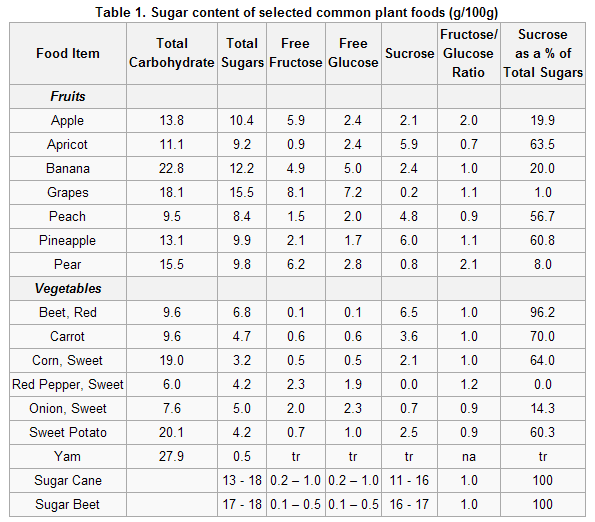
Excessive dietary fructose has been shown to cause an unhealthy elevation in serum triglycerides. This and other related factors are hypothesized to have a causative effect on the onset of the metabolic syndrome. Since fructose is found in fruits (see table below, from Wikipedia; click to enlarge), there has been some concern that eating fruit may cause the metabolic syndrome.


Vegetables also have fructose. Sweet onions, for example, have more free fructose than peaches, on a gram-adjusted basis. Sweet potatoes have more sucrose than grapes (but much less overall sugar), and sucrose is a disaccharide derived from glucose and fructose. Sucrose is broken down to fructose and glucose in the human digestive tract.

Dr. Robert Lustig has given a presentation indicting fructose as the main cause of the metabolic syndrome, obesity, and related diseases. Yet, even he pointed out that the fructose in fruits is pretty harmless. This is backed up by empirical research.

The problem is over-consumption of fructose in sodas, juices, table sugar, and other industrial foods with added sugar. Table sugar is a concentrated form of sucrose. In these foods the fructose content is unnaturally high; and it comes in an easily digestible form, without any fiber or health-promoting micronutrients (vitamins and minerals).

Dr. Lustig’s presentation is available from this post by Alan Aragon. At the time of this writing, there were over 450 comments in response to Aragon’s post. If you read the comments you will notice that they are somewhat argumentative, as if Lustig and Aragon were in deep disagreement with one other. The reality is that they agree on a number of issues, including that the fructose found in fruits is generally healthy.

Fruits are among the very few natural plant foods that have been evolved to be eaten by animals, to facilitate the dispersion of the plants’ seeds. Generally and metaphorically speaking, plants do not “want” animals to eat their leaves, seeds, or roots. But they “want” animals to eat their fruits. They do not “want” one single animal to eat all of their fruits, which would compromise seed dispersion and is probably why fruits are not as addictive as doughnuts.

From an evolutionary standpoint, the idea that fruits can be unhealthy is somewhat counterintuitive. Given that fruits are made to be eaten, and that dead animals do not eat, it is reasonable to expect that fruits must be good for something in animals, at least in one important health-related process. If yes, what is it?

Well, it turns out that fructose, combined with glucose, is a better fuel for glycogen replenishment than glucose alone; in the liver and possibly in muscle, at least according to a study by Parniak and Kalant (1988). A downside of this study is that it was conduced with isolated rat liver tissue; this is a downside in terms of the findings’ generalization to humans, but helped the researchers unveil some interesting effects. The full reference and a link to the full-text version are at the end of this post.

The Parniak and Kalant (1988) study also suggests that glycogen synthesis based on fructose takes precedence over triglyceride formation. Glycogen synthesis occurs when glycogen reserves are depleted. The liver of an adult human stores about 100 g of glycogen, and muscles store about 500 g. An intense 30-minute weight training session may use up about 63 g of glycogen, not much but enough to cause some of the responses associated with glycogen depletion, such as an acute increase in adrenaline and growth hormone secretion.

Liver glycogen is replenished in a few hours. Muscle glycogen takes days. Glycogen synthesis is discussed at some length in this excellent book by Jack H. Wilmore, David L. Costill, and W. Larry Kenney. That discussion generally assumes no blood sugar metabolism impairment (e.g., diabetes), as does this post.

If one’s liver glycogen tank is close to empty, eating a couple of apples will have little to no effect on body fat formation. This will be so even though two apples have close to 30 g of carbohydrates, more than 20 g of which being from sugars. The liver will grab everything for itself, to replenish its 100 g glycogen tank.

In the Parniak and Kalant (1988) study, when glucose and fructose were administered simultaneously, glycogen synthesis based on glucose was increased by more than 200 percent. Glycogen synthesis based on fructose was increased by about 50 percent. In fruits, fructose and glucose come together. Again, this was an in vitro study, with liver cells obtained after glycogen depletion (the rats were fasting).

What leads to glycogen depletion in humans? Exercise does, both aerobic and anaerobic. So does intermittent fasting.

What happens when we consume excessive fructose from sodas, juices, and table sugar? The extra fructose, not used for glycogen replenishment, is converted into fat by the liver. That fat is packaged in the form of triglycerides, which are then quickly secreted by the liver as small VLDL particles. The VLDL particles deliver their content to muscle and body fat tissue, contributing to body fat accumulation. After delivering their cargo, small VLDL particles eventually become small-dense LDL particles; the ones that can potentially cause atherosclerosis.

Reference:

Parniak, M.A. and Kalant, N. (1988). Enhancement of glycogen concentrations in primary cultures of rat hepatocytes exposed to glucose and fructose. Biochemical Journal, 251(3), 795–802.

Sunday, May 30, 2010

Growth hormone may rise 300 percent with exercise: Acute increases also occur in cortisol, adrenaline, and noradrenaline

The figure below (click to enlarge) is from the outstanding book Physiology of sport and exercise, by Jack H. Wilmore, David L. Costill, and W. Larry Kenney. If you are serious about endurance or resistance exercise, or want to have a deeper understanding of exercise physiology beyond what one can get in popular exercise books, this book should be in your personal and/or institutional library. It is one of the most comprehensive textbooks on exercise physiology around. The full reference to the book is at the end of this post.


The hormonal and free fatty acid responses shown on the two graphs are to relatively intense exercise combining aerobic and anaerobic components. Something like competitive cross-country running in an area with hills would lead to that type of response. As you can see, cortisol spikes at the beginning, combining forces with adrenaline and noradrenaline (a.k.a. epinephrine and norepinephrine) to quickly increase circulating free fatty acid levels. Then free fatty acid levels are maintained elevated by adrenaline, noradrenaline, and growth hormone. As you can see from the graphs, free fatty acid levels are initially pulled up by cortisol, and then are very strongly correlated with adrenaline and noradrenaline.  Those free fatty acids feed muscle, and also lead to the production of ketones, which provide extra fuel for muscle tissue.

Growth hormone stays flat for about 40 minutes, after which it goes up steeply. At around the 90-minute mark, it reaches a level that is quite high; 300 percent higher than it was prior to the exercise session. Natural elevation of circulating growth hormone through intense exercise, intermittent fasting, and restful sleep, leads to a number of health benefits. It helps burn abdominal fat, often hours after the exercise session, and helps builds muscle (in conjunction with other hormones, such as testosterone). It appears to increase insulin sensitivity in the long run. Maybe natural elevation of circulating growth hormone is one of the “secrets” of people like Bob Delmonteque, who is probably the fittest octogenarian in the world today.

Aerobic activities normally do not elevate growth hormone levels, even though they are healthy, unless they lead to a significant degree of glycogen depletion. Glycogen is stored in the liver and muscle, with muscle storing about 5 times more than the liver (about 500 g in adults). Once those reserves go down significantly during exercise, it seems that growth hormone is recruited to ramp up fat catabolism and facilitate other metabolic processes. Walking for an hour, even if briskly, is good for fat burning, but generates only a small growth hormone elevation. Including a few all-out sprints into that walk can help significantly increase growth hormone secretion.

Having said that, it is not really clear whether growth hormone elevation is a response to glycogen depletion, or whether both happen together in response to another stimulus or related metabolic process. There are other factors that come into play as well. For example, circulating growth hormone increase is moderated by sex hormone (e.g., testosterone, estrogen) secretion, thus larger growth hormone increases in response to exercise are observed in older men than in older women. (Testosterone declines more slowly with age in men than estrogen does in women.) Also, growth hormone increase seems to be correlated with an increase in circulating ketones.

Heavy resistance exercise seems to lead to a higher growth hormone elevation per unit of time than endurance exercise. That is, an intense resistance training session lasting only 30 minutes can lead to an acute circulating growth hormone response, similar to that shown on the figure. The key seems to be reaching the point during the exercise where muscle glycogen stores are significantly depleted. Many people who weight-train achieve this regularly by combining a reasonable number of sets (e.g., 6-12), with repetitions in the muscle hypertrophy range (again, 6-12); and progressive overload, whereby resistance is increased incrementally every session.

Progressive overload is needed because glycogen reserves are themselves increased in response to training, so one has to increase resistance every session to keep up with those increases. This goes on only up to a point, a point of saturation, usually reached by elite athletes. Glycogen is the primary fuel for anaerobic exercise; fat is used as fuel in the recovery period between sets, and after the exercise is over. Glycogen is expended proportionally to the number of calories used in the anaerobic effort. Calories are expended proportionally to the total amount of weight moved around, and are also a function of the movements performed (moving a certain weight 1 feet spends less energy than moving it 3 feet). By the way, not much glycogen is depleted in a 30-minute session. The total caloric expenditure will probably be around 250 calories above the basal metabolic rate, which will require about 63 g of glycogen.

Many sensations are associated with reaching the glycogen depletion level required for an acute growth hormone response during heavy anaerobic exercise. Often light to severe nausea is experienced. Many people report a “funny” feeling, which is unmistakable to them, but very difficult to describe. In some people the “funny” feeling is followed, after even more exertion, by a progressively strong sensation of “pins and needles”, which, unlike that associated with a heart attack, comes slowly and also goes away slowly with rest. Some people feel lightheaded as well.

It seems that the optimal point is reached immediately before the above sensations become bothersome; perhaps at the onset of the “funny” feeling. My personal impression is that the level at which one experiences the “pins and needles” sensation should be avoided, because that is a point where your body is about to “force” you to stop exercising. (Note: I am not a bodybuilder; see “Interesting links” for more extensive resources on the subject.) Besides, go to that point or beyond and significant muscle catabolism may occur, because the body prioritizes glycogen reserves over muscle protein. It will break that protein down to produce glucose via gluconeogenesis to feed muscle glycogenesis.

That the body prioritizes muscle glycogen reserves over muscle protein is surprising to many, but makes evolutionary sense. In our evolutionary past, there were no selection pressures on humans to win bodybuilding tournaments. For our hominid ancestors, it was more important to have the glycogen tank at least half-full than to have some extra muscle protein. Without glycogen, the violent muscle contractions needed for a “fight or flight” response to an animal attack simply cannot happen. And large predators (e.g., a bear) would not feel intimated by big human muscles alone; it would be the human’s response using those muscles that would result in survival or death.

Overall, selection pressures probably favored functional strength combined with endurance, leading to body types similar to those of the hunter-gatherers shown on this post.

Even though the growth hormone response to exercise can be steep, the highest natural growth hormone spike seems to be the one that occurs at night, during deep sleep.

Exercising hard pays off, but only if one sleeps well.

Reference:

Wilmore, J.H., Costill, D.L., & Kenney, W.L. (2007). Physiology of sport and exercise. Champaign, IL: Human Kinetics.

Sunday, February 28, 2010

Body fat and disease: How much body fat can I lose in one day?

Body fat is not an inert deposit of energy. It can be seen as a distributed endocrine organ. Body fat cells, or adipocytes, secrete a number of different hormones into the bloodstream. Major hormones secreted by adipose tissue are adiponectin and leptin.

Estrogen is also secreted by body fat, which is one of the reasons why obesity is associated with infertility. (Yes, abnormally high levels of estrogen can reduce fertility in both men and women.) Moreover, body fat secretes tumor necrosis factor-alpha, a hormone that is associated with generalized inflammation and a number of diseases, including cancer, when in excess.

The reduction in circulating tumor necrosis factor-alpha and other pro-inflammatory hormones as one loses weight is one reason why non-obese people usually experience fewer illness symptoms than those who are obese in any given year, other things being equal. For example, the non-obese will have fewer illness episodes that require full rest during the flu season. In those who are obese, the inflammatory response accompanying an illness (which is necessary for recovery) will often be exaggerated.

The exaggerated inflammatory response to illness often seen in the obese is one indication that obesity in an unnatural state for humans. It is reasonable to assume that it was non-adaptive for our Paleolithic ancestors to be unable to perform daily activities because of an illness. The adaptive response would be physical discomfort, but not to the extent that one would require full rest for a few days to fully recover.

Inflammation markers such as C-reactive protein are positively correlated with body fat. As body fat increases, so does inflammation throughout the body. Lipid metabolism is negatively affected by excessive body fat, and so is glucose metabolism. Obesity is associated with leptin and insulin resistance, which are precursors of diabetes type 2.

Some body fat is necessary for survival; that is normally called essential body fat. The table below (from Wikipedia) shows various levels of body fat, including essential levels. Also shown are body fat levels found in athletes, as well as fit, “not so fit” (indicated as "Acceptable"), and obese individuals. Women normally have higher healthy levels of body fat than men.


If one is obese, losing body fat becomes a very high priority for health reasons.

There are many ways in which body fat can be measured.

When one loses body fat through fasting, the number of adipocytes is not actually reduced. It is the amount of fat stored in adipocytes that is reduced.

How much body fat can a person lose in one day?

Let us consider a man, John, whose weight is 170 lbs (77 kg), and whose body fat percentage is 30 percent. John carries around 51 lbs (23 kg) of body fat. Standing up is, for John, a form of resistance exercise. So is climbing stairs.

During a 24-hour fast, John’s basal metabolic rate is estimated at about 2,550 kcal/day. This is the number of calories John would spend doing nothing the whole day. It can vary a lot for different individuals; here it is calculated as 15 times John’s weight in lbs.

The 2,550 kcal/day is likely an overestimation for John, because the body adjusts its metabolic rate downwards during a fast, leading to fewer calories being burned.

Typically women have lower basal metabolic rates than men of equal weight.

For the sake of discussion, we expect each gram of John’s body fat to contribute about 8 kcals of energy, assuming a rate of conversion of body fat to calories of about 90 percent.

Thus during a 24-hour fast John burns about 318 g of fat, or about 0.7 lbs. In reality, the actual amount may be lower (e.g., 0.35 lbs), because of the body's own down-regulation of its basal metabolic rate during a fast. This down-regulation varies widely across different individuals, and is generally small.

Many people think that this is not much for the effort. The reality is that body fat loss is a long term game, and cannot be achieved through fasting alone; this is a discussion for another post.

It is worth noting that intermittent fasting (e.g., one 24-hour fast per week) has many other health benefits, even if no overall calorie restriction occurs. That is, intermittent fasting is associated with health benefits even if one fasts every other day, and eats twice one's normal intake on the non-fasting days.

Some of the calories being burned during John's 24-hour fast will be from glucose, mostly from John’s glycogen reserves in the liver if he is at rest. Muscle glycogen stores, which store more glucose substrate (i.e., material for production of glucose) than liver glycogen, are mobilized primarily through anaerobic exercise.

Very few muscle-derived calories end up being used through the protein and glycogen breakdown pathways in a 24-hour fast. John’s liver glycogen reserves, plus the body’s own self-regulation, will largely spare muscle tissue.

The idea that one has to eat every few hours to avoid losing muscle tissue is complete nonsense. Muscle buildup and loss happen all the time through amino acid turnover.

Net muscle gain occurs when the balance is tipped in favor of buildup, to which resistance exercise and the right hormonal balance (including elevated levels of insulin) contribute.

One of the best ways to lose muscle tissue is lack of use. If John's arm were immobilized in a cast, he would lose muscle tissue in that arm even if he ate every 30 minutes.

Longer fasts (e.g., lasting multiple days, with only water being consumed) will invariably lead to some (possibly significant) muscle breakdown, as muscle is the main store of glucose-generating substrate in the human body.

In a 24-hour fast (a relatively short fast), the body will adjust its metabolism so that most of its energy needs are met by fat and related byproducts. This includes ketones, which are produced by the liver based on dietary and body fat.

How come some people can easily lose 2 or 3 pounds of weight in one day?

Well, it is not body fat that is being lost, or muscle. It is water, which may account for as much as 75 percent of one’s body weight.

References:

Elliott, W.H., & Elliott, D.C. (2009). Biochemistry and molecular biology. New York: NY: Oxford University Press.

Fleck, S.J., & Kraemer, W.J. (2004). Designing resistance training programs. Champaign, IL: Human Kinetics.

Large, V., Peroni, O., Letexier, D., Ray, H., & Beylot, M. (2004). Metabolism of lipids in human white adipocyte. Diabetes & Metabolism, 30(4), 294-309.