Showing posts with label obesity. Show all posts

Monday, February 20, 2012

The “pork paradox”? National pork consumption and obesity

In my previous post () I discussed some country data linking pork consumption and health, analyzed with WarpPLS (). One of the datasets used, the most complete, contained data from Nationmaster.com () for the following countries: Australia, Brazil, Canada, China, Denmark, France, Germany, Hong Kong, Hungary, Japan, Mexico, Poland, Russia, Singapore, Spain, Sweden, United Kingdom, and United States. That previous post also addressed a study by Bridges (), based on country-level data, suggesting that pork consumption may cause liver disease.

In this post we continue that analysis, but with a much more complex model containing the following country variables: wealth (PPP-adjusted GNP/person), pork consumption (lbs/person/year), alcohol consumption (liters/person/year), obesity (% of population), and life expectancy (years). The model and results, generated by WarpPLS, are shown on the figure below. (See notes at the end of this post.) These results are only for direct effects.


WarpPLS also calculates total effects, which are the effects of each variable on any other variable to which it is linked directly and/or indirectly. Two variables may be linked indirectly, through various paths, even if they are not linked directly (i.e., have an arrow directly connecting them). Another set of outputs generated by the software are effect sizes, which are calculated as Cohen’s f-squared coefficients. The figure below shows the total effects table. The values underlined in red are for total effects that are both statistically significant and also above the effect size threshold recommended by Cohen to be considered relevant (f-squared > 0.02).


As I predicted in my previous post, wealth is positively associated with pork consumption. So is alcohol consumption, and more strongly than wealth; which is consistent with a study by Jeanneret and colleagues showing a strong association between alcohol consumption and protein rich diets (). The inclusion of wealth in the model, compared with the model without wealth in the previous post, renders the direct and total effects of alcohol and pork consumption on life expectancy statistically indistinguishable from zero. (This often happens when a confounder is added to a model.)

Pork consumption is negatively associated with obesity, which is interesting. So is alcohol consumption, but much less strongly than pork consumption. This does not mean that if you eat 20 doughnuts every day, together with 1 lb of pork, you are not going to become obese. What this does suggest is that maybe countries where pork is consumed more heavily are somewhat more resistant to obesity. Here it should be noted that pork is very popular in Asian countries, which are becoming increasingly wealthy, but without the widespread obesity that we see in the USA.

But it is not the inclusion of Asian countries in the dataset that paints such a positive picture for pork consumption vis-à-vis obesity, and even weakens the association between wealth and obesity so much as to make it statistically non-significant. Denmark is a wealthy country that has very low levels of obesity. And it happens to have the highest level of pork consumption in the whole dataset: 142.6 lbs/person/year. So we are not talking about an “Asian paradox” here.

More like a “pork paradox”.

Finally, as far as life expectancy is concerned, the key factors seem to be wealth and obesity. Wealth has a major positive effect on life expectancy, while obesity has a much weaker negative effect. Well, access to sanitation, medical services, and other amenities of civilization, still trumps obesity in terms of prolonging life; however miserable life may turn out to be. The competing effects of these two variables (i.e., wealth and obesity) were taken into consideration, or controlled for, in the calculation of total effects and effect sizes.

The fact that pork consumption is negatively associated with obesity goes somewhat against the idea that pork is inherently unhealthy; even though pork certainly can cause disease if not properly prepared and/or cooked, which is true for many other plant and animal foods. The possible connection with liver problems, alluded to in the previous post, is particularly suspicious in light of these results. Liver diseases often impair that organ’s ability to make glycogen based on carbohydrates and protein; that is, liver diseases frequently lead to liver insulin resistance. And obesity frequently follows from liver insulin resistance.

Given that pork consumption appears to be negatively associated with obesity, it would be surprising if it was causing widespread liver disease, unless its relationship with liver disease was found to be nonlinear. (Alcohol consumption seems to be nonlinearly associated with liver disease.) Still, most studies that suggest the existence of a causal link between pork consumption and liver disease, like Bridges’s (), hint at a linear and dose-dependent relationship.

Notes

- Country-level data is inherently problematic, particularly when simple models are used (e.g., a model with only two variables). There are just too many possible confounders that may lead to the appearance of causal associations.

- More complex models ameliorate the above situation somewhat, but bump into another problem associated with country-level data – small sample sizes. We used data from 18 countries in this analysis, which is more than in the Bridges study. Still, the effective sample size here (N=18) is awfully small.

- There were some missing values in this dataset, which were handled by WarpPLS employing the most widely used approach in these cases – i.e., by replacing the missing values with the mean of each column. The percentages of missing values per variable (i.e., column) were: alcohol consumption: 27.78%; life expectancy: 5.56%; and obesity: 33.33%.

Monday, February 13, 2012

Does pork consumption cause cirrhosis? Perhaps, if people become obese from eating pork

The idea that pork consumption may cause cirrhosis has been around for a while. A fairly widely cited 1985 study by Nanji and French () provides one of the strongest indictments of pork: “In countries with low alcohol consumption, no correlation was obtained between alcohol consumption and cirrhosis. However, a significant correlation was obtained between cirrhosis and pork.”

Recently Paul Jaminet wrote a blog post on the possible link between pork consumption and cirrhosis (). Paul should be commended for bringing this topic to the fore, as the implications are far-reaching and very serious. One of the key studies mentioned in Paul’s post is a 2009 article by Bridges (), from which the graphs below were taken.


The graphs above show a correlation between cirrhosis and alcohol consumption of 0.71, and a correlation between cirrhosis and pork consumption of 0.83. That is, the correlation between cirrhosis and pork consumption is the stronger of the two! Combining this with the Nanji and French study, we have evidence that: (a) in countries with low alcohol consumption we can find a significant correlation between cirrhosis and pork consumption; and (b) in countries where both alcohol and pork are consumed, pork consumption has the strongest correlation with cirrhosis.

Do we need anything else to ban pork from our diets? Yes, we do, as there is more to this story.

Clearly alcohol and pork consumption are correlated as well, as we can see from the graphs above. That is, countries where alcohol is consumed more heavily also tend to have higher levels of pork consumption. If alcohol and pork consumption are correlated, then a multivariate analysis of their effects should be conducted, as one of the hypothesized effects (of alcohol or pork) on cirrhosis may even disappear after controlling for the other effect.

I created a dataset, as best as I could, based on the graphs from the Bridges article. (I could not get the data online.) I then entered it into WarpPLS (). I wanted to run a moderating effect analysis, which is a form of nonlinear multivariate analysis. This is important, because the association between alcohol consumption and disease in general is well known to be nonlinear.

In fact, the relationship between alcohol consumption and disease is often used as a classic example of hormesis (), and its characteristic J-curve shape. Since correlation is a measure of linear association, the lower correlation between alcohol consumption and cirrhosis, when compared with pork consumption, may be just a “mirage of linearity”. In multivariate analyses, this mirage of linearity may lead to what are known as type I and II errors, at the same time ().

I should note that the Bridges study did something akin to a moderating effect analysis; through an analysis of the interaction between alcohol and pork consumption. However, in that analysis the values of the variables that were multiplied to create a “dummy” interaction variable were on their original scales, which can be a major source of bias. A more advisable way to conduct an interaction effect analysis is to first make the variables dimensionless, by standardizing them, and then creating a dummy interaction variable as a product of the two variables. That is what WarpPLS does for moderating effects’ estimation.

One more detour, leading to an important implication, and then we will get to the results. In a 1988 article, Jeanneret and colleagues show evidence of a strong and possibly causal association between alcohol consumption and protein-rich diets (). One possible implication of this is that in countries where pork is a dietary staple, like Denmark and Germany, alcohol consumption should be strongly and causally associated with pork consumption. (I guess Anthony Bordain would agree with this eh?)

Below are the results of a multivariate analysis on a model that incorporates the above implication, by including a link between alcohol and pork consumption. The model also explores the role of pork consumption as a moderator of the relationship between alcohol and cirrhosis, as well as the direct effect of pork consumption on cirrhosis. Finally, the total effects of alcohol and pork consumption on cirrhosis are also investigated; they are shown on the left.


The total effects are both statistically significant, with the total effect of alcohol consumption being 94 percent stronger than the total effect of pork consumption on cirrhosis. Looking at the model, alcohol consumption is strongly associated with pork consumption (which is consistent with Jeanneret and colleagues’s study). Alcohol consumption is also strongly associated with cirrhosis, through a direct effect; much more so than pork. Finally, pork consumption seems to strengthen the relationship between alcohol consumption and cirrhosis (the moderating effect).

As we can see the relationship between pork consumption and cirrhosis is still there, in moderating and direct effects, even though it seems to be a lot weaker than that between alcohol consumption and cirrhosis. Why does pork seem to influence cirrhosis at all in this dataset?

Well, there is another factor that is strongly associated with cirrhosis, and that is obesity (). In fact, obesity is associated with just about any major disease, including various types of cancer ().

And in countries where pork is a dietary staple, isn’t it reasonable to assume that pork consumption will play a role in obesity? Often folks who consume a lot of addictive industrial foods (e.g., bread, candy, regular sodas) also eat plenty of foods with saturated fat; and the latter end up showing up in disease statistics, misleadingly supporting the lipid hypothesis. The phenomenon involving pork and cirrhosis may well be similar.

But you may find the above results and argument not convincing enough. Maybe you want to see some evidence that pork is actually good for one’s health. The results above suggest that it may not be bad at all, if you buy into the obesity angle, but not that it can be good.

So I downloaded the most recent data from Nationmaster.com () on the following variables: pork consumption, alcohol consumption, and life expectancy. The list of countries was a bit larger than and different from that in the Bridges study; the following countries were included: Australia, Brazil, Canada, China, Denmark, France, Germany, Hong Kong, Hungary, Japan, Mexico, Poland, Russia, Singapore, Spain, Sweden, United Kingdom, and United States. Below are the results of a simple multivariate analysis with WarpPLS.


As with the Bridges dataset, there is a strong multivariate association between alcohol and pork consumption (0.43). The multivariate association between alcohol consumption and life expectancy is negative (-0.14). The multivariate association between pork consumption and life expectancy is positive (0.36). Neither association is statistically significant, although the association involving pork consumption gets close to significance with a P=0.11 (a confidence level of 89 percent; calculated through jackknifing, a nonparametric technique). The graphs show the plots for the associations and the best-fitting lines; the blue dashed arrows indicate the multivariate associations to which the graphs refer. So, in this second dataset from Nationmaster.com, the more pork is consumed in a country, the longer is the life expectancy in that country.

In other words, for each 1 standard deviation variation in pork consumption, there is a 0.36 standard deviation variation in life expectancy, after we control for alcohol consumption. The standard deviation for pork consumption is 36.281 lbs/person/year, or 45.087 g/person/day; for life expectancy, it is 4.677 years. Working the numbers a bit more, the results above suggest that each extra gram of pork consumed per person per day is associated with approximately 13 additional days of overall life expectancy in a country! This is calculated as: 4.677/45.087*0.36*365 = 13.630.

Does this prove that eating pork will make you live longer? No single study will “prove” something like that. Pork consumption is also likely a marker for wealth in a country; and wealth is strongly and positively associated with life expectancy at the country level. Moreover, when you aggregate dietary and disease incidence data by country, often the statistical effects are caused by those people in the dietary extremes (e.g., alcohol abuse, not moderate consumption). Finally, if people avoid death from certain diseases, they will die in higher quantities from other diseases, which may bias statistical results toward what may look like a higher incidence of those other diseases.

What the results summarized in this post do suggest is that pork consumption may not be a problem at all, unless you become obese from eating it. How do you get obese from eating pork? Eating it together with industrial foods that are addictive would probably help.

Monday, January 30, 2012

Kleiber's law and its possible implications for obesity

Kleiber's law () is one of those “laws” of nature that is both derived from, and seems to fit quite well with, empirical data. It applies to most animals, including humans. The law is roughly summarized through the equation below, where E = energy expenditure at rest per day, and M = body weight in kilograms.


Because of various assumptions made in the original formulation of the law, the values of E do not translate very well to calories as measured today. What is important is the exponent, and what it means in terms of relative increases in weight. Since the exponent in the equation is 3/4, which is lower than 1, the law essentially states that as body weight increases animals become more efficient from an energy expenditure perspective. For example, the energy expenditure at rest of an elephant, per unit of body weight, is significantly lower than that of a mouse.

The difference in weight does not have to be as large as that between an elephant and a mouse for a clear difference in energy expenditure to be noticed. Moreover, the increase in energy efficiency predicted by the law is independent of what makes up the weight; whether it is more or less lean body mass, for example. And the law is very generic, also applying to different animals of the same species, and even the same animal at different developmental stages.

Extrapolating the law to humans is quite interesting. Let us consider a person weighing 68 kg (about 150 lbs). According to Kleiber's law, and using a constant multiplied to M to make it consistent with current calorie measurement assumptions (see Notes at the end of this post), this person’s energy expenditure at rest per day would be about 1,847 calories.

A person weighing 95 kg (about 210 lbs) would spend 2,374 calories at rest per day according to Kleiber's law. However, if we were to assume a linear increase based on the daily calorie expenditure at a weight of 68 kg, this person weighing 95 kg would spend 2,508 calories per day at rest. The difference of approximately 206 calories per day is a reflection of Kleiber's law.

This difference of 206 calories per day would translate into about 23 g of extra body fat being stored per day. Per month this would be about 688 g, a little more than 1.5 lbs. Not a negligible amount. So, as you become obese, your body becomes even more efficient on a weight-adjusted basis, from an energy expenditure perspective.

One more roadblock to go from obese to lean.

Now, here is the interesting part. It is unreasonable to assume that the extra mass itself has a significantly lower metabolic rate, with this fully accounting for the relative increase in efficiency. It makes more sense to think that the extra mass leads to systemic adaptations, which in turn lead to whole-body economies of scale (). In existing bodies, these adaptations should happen over time, as long-term compensatory adaptations ().

The implications are fascinating. One implication is that, if the compensatory adaptations that lead to a lower metabolic rate are long term, they should also take some time to undo. This is what some call having a “broken metabolism”; which may turn out not to be “broken”, but having some inertia to overcome before it comes back to a former state. Thus, lower metabolic rates should generally be observed in the formerly obese, with reductions compatible with Kleiber's law. Those reductions themselves should be positively correlated with the ratio of time spent in the obese and lean states.

Someone who was obese at 95 kg should have a metabolic rate approximately 5.6 percent lower than a never obese person, soon after reaching a weight of 68 kg (5.6 percent = [2,508 – 2,374] / 2,374). If the compensatory adaptation can be reversed, as I believe it can, we should see slightly lower percentage reductions in studies including formerly obese participants who had been lean for a while. This expectation is consistent with empirical evidence. For example, a study by Astrup and colleagues () concluded that: “Formerly obese subjects had a 3–5% lower mean relative RMR than control subjects”.

Another implication, which is related to the one above, is that someone who becomes obese and goes right back to lean should not see that kind of inertia. That is, that person should go right back to his or her lean resting metabolic rate. Perhaps Drew Manning’s Fit-2-Fat-2-Fit experiment () will shed some light on this possible implication.

A person becoming obese and going right back to lean is not a very common occurrence. Sometimes this is done on purpose, for professional reasons, such as before and after photos for diet products. Believed it or not, there is a market for this!

Notes

- Calorie expenditure estimation varies a lot depending on the equation used. The multiplier used here was 78,  based on Cunningham’s equation, and assuming 10 percent body fat. The calorie expenditure for the same 68 kg person using Katch-McArdle’s equation, also assuming 10 percent body fat, would be about 1,692 calories. That would lead to a different multiplier.

- The really important thing to keep in mind, for the purposes of the discussion presented here, is the relative decrease in energy expenditure at rest, per unit of weight, as weight goes up. So we stuck with the 78 multiplier for illustration purposes.

- There is a lot of variation across individuals in energy expenditure at rest due to other factors such as nonexercise activity thermogenesis ().

Monday, August 29, 2011

Men who are skinny-fat: There are quite a few of them

The graph below (from Wikipedia) plots body fat percentage (BF) against body mass index (BMI) for men. The data is a bit old: 1994. The top-left quadrant refers to men with BF greater than 25 percent and BMI lower than 25. A man with a BF greater than 25 has crossed into obese territory, even though a BMI lower than 25 would suggest that he is not even overweight. These folks are what we could call skinny-fat men.


The data is from the National Health and Nutrition Examination Survey (NHANES), so it is from the USA only. Interesting that even though this data is from 1994, we already could find quite a few men with more than 25 percent BF and a BMI of around 20. One example of this would be a man who is 5’11’’, weighing 145 lbs, and who would be technically obese!

About 8 percent of the entire sample of men used as a basis for the plot fell into the area defined by the top-left quadrant – the skinny-fat men. (That quadrant is one in which the BMI measure is quite deceiving; another is the bottom-right quadrant.) Most of us would be tempted to conclude that all of these men were sick or on the path to becoming so. But we do not know this for sure. On the standard American diet, I think it is a reasonably good guess that these skinny-fat men would not fare very well.

What is most interesting for me regarding this data, which definitely has some measurement error built in (e.g., zero BF), is that it suggests that the percentage of skinny-fat men in the general population is surprisingly high. (And this seems to be the case for women as well.) Almost too high to characterize being skinny-fat as a disease per se, much less a genetic disease. Genetic diseases tend to be rarer.

In populations under significant natural selection pressure, which does not include modern humans living in developed countries, genetic diseases tend to be wiped out by evolution. (The unfortunate reality is that modern medicine helps these diseases spread, although quite slowly.)  Moreover, the prevalence of diabetes in the population was not as high as 8 percent in 1994, and is not that high today either; although it tends to be concentrated in some areas and cluster with obesity as defined based on both BF and BMI.

And again, who knows, maybe these folks (the skinny-fat men) were not even the least healthy in the whole sample, as one may be tempted to conclude.

Maybe being skinny-fat is a trait, passed on across generations, not a disease. Maybe such a trait was useful at some point in the not so distant past to some of our ancestors, but leads to degenerative diseases in the context of a typical Western diet. Long-living Asians with low BMI tend to gravitate more toward the skinny-fat quadrant than many of their non-Asian counterparts. That is, long-living Asians generally tend have higher BF percentage at the same BMI (see a discussion about the Okinawans on this post).

Evolution is a deceptively simple process, which can lead to very odd results.

This “trait-not-disease” idea may sound like semantics, but it has major implications. It would mean that many of the folks who are currently seen as diseased or disease-prone, are in fact simply “different”. At a point in time in our past, under a unique set of circumstances, they might have been the ones who would have survived. The ones who would have been perceived as healthier than average.

Monday, April 4, 2011

The China Study II: Carbohydrates, fat, calories, insulin, and obesity

The “great blogosphere debate” rages on regarding the effects of carbohydrates and insulin on health. A lot of action has been happening recently on Peter’s blog, with knowledgeable folks chiming in, such as Peter himself, Dr. Harris, Dr. B.G. (my sista from anotha mista), John, Nigel, CarbSane, Gunther G., Ed, and many others.

I like to see open debate among people who hold different views consistently, are willing to back them up with at least some evidence, and keep on challenging each other’s views. It is very unlikely that any one person holds the whole truth regarding health matters. Unfortunately this type of debate also confuses a lot of people, particularly those blog lurkers who want to get all of their health information from one single source.

Part of that “great blogosphere debate” debate hinges on the effect of low or high carbohydrate dieting on total calorie consumption. Well, let us see what the China Study II data can tell us about that, and about a few other things.

WarpPLS was used to do the analyses below. For other China Study analyses, many using WarpPLS as well as HealthCorrelator for Excel, click here. For the dataset used here, visit the HealthCorrelator for Excel site and check under the sample datasets area.

The two graphs below show the relationships between various foods, carbohydrates as a percentage of total calories, and total calorie consumption. A basic linear analysis was employed here. As carbohydrates as a percentage of total calories go up, the diet generally becomes a high carbohydrate diet. As it goes down, we see a move to the low carbohydrate end of the scale.


The left parts of the two graphs above are very similar. They tell us that wheat flour consumption is very strongly and negatively associated with rice consumption; i.e., wheat flour displaces rice. They tell us that fruit consumption is positively associated with rice consumption. They also tell us that high wheat flour consumption is strongly and positively associated with being on a high carbohydrate diet.

Neither rice nor fruit consumption has a statistically significant influence on whether the diet is high or low in carbohydrates, with rice having some effect and fruit practically none. But wheat flour consumption does. Increases in wheat flour consumption lead to a clear move toward the high carbohydrate diet end of the scale.

People may find the above results odd, but they should realize that white glutinous rice is only 20 percent carbohydrate, whereas wheat flour products are usually 50 percent carbohydrate or more. Someone consuming 400 g of white rice per day, and no other carbohydrates, will be consuming only 80 g of carbohydrates per day. Someone consuming 400 g of wheat flour products will be consuming 200 g of carbohydrates per day or more.

Fruits generally have much less carbohydrate than white rice, even very sweet fruits. For example, an apple is about 12 percent carbohydrate.

There is a measure that reflects the above differences somewhat. That measure is the glycemic load of a food; not to be confused with the glycemic index.

The right parts of the graphs above tell us something else. They tell us that the percentage of carbohydrates in one’s diet is strongly associated with total calorie consumption, and that this is not the case with percentage of fat in one’s diet.

Given the above, one may be interested in looking at the contribution of individual foods to total calorie consumption. The graph below focuses on that. The results take nonlinearity into consideration; they were generated using the Warp3 algorithm option of WarpPLS.


As you can see, wheat flour consumption is more strongly associated with total calories than rice; both associations being positive. Animal food consumption is negatively associated, somewhat weakly but statistically significantly, with total calories. Let me repeat for emphasis: negatively associated. This means that, as animal food consumption goes up, total calories consumed go down.

These results may seem paradoxical, but keep in mind that animal foods displace wheat flour in this dataset. Note that I am not saying that wheat flour consumption is a confounder; it is controlled for in the model above.

What does this all mean?

Increases in both wheat flour and rice consumption lead to increases in total caloric intake in this dataset. Wheat has a stronger effect. One plausible mechanism for this is abnormally high blood glucose elevations promoting abnormally high insulin responses. Refined carbohydrate-rich foods are particularly good at raising blood glucose fast and keeping it elevated, because they usually contain a lot of easily digestible carbohydrates. The amounts here are significantly higher than anything our body is “designed” to handle.

In normoglycemic folks, that could lead to a “lite” version of reactive hypoglycemia, leading to hunger again after a few hours following food consumption. Insulin drives calories, as fat, into adipocytes. It also keeps those calories there. If insulin is abnormally elevated for longer than it should be, one becomes hungry while storing fat; the fat that should have been released to meet the energy needs of the body. Over time, more calories are consumed; and they add up.

The above interpretation is consistent with the result that the percentage of fat in one’s diet has a statistically non-significant effect on total calorie consumption. That association, although non-significant, is negative. Again, this looks paradoxical, but in this sample animal fat displaces wheat flour.

Moreover, fat leads to no insulin response. If it comes from animals foods, fat is satiating not only because so much in our body is made of fat and/or requires fat to run properly; but also because animal fat contains micronutrients, and helps with the absorption of those micronutrients.

Fats from oils, even the healthy ones like coconut oil, just do not have the latter properties to the same extent as unprocessed fats from animal foods. Think slow-cooking meat with some water, making it release its fat, and then consuming all that fat as a sauce together with the meat.

In the absence of industrialized foods, typically we feel hungry for those foods that contain nutrients that our body needs at a particular point in time. This is a subconscious mechanism, which I believe relies in part on past experience; the reason why we have “acquired tastes”.

Incidentally, fructose leads to no insulin response either. Fructose is naturally found mostly in fruits, in relatively small amounts when compared with industrial foods rich in refined sugars.

And no, the pancreas does not get “tired” from secreting insulin.

The more refined a carbohydrate-rich food is, the more carbohydrates it tends to pack per unit of weight. Carbohydrates also contribute calories; about 4 calories per g. Thus more carbohydrates should translate into more calories.

If someone consumes 50 g of carbohydrates per day in excess of caloric needs, that will translate into about 22.2 g of body fat being stored. Over a month, that will be approximately 666.7 g. Over a year, that will be 8 kg, or 17.6 lbs. Over 5 years, that will be 40 kg, or 88 lbs. This is only from carbohydrates; it does not consider other macronutrients.

There is no need to resort to the “tired pancreas” theory of late-onset insulin resistance to explain obesity in this context. Insulin resistance is, more often than not, a direct result of obesity. Type 2 diabetes is by far the most common type of diabetes; and most type 2 diabetics become obese or overweight before they become diabetic. There is clearly a genetic effect here as well, which seems to moderate the relationship between body fat gain and liver as well as pancreas dysfunction.

It is not that hard to become obese consuming refined carbohydrate-rich foods. It seems to be much harder to become obese consuming animal foods, or fruits.

Tuesday, October 5, 2010

The China Study II: Does calorie restriction increase longevity?

The idea that calorie restriction extends human life comes largely from studies of other species. The most relevant of those studies have been conducted with primates, where it has been shown that primates that eat a restricted calorie diet live longer and healthier lives than those that are allowed to eat as much as they want.

There are two main problems with many of the animal studies of calorie restriction. One is that, as natural lifespan decreases, it becomes progressively easier to experimentally obtain major relative lifespan extensions. (That is, it seems much easier to double the lifespan of an organism whose natural lifespan is one day than an organism whose natural lifespan is 80 years.) The second, and main problem in my mind, is that the studies often compare obese with lean animals.

Obesity clearly reduces lifespan in humans, but that is a different claim than the one that calorie restriction increases lifespan. It has often been claimed that Asian countries and regions where calorie intake is reduced display increased lifespan. And this may well be true, but the question remains as to whether this is due to calorie restriction increasing lifespan, or because the rates of obesity are much lower in countries and regions where calorie intake is reduced.

So, what can the China Study II data tell us about the hypothesis that calorie restriction increases longevity?

As it turns out, we can conduct a preliminary test of this hypothesis based on a key assumption. Let us say we compared two populations (e.g., counties in China), based on the following ratio: number of deaths at or after age 70 divided by number deaths before age 70. Let us call this the “ratio of longevity” of a population, or RLONGEV. The assumption is that the population with the highest RLONGEV would be the population with the highest longevity of the two. The reason is that, as longevity goes up, one would expect to see a shift in death patterns, with progressively more people dying old and fewer people dying young.

The 1989 China Study II dataset has two variables that we can use to estimate RLONGEV. They are coded as M005 and M006, and refer to the mortality rates from 35 to 69 and 70 to 79 years of age, respectively. Unfortunately there is no variable for mortality after 79 years of age, which limits the scope of our results somewhat. (This does not totally invalidate the results because we are using a ratio as our measure of longevity, not the absolute number of deaths from 70 to 79 years of age.) Take a look at these two previous China Study II posts (here, and here) for other notes, most of which apply here as well. The notes are at the end of the posts.

All of the results reported here are from analyses conducted using WarpPLS. Below is a model with coefficients of association; it is a simple model, since the hypothesis that we are testing is also simple. (Click on it to enlarge. Use the "CRTL" and "+" keys to zoom in, and CRTL" and "-" to zoom out.) The arrows explore associations between variables, which are shown within ovals. The meaning of each variable is the following: TKCAL = total calorie intake per day; RLONGEV = ratio of longevity; SexM1F2 = sex, with 1 assigned to males and 2 to females.


As one would expect, being female is associated with increased longevity, but the association is just shy of being statistically significant in this dataset (beta=0.14; P=0.07). The association between total calorie intake and longevity is trivial, and statistically indistinguishable from zero (beta=-0.04; P=0.39). Moreover, even though this very weak association is overall negative (or inverse), the sign of the association here does not fully reflect the shape of the association. The shape is that of an inverted J-curve; a.k.a. U-curve. When we split the data into total calorie intake terciles we get a better picture:


The second tercile, which refers to a total daily calorie intake of 2193 to 2844 calories, is the one associated with the highest longevity. The first tercile (with the lowest range of calories) is associated with a higher longevity than the third tercile (with the highest range of calories). These results need to be viewed in context. The average weight in this dataset was about 116 lbs. A conservative estimate of the number of calories needed to maintain this weight without any physical activity would be about 1740. Add about 700 calories to that, for a reasonable and healthy level of physical activity, and you get 2440 calories needed daily for weight maintenance. That is right in the middle of the second tercile.

In simple terms, the China Study II data seems to suggest that those who eat well, but not too much, live the longest. Those who eat little have slightly lower longevity. Those who eat too much seem to have the lowest longevity, perhaps because of the negative effects of excessive body fat.

Because these trends are all very weak from a statistical standpoint, we have to take them with caution. What we can say with more confidence is that the China Study II data does not seem to support the hypothesis that calorie restriction increases longevity.

Reference

Kock, N. (2010). WarpPLS 1.0 User Manual. Laredo, Texas: ScriptWarp Systems.

Notes

- The path coefficients (indicated as beta coefficients) reflect the strength of the relationships; they are a bit like standard univariate (or Pearson) correlation coefficients, except that they take into consideration multivariate relationships (they control for competing effects on each variable). Whenever nonlinear relationships were modeled, the path coefficients were automatically corrected by the software to account for nonlinearity.

- Only two data points per county were used (for males and females). This increased the sample size of the dataset without artificially reducing variance, which is desirable since the dataset is relatively small (each county, not individual, is a separate data point is this dataset). This also allowed for the test of commonsense assumptions (e.g., the protective effects of being female), which is always a good idea in a multivariate analyses because violation of commonsense assumptions may suggest data collection or analysis error. On the other hand, it required the inclusion of a sex variable as a control variable in the analysis, which is no big deal.

- Mortality from schistosomiasis infection (MSCHIST) does not confound the results presented here. Only counties where no deaths from schistosomiasis infection were reported have been included in this analysis. The reason for this is that mortality from schistosomiasis infection can severely distort the results in the age ranges considered here. On the other hand, removal of counties with deaths from schistosomiasis infection reduced the sample size, and thus decreased the statistical power of the analysis.

Tuesday, September 28, 2010

Income, obesity, and heart disease in US states

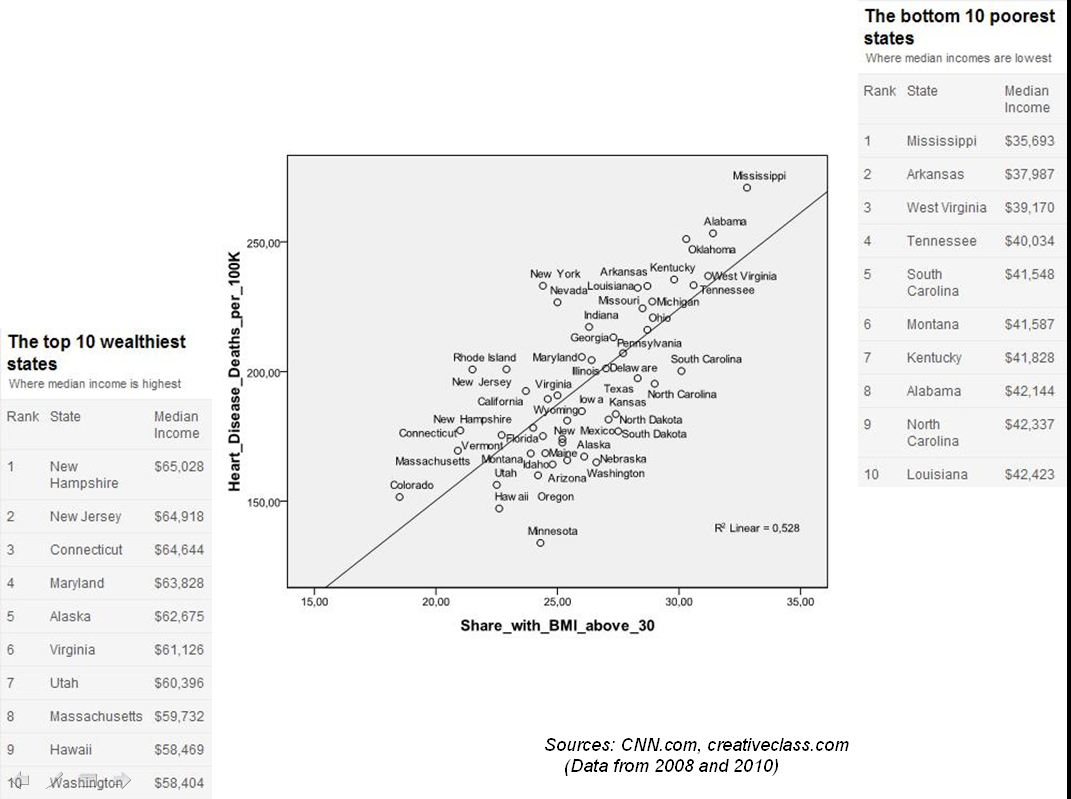
The figure below combines data on median income by state (bottom-left and top-right), as well as a plot of heart disease death rates against percentage of population with body mass index (BMI) greater than 30 percent. The data are recent, and have been provided by CNN.com and creativeclass.com, respectively.


Heart disease deaths and obesity are strongly associated with each other, and both are inversely associated with median income. US states with lower median income tend to have generally higher rates of obesity and heart disease deaths.

The reasons are probably many, complex, and closely interconnected. Low income is usually associated with high rates of stress, depression, smoking, alcoholism, and poor nutrition. Compounding the problem, these are normally associated with consumption of cheap, addictive, highly refined foods.

Interestingly, this is primarily an urban phenomenon. If you were to use hunter-gatherers as your data sources, you would probably see the opposite relationship. For example, non-westernized hunter-gatherers have no income (at least not in the “normal” sense), but typically have a lower incidence of obesity and heart disease than mildly westernized ones. The latter have some income.

Tragically, the first few generations of fully westernized hunter-gatherers usually find themselves in the worst possible spot.

Wednesday, August 4, 2010

The baffling rise in seasonal allergies: Global warming or obesity?

The July 26, 2010 issue of Fortune has an interesting set of graphs on page 14. It shows the rise of allergies in the USA, together with figures on lost productivity, doctor visits, and medical expenditures. (What would you expect? This is Fortune, and money matters.) It also shows some cool maps with allergen concentrations, and how they are likely to increase with global warming. (See below; click on it to enlarge; use the "CRTL" and "+" keys to zoom in, and CRTL" and "-" to zoom out.)


The implication: A rise in global temperatures is causing an increase in allergy cases. Supposedly the spring season starts earlier, with more pollen being produced overall, and thus more allergy cases.

Really!?

I checked their numbers against population growth, because as the population of a country increases, so will the absolute number of allergy cases (as well as cancer cases, and cases of almost any disease). What is important is whether there has been an increase in allergy rates, or the percentage of the population suffering from allergies. Well, indeed, allergy rates have been increasing.

Now, I don’t know about your neck of the woods, but temperatures have been unusually low this year in South Texas. Global warming may be happening, but given recent fluctuations in temperature, I am not sure global warming explains the increases in allergy rates. Particularly the spike in allergy rates in 2010; this seems to be very unlikely to be caused by global warming.

And I have my own experience of going from looking like a seal to looking more like a human being. When I was a seal (i.e., looked like one), I used to have horrible seasonal pollen allergies. Then I lost 60 lbs, and my allergies diminished dramatically. Why? Body fat secretes a number of pro-inflammatory hormones (see, e.g., this post, and also this one), and allergies are essentially exaggerated inflammatory responses.

So I added obesity rates to the mix, and came up with the table and graph below (click on it to enlarge).


Obesity rates and allergies do seem to go hand in hand, don’t you think? The correlation between obesity and allergy rates is a high 0.87!

Assuming that this correlation reflects reasonably well the relationship between obesity and allergy rates (something that is not entirely clear given the small sample), obesity would still explain only 75.7 percent of the variance in allergy rates (this number is the correlation squared). That is, about 24.3 percent of the variance in allergy rates would be due to other missing factors.

A strong candidate for missing factor is something that makes people obese in the first place, namely consumption of foods rich in refined grains, seeds, and sugars. Again, in my experience, removing these foods from my diet reduced the intensity of allergic reactions, but not as much as losing a significant amount of body fat. We are talking about things like cereals, white bread, doughnuts, pasta, pancakes covered with syrup, regular sodas, and fruit juices. Why? These foods also seem to increase serum concentrations of pro-inflammatory hormones within hours of their consumption.

Other candidates are vitamin D levels, and lack of exposure to natural environments during childhood, just to name a few. People seem to avoid the sun like the plague these days, which can lower their vitamin D levels. This is a problem because vitamin D modulates immune responses; so it is important in the spring, as well as in the winter. The lack of exposure to natural environments during childhood may make people more sensitive to natural allergens, like pollen.

Monday, May 24, 2010

Intermittent fasting, engineered foods, leptin, and ghrelin

Engineered foods are designed by smart people, and the goal is not usually to make you healthy; the goal is to sell as many units as possible. Some engineered foods are “fortified” with the goal of making them as healthy as possible. The problem is that food engineers are competing with many millions of years of evolution, and evolution usually leads to very complex metabolic processes. Evolved mechanisms tend to be redundant, leading to the interaction of many particles, enzymes, hormones etc.

Natural foods are not designed to make you eat them nonstop. Animals do not want to be eaten (even these odd-looking birds below). Most plants do not “want” their various nutritious parts to be eaten. Fruits are exceptions, but plants do not want one single individual to eat all their fruits. That compromises seed dispersion. Multiple individual fruit eaters enhance seed dispersion. Plants "want" one individual animal to eat some of their fruits and then move on, so that other individuals can also eat.

(Source: Teamsugar.com)

It is safe to assume that doughnut manufacturers want one single individual to eat as many doughnuts as possible, and many individuals to want to do that. That takes some serious food engineering, and a lot of testing. Success will increase the manufacturers' revenues, the real bottom line for them. The medical establishment will then take care of those individuals, and prolong their miserable lives so that they can continue eating doughnuts for as long as possible. It is self-perpetuating system.

As mentioned in this previous post, to succeed in the practice of intermittent fasting, one has to stop worrying about food, and one good step in that direction is to avoid engineered foods. In this sense, intermittent fasting can be seen as a form of liberation. Doing something enjoyable and forgetting about food. Like children playing outdoors; they do not care as much about food as they do about play. Even sleeping will do; most people forget about eating when they are asleep.

Intermittent fasting as a religious and/or social activity, as in the Great Lent and Ramadan, also seems to work well. Any activity that brings people together with a common goal, especially if the goal is not to do something evil, has a lot of potential for success.

If you approach intermittent fasting as another thing to worry about, then it will be tough – one fast per week, on the same day of the week, from 7.33 pm of one day to 3.17 pm of the next day. I exaggerate a bit. Anyway, if you approach it as another obligation, another modern stressor, you will probably fail in the medium to long term. It is just commonsense. Maybe you will be able to do it for a while, but not for long enough to reap some serious benefits. A few fasts are not going to make you lose a lot of weight; the body will adapt in a compensatory way during the fast, slowing down your metabolism a bit and conserving calories. On top of that, you will feel very, very hungry. That will make you binge when you break your fast. Compensatory adaptation (a very general phenomenon) is something that our body is very good at, regardless of what we want it to do.

From a more pragmatic perspective, for most people it is easier to fast at night and in the morning. Eating a big meal right after you wake up is not a very natural activity; several hormones that promote body fat catabolism are often elevated in the morning, causing mild physiological insulin resistance.

If you have dinner at 7 pm, skip breakfast, and then have brunch the next day at 10 am, you will have fasted for 15 h. If you skip breakfast and brunch, and have lunch at noon the next day, you will have fasted for 17 h.

On the other hand, if you have breakfast at 8 am, skip lunch, and then have dinner at 6 pm, you will have fasted only for 10 h.

Leptin levels seem to go down significantly after 12 h of fasting, leading to increased body fat catabolism and leptin sensitivity. This is a good thing, since leptin resistance seems to frequently precede insulin resistance.

Many people think that skipping breakfast will make them fat, for various reasons, including that being what sumo wrestlers do to put on enormous amounts of body fat. Well, skipping breakfast probably will make people fat if, when they break the fast, they stuff themselves to the point of almost throwing up, combine plenty of easily digestible carbohydrates (e.g., multiple bowls of rice) with a lot of dietary fat, and then go to sleep. That is what sumo wrestlers normally do.

Eating fat is great, but not together with lots of easily digestible carbohydrates. Even eating a lot of fat by itself will make it difficult for you to shed enough fat to look like the hunter-gatherers in this post. But your body fat set point will be much lower if you eat a lot of fat by itself than if you eat a lot of fat with a lot of easily digestible carbohydrates.

Anyway, if people skip breakfast and eat what they normally eat at lunch, they will not gain more body fat than they would have if they had breakfast. If they do anything to boost their metabolism in the morning, they will most certainly lose body fat in a noticeable way over several weeks, as long as they have enough fat to lose. For example, they can add some light activity in the morning (such as walking), or have a metabolism-boosting drink (e.g., coffee, green tea), or both.

Our hunter-gatherer ancestors, living outdoors, probably spent most of their day performing light activities that involved little stress. Those activities increase metabolism and fat burning, while keeping stress hormone levels at low ranges. Hunger suppression was the result, making intermittent fasting fairly easy.

Again, intermittent fasting should be approached as a form of liberation. You are no longer a slave of food.

It helps staying away from engineered foods as much as possible, because, again, they are usually engineered with food addiction in mind. I am talking primarily about foods rich in refined carbohydrates and sugars. They come in boxes and plastic bags with labels describing calories and macronutrient composition, which are often wrong or misleading.

Let us say we could transport a group of archaic Homo sapiens to a modern city, and feed them white bread, bagels, doughnuts, potato chips industrially fried in vegetable oils, and the like. Would they say “Yuck, how can these people eat this?” No, they would not. It would be heaven for them; they would want nothing else for the rest of their gustatorily happy but health-wise miserable lives.

While practicing intermittent fasting, it is probably a good idea to have fixed meal times, and skipping them from time to time. The reason is the hunger hormone ghrelin, secreted by the stomach (mostly) and pancreas to stimulate hunger and possibly prepare the digestive tract for optimal or quasi-optimal absorption of food. Its secretion appears to follow the pattern of habitual meals adopted by a person.

References:

Elliott, W.H., & Elliott, D.C. (2009). Biochemistry and molecular biology. 4th Edition. New York: NY: Oxford University Press.

Fuhrman, J., & Barnard, N.D. (1995). Fasting and eating for health: A medical doctor's program for conquering disease. New York, NY: St. Martin’s Press.

Wednesday, May 5, 2010

Obesity protects against disease, unless you eat butter

Notes:

- This post is a joke, a weird parody of academic research, which is why it is labeled “humor” and is being filed under “Abstract humor”. In my reading of academic articles I often come across articles with a lot of problems – interpretation biases, idiotic self-citation, moronic research designs, misguided immodesty, exaggerated political correctness, fake markers of high moral standards, nonsensical quantitative analysis etc. I decided to write a short post on a fictitious study that has all of these problems (a challenge).

- I apologize for this spoiler. Some people probably like humor posts better if they do not know what they are in advance, but several others may think that reading a post like this is a waste of their time. If you are in the latter category, move on to another post! If not, here it goes …

***

New groundbreaking forthcoming research by Drs. Deth and Disis (full reference at the end of this post) shows beyond much doubt that obesity is protective against disease. The research also implicates butter as a powerful disease-promoting agent. The research is forthcoming in the journal Butter Toxicity Review.

(Sources: Topnews.us and Flickr.com)

The journal is listed as an “elite”-level journal on the website of the Society for Research on Butter and its Negative Health Effects (SRBNHE). I thank the researchers for sharing their findings with a select group of notable scholars, of which I can humbly say I am part, well in advance of its official publication. Another seminal study by the same researchers has been cited in this post.

The study followed 2,301 male participants over a period of 13.3 years. Their ages ranged from 20 to 37 years. Approximately half of them were morbidly obese, with body fat percentages of 60 or higher. That is, more than half of these individuals’ bodies were pure fat! These obese individuals were matched against an age-compatible control group of fit men with a mean body fat percentage of 9.2.

The focus of the study was on sexually transmitted diseases among individuals with high moral standards. Because of that, the researchers noted that: “A small group of individuals, who admitted to availing themselves of adult entertainment services, and/or services of a similarly immoral nature, were excluded from the study.”

Among the fit individuals, 15.7 percent contracted one or more types of sexually transmitted diseases during the 13.3-year period. Only 3.1 percent of the obese individuals contracted ANY sexually transmitted disease. This difference was statistically significant at the .001 level (i.e., very significant), even when the researchers controlled for various demographic factors.

Even more interesting were the patterns of risk-avoidance behavior observed. The vast majority of the fit individuals (84.3 percent, to be more precise) reported using protective items (i.e., condoms). However, NONE of the obese individuals used those. And yet, the obese individuals had significantly less incidence of sexually transmitted diseases.

The researchers concluded that: “It is abundantly clear from this research that obesity, especially at the levels found in this study, is protective against sexually transmitted diseases.”

There were only two apparent anomalies. Among the 3.1 percent of obese individuals who contracted sexually transmitted diseases, approximately 97 percent scored very high on “NTW”, a variable that measured the net worth in dollars of the individuals, including accumulated parental allowances.

The other 3 percent (of the 3.1 percent of obese individuals) scored low on NTW but very high on a latent variable called “FBC”, based on a perceptual 11-indicator, 7-point Likert scale measurement instrument, whose anchor indicator referred to the question-statement: “He is fat but cute.” The respondents for FBC were a random group of female protesters who threatened to denounce the study for what they alleged was discrimination against adult entertainers.

Regarding these apparent anomalies, the researchers noted that: “The association with FBC calls for additional research, and does not invalidate the overall results, since it involved a very small percentage of the individuals studied (3 percent of 3.1 percent, or 0.093 percent). However, we have strong reasons to believe that the association with NTW reflects an underlying predisposition toward elevated consumption of butter.”

The researchers cited previous theoretical research, which they also co-authored and published in the same elite journal, which provides a solid basis for this suspicion. That seminal theoretical research points to a clear but complex link between being very obese/rich and: (a) elevated butter consumption; and (b) susceptibility to diseases of any kind, caused by the elevated butter consumption.

Again, I would like to thank Drs. Deth and Disis for their advance sharing of their groundbreaking findings. Their brilliance is only matched by their humility; they noted at the end of their report that: “While this groundbreaking research clearly points to the protective effects of extreme obesity, and to one more possible negative effect of butter consumption, we believe that much more research is needed to further elucidate the nature of the negative effects of this known toxin.”

Reference:

Deth, R., & Disis, M. (forthcoming). STD incidence and obesity: The deleterious effect of butter consumption. Butter Toxicity Review.

Sunday, February 28, 2010

Body fat and disease: How much body fat can I lose in one day?

Body fat is not an inert deposit of energy. It can be seen as a distributed endocrine organ. Body fat cells, or adipocytes, secrete a number of different hormones into the bloodstream. Major hormones secreted by adipose tissue are adiponectin and leptin.

Estrogen is also secreted by body fat, which is one of the reasons why obesity is associated with infertility. (Yes, abnormally high levels of estrogen can reduce fertility in both men and women.) Moreover, body fat secretes tumor necrosis factor-alpha, a hormone that is associated with generalized inflammation and a number of diseases, including cancer, when in excess.

The reduction in circulating tumor necrosis factor-alpha and other pro-inflammatory hormones as one loses weight is one reason why non-obese people usually experience fewer illness symptoms than those who are obese in any given year, other things being equal. For example, the non-obese will have fewer illness episodes that require full rest during the flu season. In those who are obese, the inflammatory response accompanying an illness (which is necessary for recovery) will often be exaggerated.

The exaggerated inflammatory response to illness often seen in the obese is one indication that obesity in an unnatural state for humans. It is reasonable to assume that it was non-adaptive for our Paleolithic ancestors to be unable to perform daily activities because of an illness. The adaptive response would be physical discomfort, but not to the extent that one would require full rest for a few days to fully recover.

Inflammation markers such as C-reactive protein are positively correlated with body fat. As body fat increases, so does inflammation throughout the body. Lipid metabolism is negatively affected by excessive body fat, and so is glucose metabolism. Obesity is associated with leptin and insulin resistance, which are precursors of diabetes type 2.

Some body fat is necessary for survival; that is normally called essential body fat. The table below (from Wikipedia) shows various levels of body fat, including essential levels. Also shown are body fat levels found in athletes, as well as fit, “not so fit” (indicated as "Acceptable"), and obese individuals. Women normally have higher healthy levels of body fat than men.


If one is obese, losing body fat becomes a very high priority for health reasons.

There are many ways in which body fat can be measured.

When one loses body fat through fasting, the number of adipocytes is not actually reduced. It is the amount of fat stored in adipocytes that is reduced.

How much body fat can a person lose in one day?

Let us consider a man, John, whose weight is 170 lbs (77 kg), and whose body fat percentage is 30 percent. John carries around 51 lbs (23 kg) of body fat. Standing up is, for John, a form of resistance exercise. So is climbing stairs.

During a 24-hour fast, John’s basal metabolic rate is estimated at about 2,550 kcal/day. This is the number of calories John would spend doing nothing the whole day. It can vary a lot for different individuals; here it is calculated as 15 times John’s weight in lbs.

The 2,550 kcal/day is likely an overestimation for John, because the body adjusts its metabolic rate downwards during a fast, leading to fewer calories being burned.

Typically women have lower basal metabolic rates than men of equal weight.

For the sake of discussion, we expect each gram of John’s body fat to contribute about 8 kcals of energy, assuming a rate of conversion of body fat to calories of about 90 percent.

Thus during a 24-hour fast John burns about 318 g of fat, or about 0.7 lbs. In reality, the actual amount may be lower (e.g., 0.35 lbs), because of the body's own down-regulation of its basal metabolic rate during a fast. This down-regulation varies widely across different individuals, and is generally small.

Many people think that this is not much for the effort. The reality is that body fat loss is a long term game, and cannot be achieved through fasting alone; this is a discussion for another post.

It is worth noting that intermittent fasting (e.g., one 24-hour fast per week) has many other health benefits, even if no overall calorie restriction occurs. That is, intermittent fasting is associated with health benefits even if one fasts every other day, and eats twice one's normal intake on the non-fasting days.

Some of the calories being burned during John's 24-hour fast will be from glucose, mostly from John’s glycogen reserves in the liver if he is at rest. Muscle glycogen stores, which store more glucose substrate (i.e., material for production of glucose) than liver glycogen, are mobilized primarily through anaerobic exercise.

Very few muscle-derived calories end up being used through the protein and glycogen breakdown pathways in a 24-hour fast. John’s liver glycogen reserves, plus the body’s own self-regulation, will largely spare muscle tissue.

The idea that one has to eat every few hours to avoid losing muscle tissue is complete nonsense. Muscle buildup and loss happen all the time through amino acid turnover.

Net muscle gain occurs when the balance is tipped in favor of buildup, to which resistance exercise and the right hormonal balance (including elevated levels of insulin) contribute.

One of the best ways to lose muscle tissue is lack of use. If John's arm were immobilized in a cast, he would lose muscle tissue in that arm even if he ate every 30 minutes.

Longer fasts (e.g., lasting multiple days, with only water being consumed) will invariably lead to some (possibly significant) muscle breakdown, as muscle is the main store of glucose-generating substrate in the human body.

In a 24-hour fast (a relatively short fast), the body will adjust its metabolism so that most of its energy needs are met by fat and related byproducts. This includes ketones, which are produced by the liver based on dietary and body fat.

How come some people can easily lose 2 or 3 pounds of weight in one day?

Well, it is not body fat that is being lost, or muscle. It is water, which may account for as much as 75 percent of one’s body weight.

References:

Elliott, W.H., & Elliott, D.C. (2009). Biochemistry and molecular biology. New York: NY: Oxford University Press.

Fleck, S.J., & Kraemer, W.J. (2004). Designing resistance training programs. Champaign, IL: Human Kinetics.

Large, V., Peroni, O., Letexier, D., Ray, H., & Beylot, M. (2004). Metabolism of lipids in human white adipocyte. Diabetes & Metabolism, 30(4), 294-309.