Many sports combine three key elements that make them excellent fitness choices: play, resistance exercise, and endurance exercise; all at the same time. Soccer is one of those sports. Its popularity is growing, even in the US! The 2010 FIFA World Cup, currently under way in South Africa, is a testament to that. It helps that the US team qualified and did well in its first game against England.
Pelé is almost 70 years old in the photo below, from Wikipedia. He is widely regarded as the greatest soccer player of all time. But not by Argentineans, who will tell you that Pelé is probably the second greatest soccer player of all time, after Maradona.
Even though Brazil is not a monarchy, Pelé is known there as simply “The King”. How serious are Brazilians about this? Well, consider this. Fernando Henrique Cardoso was one of the most popular presidents of Brazil. He was very smart; he appointed Pelé to his cabinet. But when Cardoso had a disagreement with Pelé he was broadly chastised in Brazil for disrespecting “The King”, and was forced to publicly apologize or blow his political career!
Arguably soccer is a very good choice of play activity to be used in combination with resistance exercise. When used alone it is likely to lead to much more lower- than upper-body muscle development. Unlike before the 1970s, most soccer players today use whole body resistance exercise as part of their training. Still, you often see very developed leg muscles and relatively slim upper bodies.
What leads to leg muscle gain are the sprints. Interestingly, it is the eccentric part of the sprints that add the most muscle, by causing the most muscle damage. That is, it not the acceleration, but the deceleration phase that leads to the largest gains in leg muscle.
This eccentric phase effect is true for virtually all types of anaerobic exercise, and a well known fact among bodybuilders and exercise physiologists (see, e.g., Wilmore et al., 2007; full reference at the end of the post). For example, it is not the lifting, but the lowering of the bar in the chest press, which leads to the most muscle gain.
Like many sports practiced at high levels of competition, professional soccer can lead to serious injuries. So can non-professional, but highly competitive play. Common areas of injury are the ankles and the knees. See Mandelbaum & Putukian (1999) for a discussion of possible types of health problems associated with soccer; it focuses on females, but is broad enough to serve as a general reference. The full reference and link to the article are given below.
References:
Mandelbaum, B.R., & Putukian, M. (1999). Medical concerns and specificities in female soccer players. Science & Sports, 14(5), 254-260.
Wilmore, J.H., Costill, D.L., & Kenney, W.L. (2007). Physiology of sport and exercise. Champaign, IL: Human Kinetics.
Healthy living soul there is a strong, here are a few lots of information about health. Some information on body care, skin care, eye health, and others.
Tuesday, June 15, 2010
Friday, June 11, 2010
Fructose in fruits may be good for you, especially if you are low in glycogen
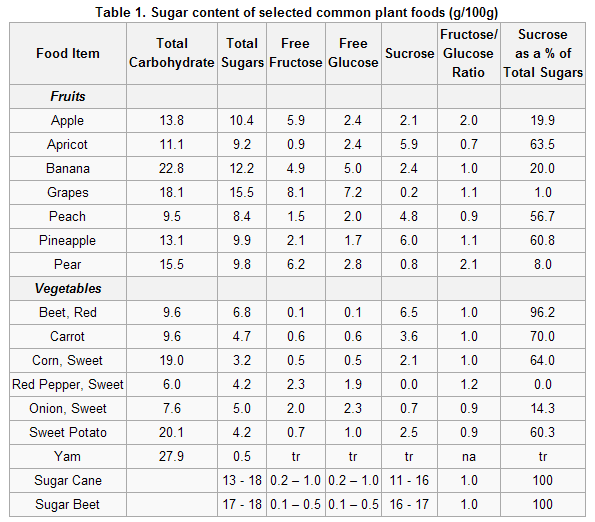
Excessive dietary fructose has been shown to cause an unhealthy elevation in serum triglycerides. This and other related factors are hypothesized to have a causative effect on the onset of the metabolic syndrome. Since fructose is found in fruits (see table below, from Wikipedia; click to enlarge), there has been some concern that eating fruit may cause the metabolic syndrome.
Vegetables also have fructose. Sweet onions, for example, have more free fructose than peaches, on a gram-adjusted basis. Sweet potatoes have more sucrose than grapes (but much less overall sugar), and sucrose is a disaccharide derived from glucose and fructose. Sucrose is broken down to fructose and glucose in the human digestive tract.
Dr. Robert Lustig has given a presentation indicting fructose as the main cause of the metabolic syndrome, obesity, and related diseases. Yet, even he pointed out that the fructose in fruits is pretty harmless. This is backed up by empirical research.
The problem is over-consumption of fructose in sodas, juices, table sugar, and other industrial foods with added sugar. Table sugar is a concentrated form of sucrose. In these foods the fructose content is unnaturally high; and it comes in an easily digestible form, without any fiber or health-promoting micronutrients (vitamins and minerals).
Dr. Lustig’s presentation is available from this post by Alan Aragon. At the time of this writing, there were over 450 comments in response to Aragon’s post. If you read the comments you will notice that they are somewhat argumentative, as if Lustig and Aragon were in deep disagreement with one other. The reality is that they agree on a number of issues, including that the fructose found in fruits is generally healthy.
Fruits are among the very few natural plant foods that have been evolved to be eaten by animals, to facilitate the dispersion of the plants’ seeds. Generally and metaphorically speaking, plants do not “want” animals to eat their leaves, seeds, or roots. But they “want” animals to eat their fruits. They do not “want” one single animal to eat all of their fruits, which would compromise seed dispersion and is probably why fruits are not as addictive as doughnuts.
From an evolutionary standpoint, the idea that fruits can be unhealthy is somewhat counterintuitive. Given that fruits are made to be eaten, and that dead animals do not eat, it is reasonable to expect that fruits must be good for something in animals, at least in one important health-related process. If yes, what is it?
Well, it turns out that fructose, combined with glucose, is a better fuel for glycogen replenishment than glucose alone; in the liver and possibly in muscle, at least according to a study by Parniak and Kalant (1988). A downside of this study is that it was conduced with isolated rat liver tissue; this is a downside in terms of the findings’ generalization to humans, but helped the researchers unveil some interesting effects. The full reference and a link to the full-text version are at the end of this post.
The Parniak and Kalant (1988) study also suggests that glycogen synthesis based on fructose takes precedence over triglyceride formation. Glycogen synthesis occurs when glycogen reserves are depleted. The liver of an adult human stores about 100 g of glycogen, and muscles store about 500 g. An intense 30-minute weight training session may use up about 63 g of glycogen, not much but enough to cause some of the responses associated with glycogen depletion, such as an acute increase in adrenaline and growth hormone secretion.
Liver glycogen is replenished in a few hours. Muscle glycogen takes days. Glycogen synthesis is discussed at some length in this excellent book by Jack H. Wilmore, David L. Costill, and W. Larry Kenney. That discussion generally assumes no blood sugar metabolism impairment (e.g., diabetes), as does this post.
If one’s liver glycogen tank is close to empty, eating a couple of apples will have little to no effect on body fat formation. This will be so even though two apples have close to 30 g of carbohydrates, more than 20 g of which being from sugars. The liver will grab everything for itself, to replenish its 100 g glycogen tank.
In the Parniak and Kalant (1988) study, when glucose and fructose were administered simultaneously, glycogen synthesis based on glucose was increased by more than 200 percent. Glycogen synthesis based on fructose was increased by about 50 percent. In fruits, fructose and glucose come together. Again, this was an in vitro study, with liver cells obtained after glycogen depletion (the rats were fasting).
What leads to glycogen depletion in humans? Exercise does, both aerobic and anaerobic. So does intermittent fasting.
What happens when we consume excessive fructose from sodas, juices, and table sugar? The extra fructose, not used for glycogen replenishment, is converted into fat by the liver. That fat is packaged in the form of triglycerides, which are then quickly secreted by the liver as small VLDL particles. The VLDL particles deliver their content to muscle and body fat tissue, contributing to body fat accumulation. After delivering their cargo, small VLDL particles eventually become small-dense LDL particles; the ones that can potentially cause atherosclerosis.
Reference:
Parniak, M.A. and Kalant, N. (1988). Enhancement of glycogen concentrations in primary cultures of rat hepatocytes exposed to glucose and fructose. Biochemical Journal, 251(3), 795–802.
Vegetables also have fructose. Sweet onions, for example, have more free fructose than peaches, on a gram-adjusted basis. Sweet potatoes have more sucrose than grapes (but much less overall sugar), and sucrose is a disaccharide derived from glucose and fructose. Sucrose is broken down to fructose and glucose in the human digestive tract.
Dr. Robert Lustig has given a presentation indicting fructose as the main cause of the metabolic syndrome, obesity, and related diseases. Yet, even he pointed out that the fructose in fruits is pretty harmless. This is backed up by empirical research.
The problem is over-consumption of fructose in sodas, juices, table sugar, and other industrial foods with added sugar. Table sugar is a concentrated form of sucrose. In these foods the fructose content is unnaturally high; and it comes in an easily digestible form, without any fiber or health-promoting micronutrients (vitamins and minerals).
Dr. Lustig’s presentation is available from this post by Alan Aragon. At the time of this writing, there were over 450 comments in response to Aragon’s post. If you read the comments you will notice that they are somewhat argumentative, as if Lustig and Aragon were in deep disagreement with one other. The reality is that they agree on a number of issues, including that the fructose found in fruits is generally healthy.
Fruits are among the very few natural plant foods that have been evolved to be eaten by animals, to facilitate the dispersion of the plants’ seeds. Generally and metaphorically speaking, plants do not “want” animals to eat their leaves, seeds, or roots. But they “want” animals to eat their fruits. They do not “want” one single animal to eat all of their fruits, which would compromise seed dispersion and is probably why fruits are not as addictive as doughnuts.
From an evolutionary standpoint, the idea that fruits can be unhealthy is somewhat counterintuitive. Given that fruits are made to be eaten, and that dead animals do not eat, it is reasonable to expect that fruits must be good for something in animals, at least in one important health-related process. If yes, what is it?
Well, it turns out that fructose, combined with glucose, is a better fuel for glycogen replenishment than glucose alone; in the liver and possibly in muscle, at least according to a study by Parniak and Kalant (1988). A downside of this study is that it was conduced with isolated rat liver tissue; this is a downside in terms of the findings’ generalization to humans, but helped the researchers unveil some interesting effects. The full reference and a link to the full-text version are at the end of this post.
The Parniak and Kalant (1988) study also suggests that glycogen synthesis based on fructose takes precedence over triglyceride formation. Glycogen synthesis occurs when glycogen reserves are depleted. The liver of an adult human stores about 100 g of glycogen, and muscles store about 500 g. An intense 30-minute weight training session may use up about 63 g of glycogen, not much but enough to cause some of the responses associated with glycogen depletion, such as an acute increase in adrenaline and growth hormone secretion.
Liver glycogen is replenished in a few hours. Muscle glycogen takes days. Glycogen synthesis is discussed at some length in this excellent book by Jack H. Wilmore, David L. Costill, and W. Larry Kenney. That discussion generally assumes no blood sugar metabolism impairment (e.g., diabetes), as does this post.
If one’s liver glycogen tank is close to empty, eating a couple of apples will have little to no effect on body fat formation. This will be so even though two apples have close to 30 g of carbohydrates, more than 20 g of which being from sugars. The liver will grab everything for itself, to replenish its 100 g glycogen tank.
In the Parniak and Kalant (1988) study, when glucose and fructose were administered simultaneously, glycogen synthesis based on glucose was increased by more than 200 percent. Glycogen synthesis based on fructose was increased by about 50 percent. In fruits, fructose and glucose come together. Again, this was an in vitro study, with liver cells obtained after glycogen depletion (the rats were fasting).
What leads to glycogen depletion in humans? Exercise does, both aerobic and anaerobic. So does intermittent fasting.
What happens when we consume excessive fructose from sodas, juices, and table sugar? The extra fructose, not used for glycogen replenishment, is converted into fat by the liver. That fat is packaged in the form of triglycerides, which are then quickly secreted by the liver as small VLDL particles. The VLDL particles deliver their content to muscle and body fat tissue, contributing to body fat accumulation. After delivering their cargo, small VLDL particles eventually become small-dense LDL particles; the ones that can potentially cause atherosclerosis.
Reference:
Parniak, M.A. and Kalant, N. (1988). Enhancement of glycogen concentrations in primary cultures of rat hepatocytes exposed to glucose and fructose. Biochemical Journal, 251(3), 795–802.
Wednesday, June 9, 2010
Cortisol, stress, excessive gluconeogenesis, and visceral fat accumulation
Cortisol is a hormone that plays several very important roles in the human body. Many of these are health-promoting, under the right circumstances. Others can be disease-promoting, especially if cortisol levels are chronically elevated.
Among the disease-promoting effects of chronically elevated blood cortisol levels are that of excessive gluconeogenesis, causing high blood glucose levels even while a person is fasting. This also causes muscle wasting, as muscle tissue is used to elevate blood glucose levels.
Cortisol also seems to transfer body fat from subcutaneous to visceral areas. Presumably cortisol promotes visceral fat accumulation to facilitate the mobilization of that fat in stressful “fight-or-flight” situations. Visceral fat is much easier to mobilize than subcutaneous fat, because visceral fat deposits are located in areas where vascularization is higher, and are closer to the portal vein.
The problem is that modern humans often experience stress without the violent muscle contractions of a “fight-or-flight” response that would have normally occurred among our hominid ancestors. Arguably those muscle contractions would have normally been in the anaerobic range (like a weight training set) and be fueled by both glycogen and fat. Recovery from those anaerobic "workouts" would induce aerobic metabolic responses, for which the main fuel would be fat.
Coates and Herbert (2008) studied hormonal responses of a group of London traders. Among other interesting results, they found that a trader’s blood cortisol level rises with the volatility of the market. The figure below (click to enlarge) shows the variation in cortisol levels against a measure of market volatility.
On a day of high volatility cortisol levels can be significantly higher than those on a day with little volatility. The correlation between cortisol levels and market volatility in this study was a very high 0.93. This is almost a perfectly linear association. Market volatility is associated with traders’ stress levels; stress that is experienced without heavy physical exertion.
Cortisol levels go up a lot with stress. And modern humans live in hyper-stressful environments. Unfortunately stress in modern urban environments is often experienced while sitting down. In the majority of cases stress is experienced without any vigorous physical activity in response to it.
As Geoffrey Miller pointed out in his superb book, The Mating Mind, the lives of our Paleolithic ancestors would probably look rather boring to a modern human. But that is the context in which our endocrine responses evolved.
Our insatiable appetite for over stimulation may be seen as a disease. A modern disease. A disease of civilization.
Well, it is no wonder that heavy physical activity is NOT a major trigger of death by sudden cardiac arrest. Bottled up modern human stress likely is.
We need to learn how to make stress management techniques work for us.
Visiting New Zealand at least once and watching this YouTube video clip often to remind you of the experience does not hurt either! Note the “honesty box” at around 50 seconds into the clip.
References:
Coates, J.M., & Herbert, J. (2008). Endogenous steroids and financial risk taking on a London trading floor. Proceedings of the National Academic of Sciences of the U.S.A., 105(16), 6167–6172.
Elliott, W.H., & Elliott, D.C. (2009). Biochemistry and molecular biology. 4th Edition. New York: NY: Oxford University Press.
Among the disease-promoting effects of chronically elevated blood cortisol levels are that of excessive gluconeogenesis, causing high blood glucose levels even while a person is fasting. This also causes muscle wasting, as muscle tissue is used to elevate blood glucose levels.
Cortisol also seems to transfer body fat from subcutaneous to visceral areas. Presumably cortisol promotes visceral fat accumulation to facilitate the mobilization of that fat in stressful “fight-or-flight” situations. Visceral fat is much easier to mobilize than subcutaneous fat, because visceral fat deposits are located in areas where vascularization is higher, and are closer to the portal vein.
The problem is that modern humans often experience stress without the violent muscle contractions of a “fight-or-flight” response that would have normally occurred among our hominid ancestors. Arguably those muscle contractions would have normally been in the anaerobic range (like a weight training set) and be fueled by both glycogen and fat. Recovery from those anaerobic "workouts" would induce aerobic metabolic responses, for which the main fuel would be fat.
Coates and Herbert (2008) studied hormonal responses of a group of London traders. Among other interesting results, they found that a trader’s blood cortisol level rises with the volatility of the market. The figure below (click to enlarge) shows the variation in cortisol levels against a measure of market volatility.
On a day of high volatility cortisol levels can be significantly higher than those on a day with little volatility. The correlation between cortisol levels and market volatility in this study was a very high 0.93. This is almost a perfectly linear association. Market volatility is associated with traders’ stress levels; stress that is experienced without heavy physical exertion.
Cortisol levels go up a lot with stress. And modern humans live in hyper-stressful environments. Unfortunately stress in modern urban environments is often experienced while sitting down. In the majority of cases stress is experienced without any vigorous physical activity in response to it.
As Geoffrey Miller pointed out in his superb book, The Mating Mind, the lives of our Paleolithic ancestors would probably look rather boring to a modern human. But that is the context in which our endocrine responses evolved.
Our insatiable appetite for over stimulation may be seen as a disease. A modern disease. A disease of civilization.
Well, it is no wonder that heavy physical activity is NOT a major trigger of death by sudden cardiac arrest. Bottled up modern human stress likely is.
We need to learn how to make stress management techniques work for us.
Visiting New Zealand at least once and watching this YouTube video clip often to remind you of the experience does not hurt either! Note the “honesty box” at around 50 seconds into the clip.
References:
Coates, J.M., & Herbert, J. (2008). Endogenous steroids and financial risk taking on a London trading floor. Proceedings of the National Academic of Sciences of the U.S.A., 105(16), 6167–6172.
Elliott, W.H., & Elliott, D.C. (2009). Biochemistry and molecular biology. 4th Edition. New York: NY: Oxford University Press.
Subscribe to:
Posts (Atom)
